‘Math guy’ offers new math teaching methods
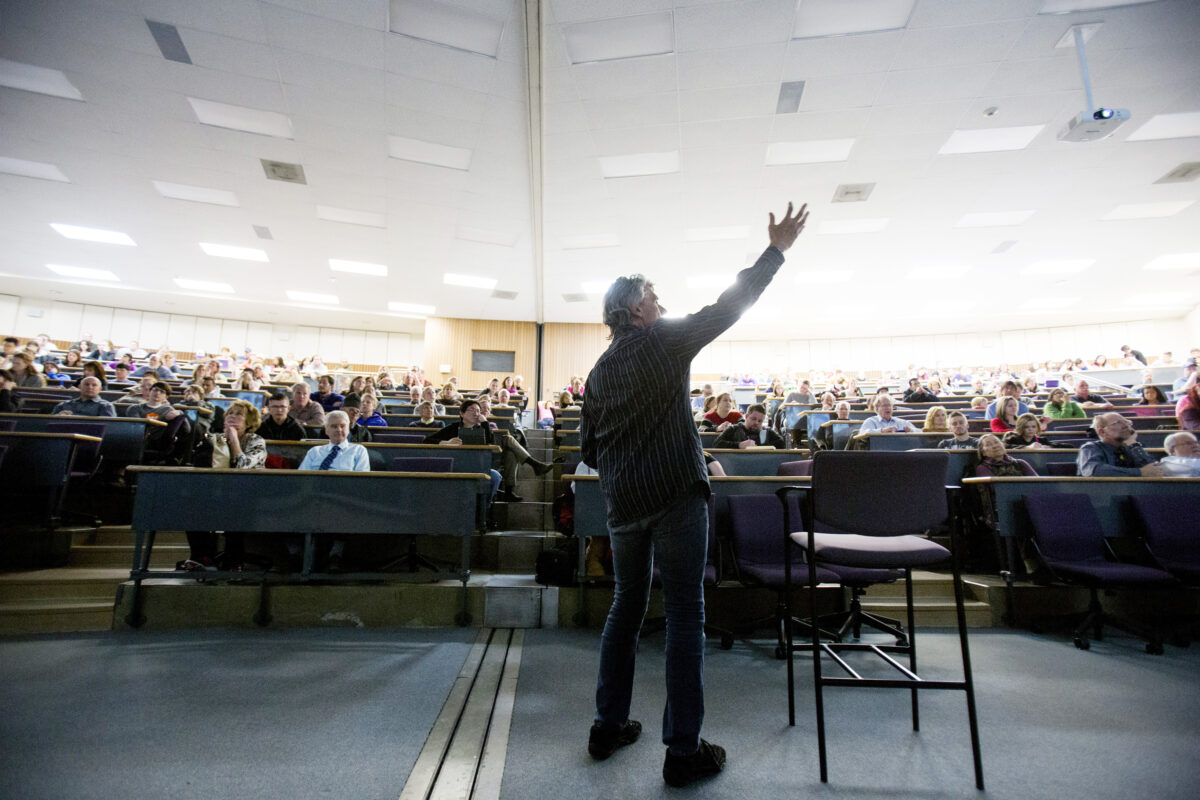
Mathematician and Co-founder and Executive Director of Stanford University's H-STAR Institute Dr. Keith Devlin spoke about math, the symbol barrier and the development of understanding math through new mediums such as tablets at Weber State University in Ogden on Thursday, February 26, 2015.
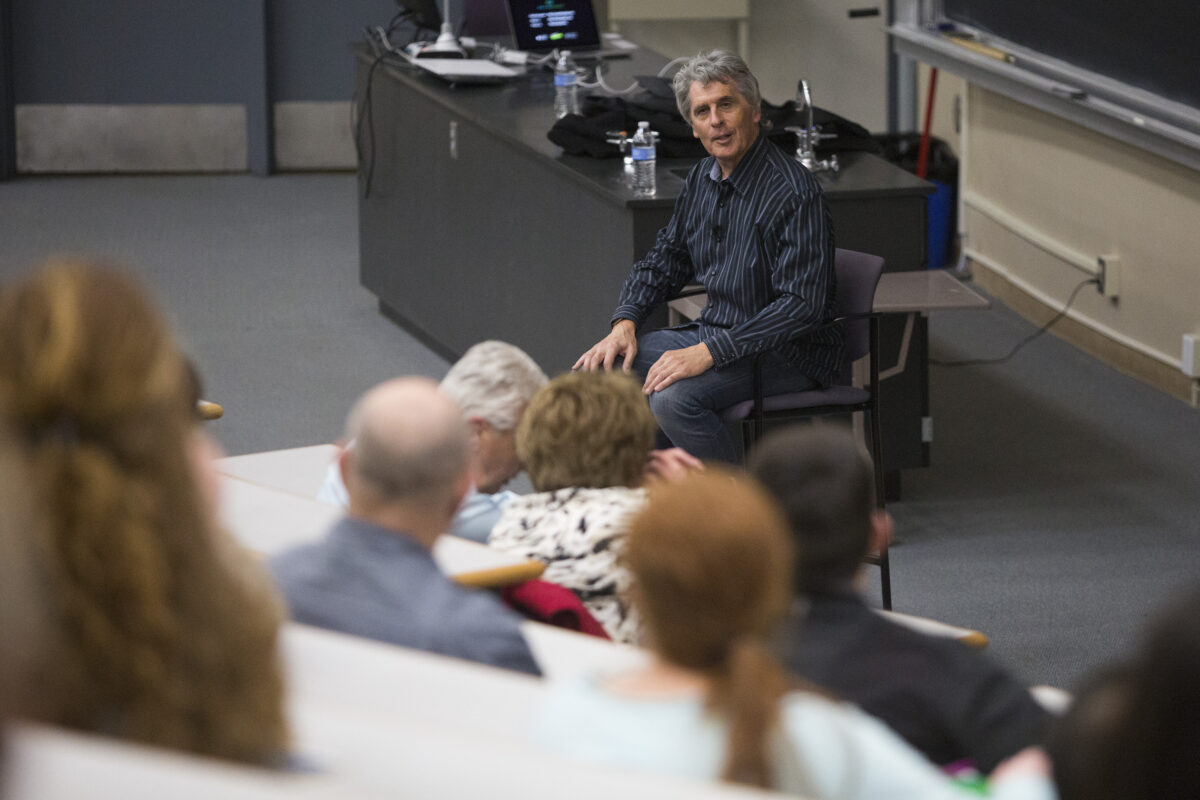
Mathematician and Co-founder and Executive Director of Stanford University's H-STAR Institute Dr. Keith Delvin spoke about math, the symbol barrier and the development of understanding math through new mediums such as tablets at Weber State University in Ogden on Thursday, February 26, 2015.
OGDEN – National Public Radio’s “math guy,” Keith Devlin, offered some fresh ideas on math to a large crowd at Weber State University’s Lind Lecture Hall.
Devlin, a math professor at Stanford and author of 32 books and 80 articles relating to mathematics, is working with his company, BrainQuake, to make math-friendly video games. As Devlin detailed the history of math, he talked about how many could be taught math better by using simple games rather than complex symbols.
As part of his presentation Thursday, he showed what many would think to be a complex math problem with a page full of symbols and logarithms. Right next to it he showed how the problem could be solved with an app game he helped create called Wuzzit Trouble. There are different variations of the game that is geared to children and adults.
Devlin talked about what he called the “symbol barrier” as it relates to those learning math. “It’s not that they can’t do the math; the symbols are the barrier,” he said.
He contrasted the way music is taught to the way math is taught. “If you want to learn to play you learn the basics; if you want to specialize you use notations. Why don’t we do that with math?” Devlin asked. He noted that in the past it couldn’t happen because in math there were no instruments to help people to learn, but now there is – an Ipad.
“Using games eliminates the fear factor,” he said. “We are making use of old ideas in context of new technology.”
He talked about a recent study done with students where with one group they did their regular math work in class. In another group students were allowed to play the math game app every day for four weeks, totaling 120 minutes over the four weeks. Both groups were given the same test. “The results were unbelievable,” he said. The “game” group was a weaker group and almost caught up completely to the other group.
Devlin said the magic of the math games really manifests itself in different socioeconomic groups. Many students in the minority or lower socioeconomic class are weaker in math because they lack confidence. When allowed to learn the concepts with the math games they are coming forward to work problems in front of their classmates and finding success. Devlin said playing the games feels safe for them and they gain more knowledge and confidence. “Kids that did better are more willing to try and fail on the games,” he said. He compared an Ipad to a little abacus. “It can change the way math is learned,” Devlin noted.
He did acknowledge that there is a place for symbols in math, a vital and important place, but said that can come later. He also talked about how his ideas relate to the Common Core standards. People often say that Common Core math isn’t the way they learned math, which he said is true. The Common Core math is a way for students to learn math, not necessarily the symbology of math.
Kristen Lee is a math major at WSU and she enjoyed Devlin’s lecture. She recently worked with a preschooler and asked them what two plus two was and they couldn’t tell her, but when she told the preschooler she had two cookies and then someone gave her two more cookies, they were able to tell her she had four cookies. “I realized students that young are capable of doing math on their terms without the symbols,” she said. “That’s what he said here tonight,” she added. She likes the idea that there is another way to do math and teach it that might work better.
Rachel Bryant is also a student at WSU, but has school-aged children. “I want to help my kids learn to do math and I think he gave us some good ideas,” Bryant said. She admits that she enjoys math, but enjoys the symbols behind math. Now she has some tools to look at math in a new way and understand how her children are learning it too.
Julian Chan is an assistant math professor at WSU. He said he enjoyed the rich history Devlin presented.
Devlin’s address was part of a biannual lecture series presented by the Harold W. Ritchey Lecture Series and made possible by an endowment to the WSU College of Science by the late Ritchey, who was a renowned scientist and engineer. To see more about Devlin’s game series visit www.brainquake.com.
Education

LLOYD: Standard-Examiner adds new kid-focused page for families to help improve children’s literacy

They did it … maybe you can too: Community that rallied to build Green Acres playground shares tips on process