Cutting, burning: Utah teachers train in mental health first aid
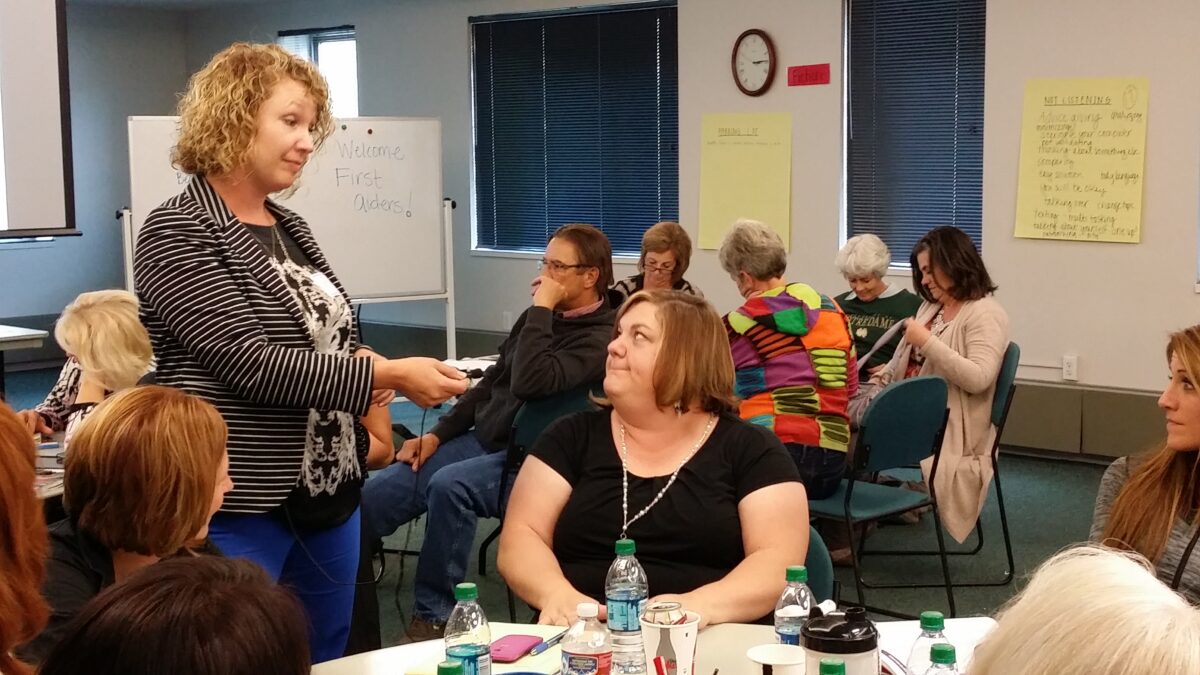
Christy Hutcinson, with Davis School District's student services department, discusses a scenario in which a student might need mental health first aid with Clearfield High School teacher Connie Kearl. The discussion was part of a class taught at the Davis School District offices, in Farmington, on Oct. 19, 2015.
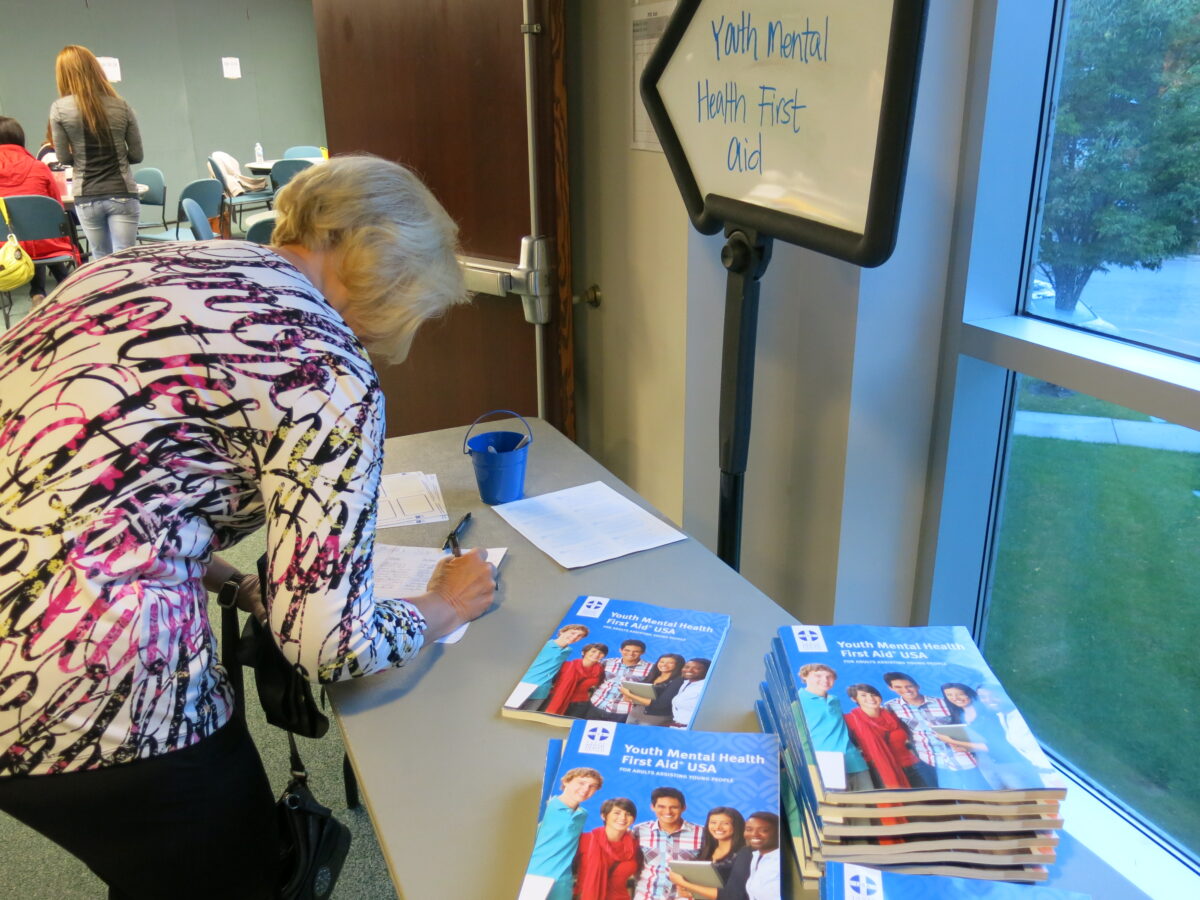
Teacher Sallee Drake, of Layton High School, signs in at a mental health first aid class, taught at the Davis School District office, in Farmington, on Oct. 19, 2015.

Teachers attending a Mental health First Aid class at Davis School District, on Oct. 19, 2015, received this manual to guide them through situations they might encounter in the classroom or community.
FARMINGTON — If a teen accidentally cuts herself, you know you should cover the wound with a sterile dressing, apply direct pressure to stop the bleeding, and cover the dressing with a bandage. Chances are, you learned that in a first-aid class.
But what if she cuts herself on purpose? Or what if you believe someone is experiencing a panic attack? What if one of your students seems to be suffering from severe depression? Would you know what to do?
A few teachers can answer yes, because they attended a mental health first-aid class for adults who work with young people, taught Monday, Oct. 19 in the Davis School District offices at 70 E. 100 North, Farmington.
“I signed up because I feel like there are a lot of students that struggle with mental health, and it’s something I want to understand better so that I can be better able to help them,” said Michelle Rasmussen of Clearfield High School. “There’s a lot of depression and anxiety, so I’m hoping that this gives me better tools to help my students with that.”
Several teachers from Clearfield High signed up, including Corinne Eliason, a leader in the school’s suicide prevention efforts.
“I want to learn as much as I can about addiction, because it’s such a big problem and we need to get new information to help the kids,” she said.
• RELATED: Utah’s first lady connects with students on suicide prevention
”Youth Mental Health First Aid” is a program created in Australia.
Christy Hutchinson, from Davis School District’s student services department, and Becky Austad of Intermountain Healthcare’s Northern Utah Hope Suicide Prevention Task Force, spent part of their summer in training in Dallas, Texas.
“It was an intense training because the program is evidence-based, and there’s been a lot of research and a lot of studies to prove the effectiveness of this program,” Austad said.
She said the program helps break down stigmas.
“We believe that’s one of the reasons people don’t get access to help, because of the stigmas and negative connotations that go along with having a mental health concern, so we’re big advocates of breaking down those stigmas and letting people know it’s OK to go get help,” Austad said. “Whatever it is you’re dealing with doesn’t define you. … You can live with a mental health illness and recover, and you can have resiliency, and you can live a life — a good life.”
Teachers were given a manual to read and use as a reference, and a full day of instruction. Topics included mood disorders, such as bipolar disorder and depression, as well as psychosis, ADHD (Attention Deficit Hyperactivity Disorder ), panic attacks, substance abuse disorders and eating disorders.
Slides shared during the presentation included one saying 31.9 percent of U.S. teens, age 13 to 18, are diagnosed with anxiety disorders. Just over 19 percent of teens have behavior disorders, 14.3 percent have mood disorders and 11.4 percent have substance use disorders.
“We also discuss self-injury — non-suicidal self-injury,” said Hutchinson. “That one’s more and more important, because we are looking at 12.4 percent of Davis County youth that are self-harming — not just cutting, but digesting an indigestible, and burning. It’s a growing concern.”
Becky Wright, Standard-Examiner
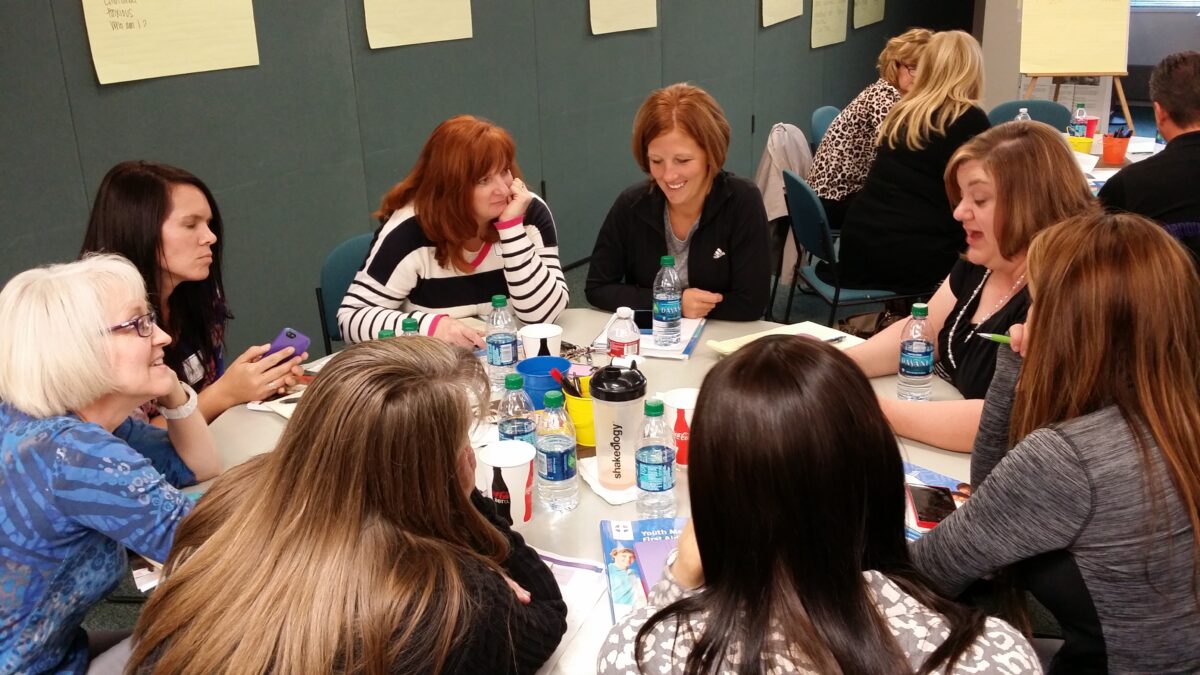
Teachers Corinne Eliason and Tagan Christensen, and coworkers from Clearfield High School, discuss a scenario in which a student might need mental health first aid. The discussion was part of a class taught at the Davis School District offices, in Farmington, on Oct. 19, 2015.
The instructors talked about the difficulty of identifying a warning sign for an emergent mental illness versus typical adolescent development.
“We often look at teens and dismiss warning signs of a mental illness and say, ‘Oh well, they’re just moody because they are a teenager,’ or ‘They sleep a lot because they’re a teenager,’ so we can minimize excessive behaviors as just typical adolescence,” said Hutchinson. “What we do in this course is we empower people to separate the two, and look for things in terms of excess. Yes, it’s normal or typical for them to be moody, it’s typical for them to sleep in excess or to have change in their appetite, but are they doing it in a way that’s impeding their day-to-day life?”
• RELATED: Too many young lives lost to suicide; Utah ranks 5th in nation
Hutchinson and Austad stressed that teachers aren’t being asked to diagnose.
“Youth Mental Health First Aid is the help offered to a young person experiencing a mental health challenge, a mental disorder or mental health crises. The first aid is given until appropriate help is received, or until the crisis resolves,” said Hutchinson. “You’re not going to step out of here and suddenly be thrown into giving people therapy or counseling . You’re not a doctor — you’re just doing your role, but you’re doing it with these tools.”
Becky Wright, Standard-Examiner
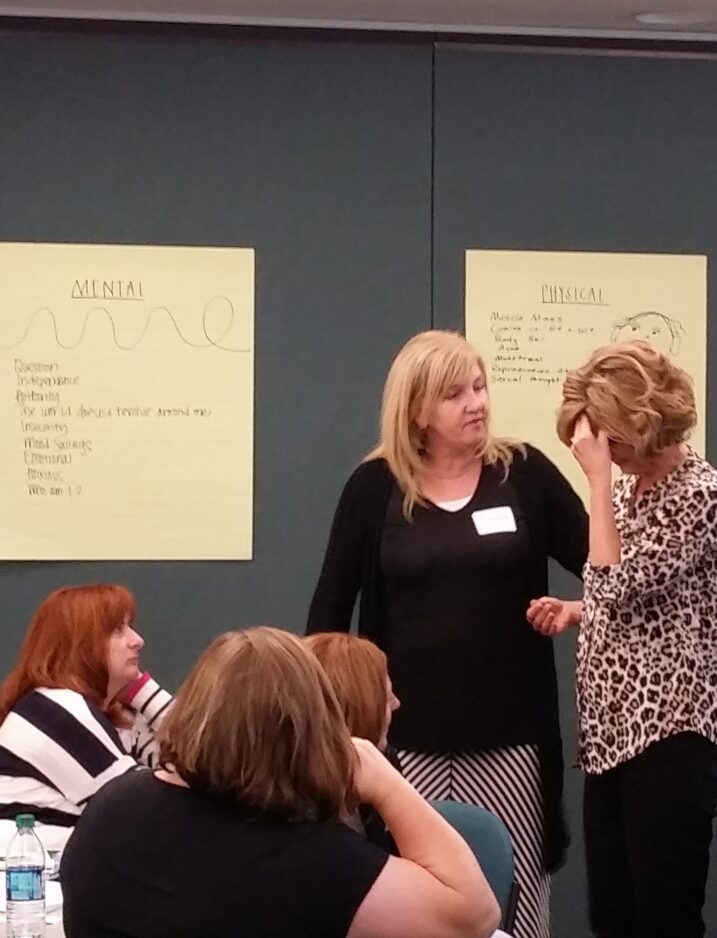
Teachers Elizabeth Katoa of Layton High, and Sandra Verbitski of Northridge High, act out a situation in which a student may be having a panic attack. The role play was part of a Youth Mental health First Aid class, taught at Davis School District offices in Farmington, on Oct. 19, 2015.
Sometimes students don’t want to talk about what’s bothering them when first approached, so Hutchinson suggested other ways to help the student feel safe before trying again.
“Take a break from the conversation,” she said. “If you’re talking to someone who is having a crisis, and you’re trying to ask the right questions and lead them through this crisis situation and they’re not responding, maybe it’s somewhere where you can say ‘Hey, let’s go play basketball, or ‘Can we go for a walk?’ or get their mind on something else.”
You can reach reporter Becky Wright at bwright@standard.net or at 801-625-4274. Follow her on Twitter at @ReporterBWright or like her on Facebook.