
Five basic inversion questions and the answers you should know

The inversion thickens in Davis County. In Layton on January 15 2015.
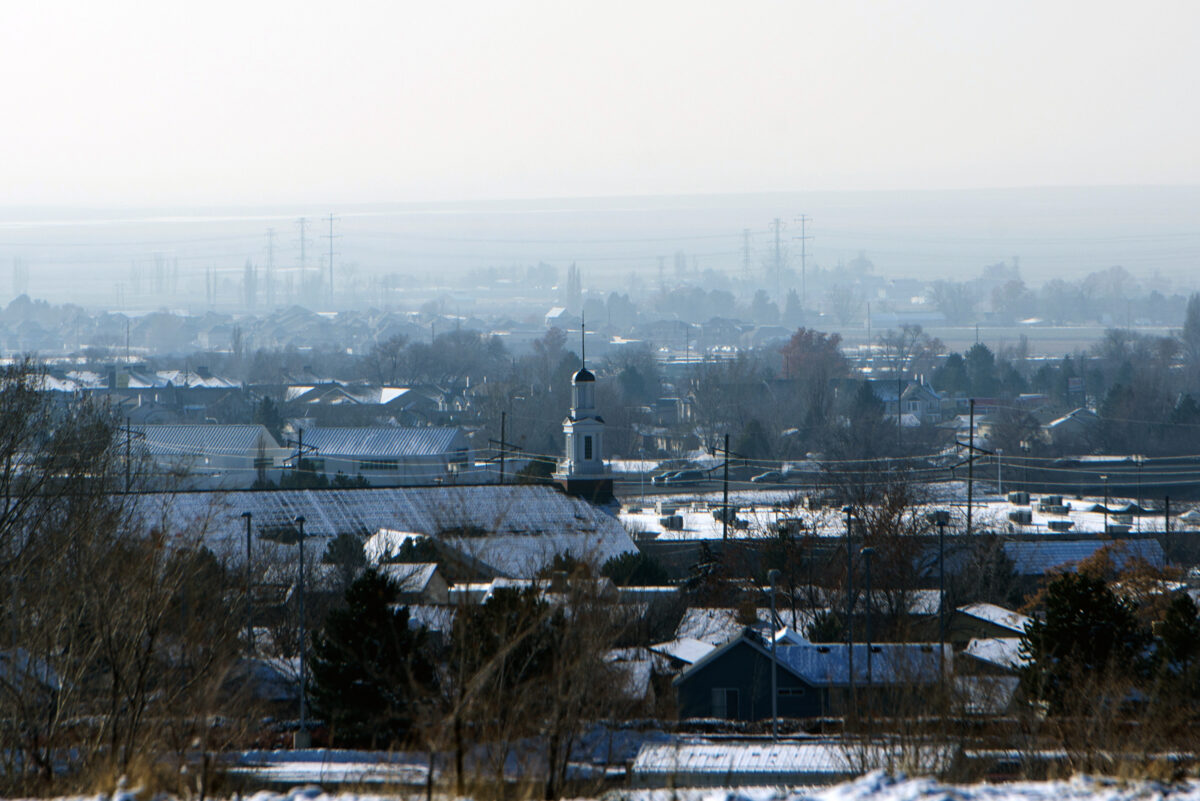
The inversion thickens in Layton on January 15, 2015.
Utahns are used to the routine — with cold weather comes crummy air quality. You probably know daily driving and wood burning contribute to the dirty haze. You might also know inversions are a natural product of the Wasatch Front’s geography. But what about that handful of basic inversion questions you’ve never bothered to ask? We’ve compiled some answers to provide extra clarity.
1. What’s particulate?
Basically, it’s specks of dirt or dust.
“It’s a particle, it’s grit,” said Bo Call, air monitoring manager for the Utah Division of Air Quality. “(We measure it) by how much settles out on a filter, so you can actually touch and feel it.”
• RELATED: 8 things you should know about Utah’s air inversions
It’s different from the ozone pollution Utah sees in the summer and the CO2 emissions contributing to global warming – those are both gases.
“One of the easiest ways for people to visualize particulate is when they look at fires,” Calls said.
Burning creates visible smoke and soot. If the chimney’s not functioning properly, things get messy.
“It turns the ceilings black and nasty,” Call said. “You can wipe your fingers and play tic-tac-toe in the dust. That’s what people generally consider to be particulate — that’s what we’re talking about.”
During winter inversions, air quality and public health officials are most concerned about particulate matter 2.5 microns or smaller — PM 2.5 — because those dirt particles are so small they enter human respiratory systems and pass through lungs to the blood.
2. Where does PM 2.5 come from during inversions?
The particulates creating nasty valley smog come from all sorts of things, like wood burning and smokestacks. But most of it comes from car tailpipes after a chemical reaction in the sky. The gases and chemical vapors mix in the atmosphere, get baked by the sun and turn into small particulate.
“What forms is ammonium nitrate,” Call said. “That can make up 70 to 80 percent of the particulate in the winter. So it’s not formed directly from a combustion source.”
• RELATED: Groups call for earlier due date on Utah’s air quality plan
Snow cover amps up those photochemical reactions. Because inversions form when the valley floor is cold, it generally means there’s also snow. That snow reflects sunlight, so the gases and vapors get baked from above and below, forming even more particulate. In some places, the amount of PM 2.5 pollution can double in just 24 hours.
3. How do forecasters know an inversion is coming?
It all boils down to weather. An inversion means there’s warm air at high elevations and cold air at lower elevations. The warm air puts an invisible lid over the valleys so particulate can’t flush out into the atmosphere. It takes a good storm to mix things up and clean the air. Even if it’s snowing, the storm might not have enough energy to mix the air and inverted temperatures.
“Inversions happen all the time, it’s a natural event. But most people don’t understand that,” Call said. “Basically after every storm, when things calm down, you get into an inversion.”
Forecasters watch inversion conditions set up and keep an eye on atmospheric conditions to figure out when the haze will blow out.
4. If I walk around outside for an hour on a bad inversion day, how much particulate pollution am I exposed to?
It all depends. Some factors include the exact particulate levels where you’re walking (it can fluctuate throughout the valley), how fast you’re walking, how heavily you’re breathing, your lung capacity and even whether you’re wearing a scarf around your mouth because it’s cold.
“We ask people to track when they feel impacted. So if you have asthma, you’re elderly, or you get that hacking cough and you noticed when pollution got bad on Thursday, we tell people to track what the value was that day,” Call said.
The air quality index values are updated every hour at air.utah.gov. DAQ also has an air quality smartphone app with real-time conditions.
“Everyone has a different tolerance for different things,” Call said. “You might figure out, ‘I can sled, but only for an hour, and I’m not going to go racing back up the hill.'”
5. It looks clear and sunny out. Why is there a ‘mandatory action’ alert?
The state has unrestricted, voluntary and mandatory action days to curb burning and to advise drivers about avoiding trips. DAQ officials sometimes put out a mandatory call when air quality is in an unhealthy range.
“The reason is the inversion is building up,” Call said. “We know the lid’s on. So we want to slow down that growth as much as possible, and that means starting as soon as possible to slow pollution.”
Preventing winter pollutions is tricky. People need to get to work. They need warm homes. The state can’t make people stop driving or ask them to turn off their water heaters. Completely shutting down factories and refineries on bad air days makes them less efficient overall and hurts jobs, too.
“So we have to do a little at a time,” Call said.
He compares it to saving for a vacation — it’s best to start early, and every little bit helps. Carpooling and using the gas furnace instead of the wood stove means fewer particulates trapped in the air.
“But we don’t have a big bank where we can store everything we did (all winter),” he said. “The weather has to come through, wash it out, then we can start again.”
Contact Reporter Leia Larsen at 801-625-4289 or llarsen@standard.net. Follow her on Facebook.com/leiaoutside or on Twitter @LeiaLarsen.
Environment
Ribbon cut on official 27th Street Trailhead; location set to play host to new 5K series
‘Wings Over Weber’ project aims to enhance understanding of Weber Basin snowpack, provide better utilization of water resources
