
Army investigation: Rogue Afghan commando planned Taylor assassination for weeks; intelligence failures cited

Maj. Brent Taylor, left, and Afghan solider Lieutenant Kefayatullah in Afghanistan in 2018. Taylor posted this picture on Facebook on Oct. 28, 2018, with a caption that read, "My Friend Lieutenant Kefayatullah, who was killed fighting the Taliban the day before voting began. Brave Afghans are fighting hard for their country." This was Maj. Taylor's last post before he was killed on Nov. 3, 2018.

Maj. Brent Taylor is pictured on the far right in a nondenominational Bible study with other military personal in Afghanistan. Referred to as "Chow Hall Church," the gathering was held on Thursdays.

Maj. Brent Taylor, center, at his 39th birthday celebration with Afghan soldiers on July 6, 2018.

Maj. Brent Taylor on a hike with a group of fellow American and NATO soldiers in Afghanistan in 2018. The soldiers took a hike on most Fridays.

The investigation report briefing of Maj. Brent Taylor's death at the Utah National Guard headquarters in Draper. Pictured from left: Stephen Taylor (Maj. Taylor's father), Tammy Taylor (Maj. Taylor's mother), Jennie Taylor (Maj. Taylor's wife), State Chaplain Utah National Guard Gerald White and Maj. Gen. Jefferson Burton.
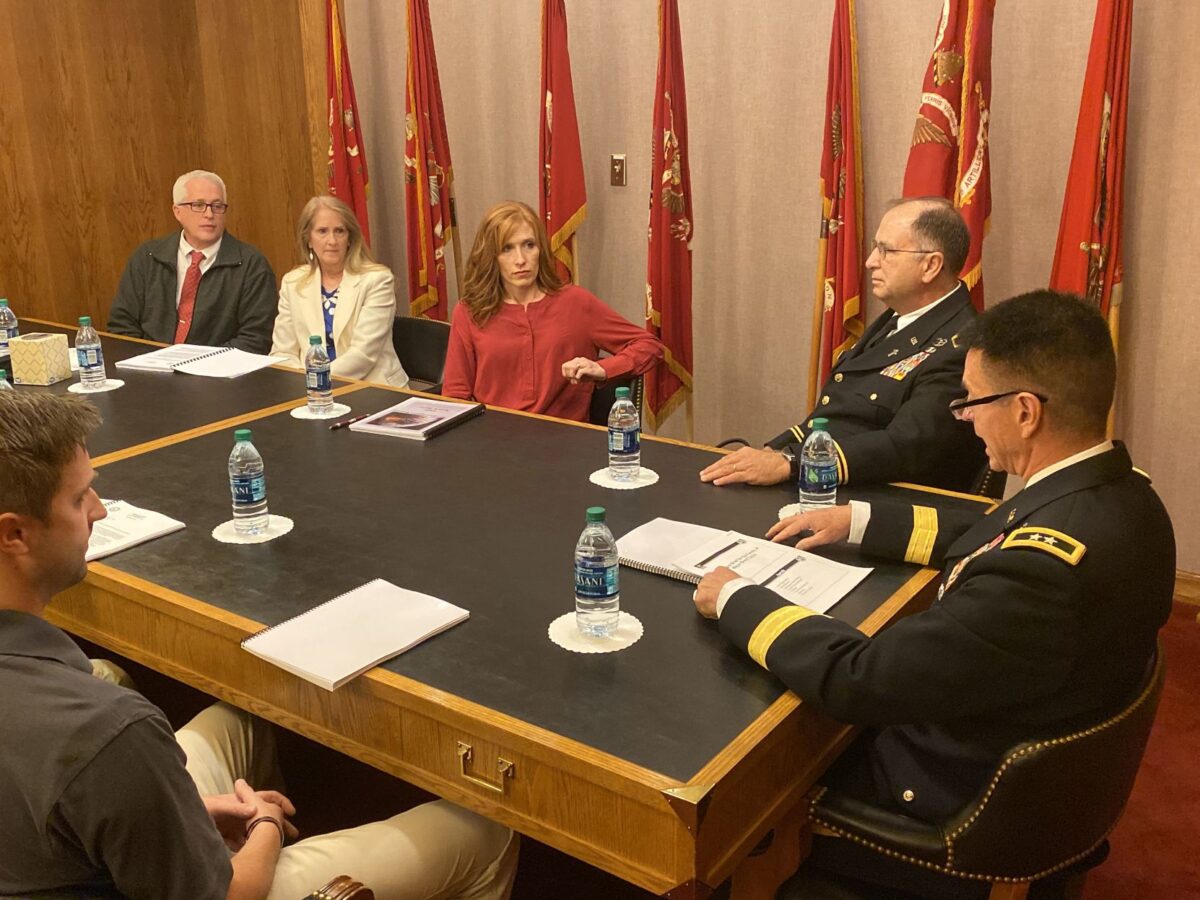
The investigation report briefing of Maj. Brent Taylor's death at the Utah National Guard headquarters in Draper. Pictured from left: Devin Taylor (Maj. Taylor's brother), Stephen Taylor (Maj. Taylor's father), Tammy Taylor (Maj. Taylor's mother), Jennie Taylor (Maj. Taylor's wife), State Chaplain Utah National Guard Gerald White and Major General Jefferson Burton.

Maj. Brent Taylor's mother, Tammy Taylor, left, Col. Michael Turley and Maj. Taylor's father, Stephen Taylor, at the investigation report briefing of Maj. Brent Taylor's death at the Utah National Guard headquarters in Draper.

A screenshot of a video chat call between Maj. Brent Taylor in Afghanistan and his daughter Caroline Taylor who is roughly 4 months at the time.

Maj. Brent Taylor plays a game of chess with Afghan and American soldiers in Afghanistan.

The investigation report briefing of Maj. Brent Taylor's death at the Utah National Guard headquarters in Draper. Pictured from left: Jennie Taylor (Maj. Taylor's wife), State Chaplain Utah National Guard Gerald White and Maj. Gen. Jefferson Burton.

Maj. Brent Taylor's wife, Jennie Taylor, takes a selfie before going into the investigation report briefing of Maj. Brent Taylor's death at the Utah National Guard headquarters in Draper. After her husbands death on Nov. 3, 2018, Jennie has been taking selfies to document her emotions.

Maj. Brent Taylor, center, on a hike with a group of fellow American and NATO soldiers in Afghanistan in 2018. The soldiers took a hike on most Fridays.

Maj. Brent Taylor is pictured on the left in this video still during a ruck march with Afghan soldiers in 2018. The march was a recreational activity that took place most Saturdays. Maj. Brent Taylor was shot and killed by an Afghan soldier on one of these marches on Nov. 3, 2018. "This is what it would have looked like the day he died," says his wife, Jennie Taylor.

Photos and memorabilia of Maj. Brent Taylor are placed on shelves in the North Ogden mayor's home where his wife, Jennie Taylor, lives with their seven children.

Photos and memorabilia of Maj. Brent Taylor are placed on shelves in the North Ogden mayor's home where his wife, Jennie Taylor, lives with their seven children.
The Afghan commando who killed Maj. Brent Taylor of North Ogden planned the insider assassination for weeks as U.S. intelligence screeners failed to act aggressively on signs of his radicalization, according to an Army investigative report.
The more than 100-page, heavily redacted document, obtained with a Freedom of Information Act request by the Standard-Examiner, gives details of the training march that Taylor led the morning of Nov. 3, 2018, which ended with an M4 rifle gunshot wound, felling the popular North Ogden mayor and veteran of four Middle Eastern deployments.

Photo supplied
The hard copy of Maj. Brent Taylor’s investigation report that explains the events that led to his death. Maj. Taylor was shot and killed by an Afghan solider on Nov. 3, 2018, in Afghanistan.
The investigation analyzed the intelligence system designed to detect potential insider attackers within the Afghan National Army at Camp Scorpion, where Taylor was stationed. It also delved into the actions of Afghan commandos and U.S. soldiers leading up to and after the shooting, and recommended corrective steps based on its findings.
The investigating officer faulted the intelligence operation at Camp Scorpion, especially a group of civilian contractors; criticized the planning, training and operations of the bodyguard unit assigned to safeguard Taylor and other military advisers; and questioned the security posture of the camp’s leadership.
Gen. Austin Scott Miller, commander of U.S. forces in Afghanistan, accepted most of the investigation’s findings, but disagreed with the conclusion that the camp leadership had been lax on security.
“Our loss of Brent is especially poignant as it was avoidable,” Miller said in his commander’s summary on the investigation. “In the immediate aftermath of the attack on Brent and during the subsequent investigation, we identified numerous missed opportunities to prevent the tragedy.”
Miller, who also leads the overall NATO Resolute Support mission in Afghanistan, added, “We could and should have done better. We will learn from this tragedy.”
THE FATEFUL HIKE
Taylor, 39, for most of 2018 had led a weekly training hike — a “ruck march” with the Ktah Khas commando battalion, commonly referred to as KKA, an Afghan special forces unit he was training.

Photo supplied
Maj. Brent Taylor is seen in the center on a ruck march in Afghanistan in 2018. The event took place most Saturdays with Afghan soldiers. Taylor was killed on a ruck march like this one on Nov. 3, 2018.
On Nov. 3 at about 9:50 a.m., the marchers were making a final turn back toward the camp gate when KKA Sgt. Asfar Khan fired two to three shots, one hitting Taylor in the back of the head, apparently killing him instantly, the report said.
Army Private Jessie Brown, who accompanied Taylor as his “Guardian Angel” protector that morning, was hit in the back but whirled and fired a burst from his M4 in the direction of the shooter.
Afghan commandos took Khan’s M4 away from him and he ran south to escape the scene. An Afghan officer ordered his troops to shoot the fleeing sergeant.
Khan was hit twice and fell. The report said Khan’s commanding officer then reached Khan first, firing a fatal shot into his head as he lay on the ground.
Taylor and Brown were the only Americans on the march. Other than Taylor’s Afghan interpreter, the rest were KKA commandos, numbering more than 200.
Taylor was pronounced dead more than an hour later after being helicoptered to the U.S. field hospital at Bagram Airfield.
Miller’s summary praised Taylor as representing “the best of America,” and U.S. and Afghan personnel interviewed by investigators lauded the actions of Brown in responding to the insider shooting, performing CPR on Taylor and organizing the National Guard major’s medical evacuation.
ASSASSINATION PLANS
The issue of insider threats faced by U.S. forces and their partner Afghan troops dominated the report.
Investigators recovered Khan’s phone after his death and found a 9-minute, 11-second video in which he outlined plans to kill Taylor.
Khan, a 20-year-old from Kabul, said he and some other commandos believed the killing a few weeks before of Gen. Abdul Raziq, police chief in Kandahar, was orchestrated by Americans and Afghan forces working with them.
“It became clear to me that we (KKA commandos) are working to kill Muslims,” Khan said on the tape, according to an Army transcript. “We were conducting these missions by the order of infidels and their slaves.”
The investigating officer said Khan incorrectly described Taylor on the video as “the leading commander of special forces in Afghanistan. … he is in charge of killing all Muslims all over Afghanistan.”
Khan and a reported co-conspirator, a fellow KKA commando, formed a group called Lashkar-e Huzaifa and began making plans, with their first goal to kill Taylor.
“I will kill Major Taylor for you guys, and I will continue my leadership,” Khan said. “This group will not accept defeat until the Americans are defeated … and we will never surrender alive.”
The alleged co-conspirator was interviewed by investigators, corroborating some of the information about Khan and his motives. The report does not say what happened to the commando after the investigation, although the investigator recommended intelligence personnel pressure him for more information on insider threats.
INTELLIGENCE FAILURES
The investigating officer said he found that, in general, personnel at Camp Scorpion — including the camp’s top officers, intelligence people and the Guardian Angels unit — “had a very trusting attitude towards the KKA.”
No insider attackers had ever emerged from the KKA, which may have lulled personnel into disregarding the possibility, the officer said, and even after Taylor’s death and tightened operations, “I found that Camp Scorpion is still susceptible to insider attacks.”
“While the KKA are one of the most reliable and trustworthy partners … the possibility of another green on blue attack at Camp Scorpion is evident,” he said.
The investigator pointed to apparent personality conflicts between the military and civilian contractor elements of the camp’s intelligence operation.
A civilian screener who had interviewed Khan on Oct 16, 2018, an annual exercise for each commando, failed to act sufficiently after Khan failed red-flag items on the radicalization screening checklist.
In the interview, Khan argued vehemently with an interpreter about the definition of infidel and expressed disdain for the Americans, the report said.
Intelligence personnel discussed Khan’s interview two days later but decided only to schedule a follow-up interview, the report said. They also failed to promptly upload the interview notes into a database used to track radicalization dangers.
Others interviewed during the investigation said the red flags in the interview should have resulted in Khan immediately being removed from duty pending an investigation.
“The fact that Khan was being blatantly disrespectful towards the linguist, his elder, demonstrated a hostile attitude toward coalition forces and foreigners,” the report said. Further, it said, “He refused to answer additional questions as to whether or not violence against coalition forces was OK.”
The investigation said it’s possible the contentious screening interview prompted KhaN to accelerate his assassination plans.
“At some point, Khan realized his actions during the screening would … likely cause him to lose his job in the KKA,” the report said. “Khan then shifted his focus onto the highest ranking U.S. adviser he had access to, Maj. Taylor.”
GUARDIAN ANGELS UNIT
The investigator said no planning went in to deploying bodyguard troops from the Guardian Angels unit. Troops were simply on call, and a lone private was assigned to escort Taylor.
Since the attack, a minimum of two Guardians must accompany advisers on training outings and other missions, and full body armor and helmets are required.
On the day of the attack, Taylor wore body armor but no helmet, and Brown had neither, the report said.
The investigation found that camp command did not require Guardian Angels or advisers to wear personal protective equipment during training outings to the south of the camp.
“This was based in part on the commander’s intent to not erode mutual trust and respect (between U.S. soldiers and Afghans in general) by not presenting a “too militarized perception,” the report said.
MISSING AMMO
The investigation also cited laxity in the control and accounting of ammunition issued to Afghan troops at Camp Scorpion.
Only a few commandos were supposed to have live ammo during the ruck marches, as a defense against any incidents during the hike, the investigation said.
But Khan somehow obtained ammo — up to 10 rounds, according to some interviewees — and 8 to 10 troops were able to immediately fire at Khan as he was running away.
When ammo went missing, those in authority assumed commandos probably were selling the rounds for personal profit, given the high levels of corruption in the Afghan forces, the report said.

Photo supplied
The investigation report briefing of Maj. Brent Taylor’s death at the Utah National Guard headquarters in Draper. Pictured from left: Maj. Gen. Jefferson Burton, Devin Taylor, Mathew Taylor, Travis Taylor (Maj. Taylor’s brothers), Col. Michael Turley, Maj. Ryan Robison, Stephen Taylor (Maj. Taylor’s father), Tammy Taylor (Maj. Taylor’s mother), Jennie Taylor (Maj. Taylor’s wife) and State Chaplain Utah National Guard Gerald White.
NO BITTERNESS
Jennie Taylor, the Utah National Guard major’s wife, said she and other close Taylor relatives received a briefing on the investigation last fall.
She said in an interview that she is not bitter about failures that may have contributed to her husband’s death.
“People are not perfect and there were errors in the system,” she said. “All of us can look at it as individuals and find room for improvement and find fault but not have bitterness. There’s just not time in life for that bitterness.”
The revelation that Khan targeted Taylor was actually comforting to her, because it showed the attack was not random. She said it means Taylor was having an impact and he was perceived as a threat to the coalition’s enemies — that his life and work had meaning.

Photo supplied
Jennie Taylor reacts at the investigative report briefing of the death of her husband and North Ogden mayor, Maj. Brent Taylor, at the Utah National Guard headquarters in Draper. Maj. Taylor was killed by an Afghan soldier during a ruck march on Nov. 3, 2018.
She’s relieved as well that he apparently did not suffer, and she is glad to realize that he died for ideals he had fought for throughout his life.
They had talked frequently about the dangers of deployments, she said, and Taylor was not dismissive of insider threats.
She said she thinks Taylor would have appreciated the outcome of the investigation of his death, “for what we learned, rather than who we can blame for this.”

BEN DORGER, Standard-Examiner
Maj. Brent Taylor’s wife, Jennie Taylor, looks through printed pictures of her husband’s time in Afghanistan on May 29, 2020, in her North Ogden home. Maj. Taylor was shot and killed by an Afghan soldier on Nov. 3, 2018.
The U.S. Army investigation into the Nov. 3, 2018, death of Maj. Brent Taylor, North Ogden’s mayor and a Utah National Guard veteran serving in Afghanistan, was completed in April 2019. The Standard-Examiner sought investigative details via the Freedom of Information Act beginning a week after Taylor’S death. The newspaper received the report on May 20, 2020.
Coverage of the report includes these stories:
• The investigation found that Taylor was targeted for assassination by an Afghan Army commando for several weeks.
• The fateful “ruck march.” A minute-by-minute account of the training hike that ended in Taylor’s death.
• Army investigators highlighted alleged incompetence and laziness among members of a civilian contracting unit responsible for screening potential insider attackers in the Afghan Army.
• Jennie Taylor says the investigation affirmed the value of her late husband’s work to teach and train Afghan Army soldiers.
• According to a June 1, 2020, Department of Defense report, 2,210 U.S. military personnel have died in Afghanistan, including 1,897 killed in action.
• A study by the Modern War Institute at West Point said 157 NATO personnel, including U.S. troops, were killed by insider attacks in Afghanistan from 2007 through 2017.
Government
Lili Bitner wants to bring her ‘grit,’ ‘determination’ and mother’s voice to House District 17 seat
Sam Barlow running on housing, education, preserving way of life in House District 17 race
