Under Trump tax cuts, Utah won’t collect $500 million in income taxes in 2026, 2027
Utah Gov. Spencer Cox’s $30.7 billion budget proposal reflects ‘flat’ revenue. Here’s what he wants lawmakers to prioritize
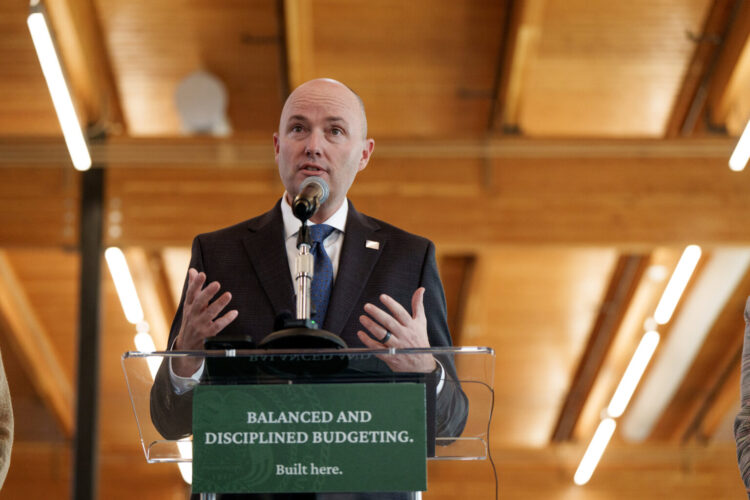
Photo by Spenser Heaps for Utah News Dispatch
Gov. Spencer Cox holds a press conference to present his budget proposal at the Salt Lake County Library in Kearns on Wednesday, Dec. 3, 2025. (Photo by Spenser Heaps for Utah News Dispatch)Thanks to tax cuts from the “one, big, beautiful” law, Utah won’t collect about half a billion dollars of income tax revenue in coming years — about $300 million in 2026 and $200 million in 2027.
That’s according to Gov. Spencer Cox’s proposed budget unveiled Wednesday, which gives lawmakers a suggested roadmap to consider ahead of their 2026 legislative session, scheduled to begin Jan. 20. Utah’s Republican-controlled Legislature typically doesn’t put finishing touches on the budget until the final days of the 45-day session, which will conclude in early March.
Cox’s $30.7 billion budget proposal is notably less than the $30.8 billion budget the 2025 Utah Legislature adopted for the current fiscal year — which Cox said during his budget announcement at a Salt Lake County library in Kearns reflects a “flat year, for sure.”
Though he said Utah has benefited from a growing economy, federal changes to tax policy within Congress’ One Big Beautiful Bill Act means Utah won’t collect about $500 million in corporate and individual income tax revenue during the 2026-2027 fiscal year that it otherwise would have without those tax cuts.
“We are complying with those changes, and we immediately adopt those changes in our state without changes coming from the Legislature,” Cox said, adding “we’re pleased to announce” a roughly $300 million “tax decrease” for Utah taxpayers in 2026.
“That’s less revenue coming into the state, which means that we are holding things flat,” Cox said.
The Trump administration’s tax cuts come at a time when Utah state leaders had already spent years chipping away at the state’s income taxes. Over the past five years, the Utah Legislature and Cox have approved a series of tax cuts that have resulted in a cumulative loss of $1.4 billion in revenue every year.
Most of those cuts have come from knocking the state’s income tax rate down several pegs. The most recent reduction approved earlier this year brought the rate down to 4.5%.
Under the Utah Constitution, the vast majority of Utah’s income tax revenue must be used to fund public education. As the Legislature has approved repeated income tax rate cuts, education advocates and others have expressed concerns about foregoing funding that could otherwise be used to bolster the state’s schools or other programs eligible for the funds. Utah’s per-pupil spending rank is consistently among the lowest in the nation.
But Republican legislative leaders have defended the cuts as necessary to keep Utah “competitive” with other states that have lower tax burdens. They’ve also argued in favor of allowing Utahns and businesses to keep more money in their pockets to help foster economic growth while balancing responsible government spending.
Because of the federal tax cuts, Cox said he’s not recommending legislators pursue yet another income tax rate reduction during the 2026 session — though he did propose setting aside $2.5 million to expand the state’s child tax credit to families with children up to 3 years old.
The governor’s budget office estimates that expanded child tax credit would provide an additional average benefit of about $220 to an estimated 11,100 families.
That’s the only tax cut Cox is proposing this year. It remains to be seen what legislators will do and whether they’ll listen to his recommendations — or keep up with their pattern of incrementally slashing the state’s income tax rate.
When asked if he would support another state income tax cut in addition to the federal tax cuts if the Legislature approves one, Cox told reporters, “We haven’t had any direct conversations about anything above and beyond that.”
“Again, it’s a tight year,” he said, though he noted that he’s supported the tax cuts approved over the last five years.
More broadly, though, the governor reiterated a point he’s made repeatedly in the past — encouraging lawmakers to consider holistic tax reform before continuing to chip away at the state’s income tax rate.
“I’ve said before, if we want to get rid of the income tax, I would support that,” he said. “But it’s impossible for us to get rid of the income tax and still function as a state government. So what are we going to replace that with?”
However, in his budget proposal, Cox does call on the Legislature to pursue property tax reform — or policies to “right-size the property tax burden distribution between residential and commercial properties.”
A legislative audit last year found Utah homeowners are carrying a disproportionate share of the state’s property tax burden because assessors find it more difficult to correctly determine the value of commercial property, resulting in a “tax shift” from one sector to another.
Even though the “flat” revenue year meant Cox’s administration had to say no to plenty of requests, the governor’s budget proposal outlines a list of priorities he wants lawmakers to consider.
Here are some highlights from the governor’s budget proposal:
Education
For public education, Cox is recommending $654.2 million next fiscal year. That includes, according to his budget proposal:
- $191.4 million for a 4.2% increase to the weighted pupil unit, which is the per-pupil rate used to calculate how much money each school should receive.
- $80 million for paraeducator grant programs, including $60 million for “targeted behavioral interventions in K-3 classrooms” and $20 million for reading support in elementary schools that have not met the statewide proficiency benchmark of 70% of third graders reading at grade level.
- $53.4 million safe learning, including $50 million for public schools to make “necessary safety upgrades” and $3.4 million for higher education institutions to “enhance campus safety.”
- $5 million to expand Promise Partnership Utah, an organization meant to build connections to support student success.
- $500,000 for a literacy campaign. Along with private donors, Cox said the campaign will put out ads and billboards meant to “remind people how important it is to read.”
Utah first lady Abby Cox also spoke at the governor’s budget proposal announcement, saying they decided to hold Wednesday’s news conference at a library to showcase the importance of reading and literacy and how social media has created a “big hole” that needs to be filled with books.
After Wednesday’s budget announcement, the first lady read a book to a room full of children at the library.
“It’s not unconnected to social media. The issues that we’re having with literacy is a direct result of us not reading and children not having access to books and not being read to,” Abby Cox said.
As part of the governor’s continued push against social media and its damaging impacts to children, Cox’s budget proposal also calls for “taking action to hold social media companies accountable for the costs associated with” harmful effects of social media, including impacts to mental health of Utahns.
Cox said he’s “hopeful” the Legislature will pass a “bell-to-bell” ban on cellphones in classrooms after stopping short of an all-day ban earlier this year.
Homelessness
Cox recommended the state use $25 million in one-time money and $20 million in ongoing money to help fund a new 1,300-bed homeless campus, while focusing that funding specifically on “homelessness and criminal justice high utilizers.”
The controversial project has been envisioned to help Utah be a “pilot” state to fulfill President Donald Trump’s executive order titled “Ending Crime and Disorder on America’s Streets.”
Though the campus plans are still being formulated, the state’s top homeless leaders and Cox have expressed support for increasing capacity for people who are civilly committed — or court ordered into mental health treatment.
They have also envisioned an “accountability center” or a “secure residential placement facility” for substance abuse treatment as an alternative to jail, where people who are “sanctioned” to go there would not be able to leave voluntarily.
That project — not expected to be built until some time in 2027 — is also projected to cost much more than what the governor included in his budget, to the tune of at least $75 million to build and north of $34 million a year to operate.
When asked about that funding gap, Cox said other partners, including local governments, “are going to have to play a role in that.” He’s also hoping by partnering with the Trump administration, Utah could get an infusion of federal funds to help with the campus.
“Because of the government shut down, we haven’t made as much progress as we had hoped, but (those conversations) are ongoing,” Cox said, adding that state leaders have been reaching out to federal officials “because we believe that with the changes that are being made to some of those funding streams around homelessness, that this is the perfect project for the federal government to get involved, that it can be a model for the nation.”
Trump’s executive order encourages cities and states to enforce stricter anti-camping laws, expands power to involuntarily treat and civilly commit people experiencing homelessness, and directs federal officials to end support for “Housing First” strategies, an approach to homelessness that prioritizes providing housing while offering — but not requiring — treatment.
“We want to make Utah the worst place to camp on the street, and the best place to get help and support,” Cox said in a prepared statement. “This budget recognizes that homelessness is complex, and solving it requires long-term commitment, community partnership, and a willingness to act boldly on behalf of those who need help the most.”
Acknowledging the campus will entail a “long-term effort,” Cox said he also included $5 million in his budget proposal for The Other Side Village, a master-planned tiny home community in Salt Lake City meant for people transitioning out of chronic homelessness.
“We know that these investments will pay great dividends for our state,” Cox said. “We want to make sure people are not camping on our streets, are not making life dangerous for people who want to take their kids out … and we want to get services to those who are struggling with addiction and mental health.”
Water
The governor has also recommended $53.8 million in “continued investments” for water infrastructure and conservation. That includes:
- $6.2 million for dam safety upgrades.
- $5 million for the Great Salt Lake long-term water program, which will “cover water leases while building on $50 million in federal funding, $200 million in pledged private investment and the Great Salt Lake 2034 Charter.”
- $5 million to extend the Colorado River Demand Management Pilot Program to “keep Utah in the driver’s seat, and to minimize disruptions to agricultural production” as changes to water use in the Colorado River Basin loom due to drought, litigation and policy changes.
- $2.5 million for Utah’s Agriculture Voluntary Incentive Program, which helps farmers and ranchers to adopt sustainable practices like upgrading irrigation systems or improving nutrient management.
Other priorities
The governor has also recommended:
- $290.3 million for state employee compensation, a 2.6% cost of living adjustment for state employees, additional pay increases based on performance, and increased funding for health and dental insurance.
- $7.6 million for reduced-price school lunch, which reflects a three-year commitment to cover the National School Lunch Program’s reduced-price category.
- $5 million for the Utah National Guard, including $3.4 million for recruitment and retention bonuses and $1.6 million for tuition assistance.
- $3 million for domestic violence and sexual assault victim services, including $2.1 million for the Utah Office of Victims of Crime, and $886,000 for the Department of Health and Human Services to continue access to services including crisis intervention, shelter, therapy and case management.
- $1.8 million to fill funding gaps for Meals on Wheels, a program that provides more than 159,000 meals to seniors.
Utah News Dispatch is part of States Newsroom, the nation’s largest state-focused nonprofit news organization.