Utah Legislature will consider a kratom ban next year
Experts report kratom to be highly addictive and criticize its easy access at gas stations
Amanda Hernández/Stateline
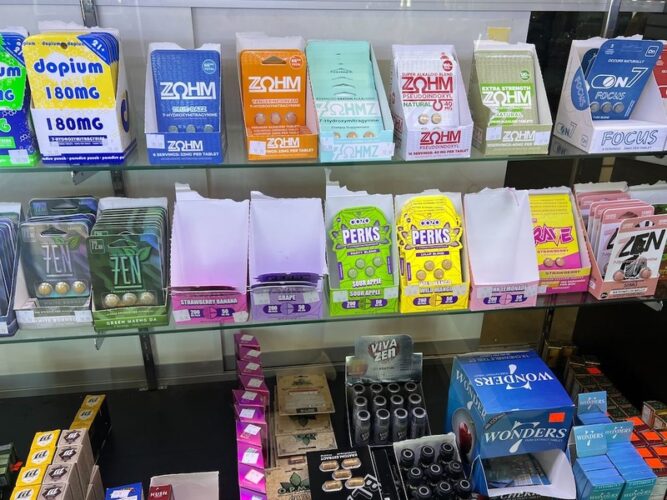
A variety of kratom and 7-OH products — including capsules, cartridges and wellness shots — are on display at a smoke shop in Buffalo, N.Y. States have led the way in regulating kratom, and now federal officials want to ban 7-OH, a powerful compound found in some kratom products. (Amanda Hernández/Stateline)Citing their highly addictive properties and strong withdrawal issues, Utah lawmakers will consider banning a little-regulated substance sold in gas stations and vape shops — kratom.
Kratom is a tree native to Southeast Asia with leaves that are often used to self-treat conditions like “pain, coughing, diarrhea, anxiety and depression, opioid use disorder, and opioid withdrawal,” according to the U.S. Food and Drug Administration. However, in its increasingly popular energy drink form and capsules, it has produced deep impacts among Utahns, lawmakers say.
“There’s a product out there on the market called kratom. It’s actually sold at gas stations. It impacts you like an opioid. It’s very addictive. It’s much, much worse than we realize,” Senate Majority Assistant Whip Mike McKell, R-Spanish Fork said in a video he posted on social media on Tuesday.
McKell is proposing a bill repealing the Kratom Consumer Protection Act state legislators passed in 2019, establishing a regulatory framework for kratom products in Utah, and including alkaloids found or derived from Kratom as schedule I controlled substances, the same category as other drugs with high potential for abuse, like heroin and ecstasy.
That would effectively ban kratom in the state.
The Health and Human Services Interim Committee unanimously voted in November to fast track the bill next legislative session. If the full Legislature votes to approve McKell’s bill, Utah would become the 10th state to ban kratom, he said.
During a November presentation, McKell showed $500 worth of kratom products to the committee, saying he easily bought them in his district and had some of them tested at the Utah Department of Agriculture and Food State Laboratory.
“It was interesting that those samples were within the state legal limit. And what that tells me is that the product itself is very, very dangerous,” McKell said in the video.
Michael Moss, director of the Utah Poison Control Center said during the November hearing that 7OH, a compound found in the kratom plant “at something less than 1% of it” is now getting purified and synthesized for consumption.
“This stuff is more like 10 to 20 times more potent than morphine, and no one should have access to 7OH,” Moss said.
The products are often marketed as natural, safe and drug-free, Moss said, with many patients arguing they had no idea the product could lead to addiction. The case load at the Poison Control Center related to the substance has doubled in the last two years, he said. And in the last several months there have also been an increase in calls related to 7OH.
“We get calls about all sorts of things, the combination of both intoxication, where someone has taken too much, often in combination with other medications, they can have unusual symptoms like agitation and tremor and hallucinations that you wouldn’t expect from an opioid,” Moss said, “on top of the opioid effects, like I’ve already mentioned, that might require Narcan to reverse an opioid overdose. We also get calls about withdrawal.”
Kratom advocates have decried what they describe as the FDA’s “war on kratom.” The American Kratom Association said on its website its members “hope to demonstrate responsible use and the health benefits of kratom will convince other countries to responsibly regulate kratom, not ban it.”
How are kratom effects felt in the state
Other experts also joined McKell during the committee presentation to speak about how kratom’s presence has been felt in Utah’s emergency rooms and other centers.
Ryan Stoneworthy, an emergency medicine physician at the Logan Regional Hospital, said that in the last four to six months he has seen 10 or more cases of kratom withdrawal, a seizure, and one death related to a kratom issue.
Megan Broekemeier, overdose fatality examiner at the Utah Department of Health and Human Services, said that in five years, there were 158 fatal overdoses involving kratom. The vast majority of them were the result of multiple substances, but her office has seen an increase of kratom-only deaths in the last year.
The areas that have a higher burden of kratom overdoses are in the Southwest Health District, which serves Washington, Iron, Kane, Beaver and Garfield counties, Broekemeier said. That’s followed by the TriCounty Health Department, which includes Uintah, Duchesne and Daggett counties, and the Weber-Morgan Health Department.
Another notable area, she added, is Provo.
“Typically, they have the lowest rates of overdose in this state,” Broekemeier said. “But this was just an area where I noticed that there’s more of a difference among kratom overdoses than all drug overdoses.”
Sen. Evan Vickers, R-Cedar City, is also working on a bill that would tackle just 7OH, including it in the schedule I category with some exceptions for small traces of the element. That also passed in the Business and Labor Interim Committee.
“If we go forward with a complete ban on kratom, there will be a coordinating clause that the trace element component would come out, so it would just be a complete ban on both (7OH) and kratom,” Vickers said.
Utah News Dispatch is part of States Newsroom, the nation’s largest state-focused nonprofit news organization.