Weber County health official warns the COVID virus may ‘always be here’
-

- Sameka Howard, a registered nurse, prepares a COVID-19 vaccine at a clinic geared to kids aged 5-11 at Highland Junior High School in Ogden on Monday, Nov. 8, 2021.
-
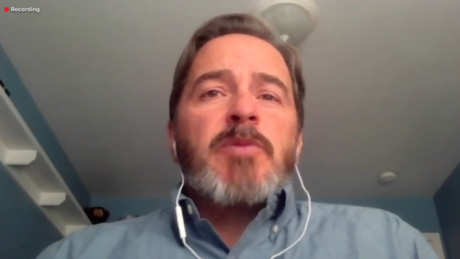
- Brian Cowan, director of the Weber-Morgan Health Department, gives a report to Weber County Commissioners on the COVID-19 case count among students. He met virtually with commissioners on Monday, Sept. 6, 2021.

Tim Vandenack, Standard-Examiner
Sameka Howard, a registered nurse, prepares a COVID-19 vaccine at a clinic geared to kids aged 5-11 at Highland Junior High School in Ogden on Monday, Nov. 8, 2021.
OGDEN — You may have to get accustomed to the COVID virus.
As the monthly case count continues to climb year over year, with more vaccinated people expected to contract the virus, COVID-19 may not be going away completely, Weber County’s top health official warns.
“Our initial intents were really to try and control the spread of the disease as much as we could and try to isolate it before it became endemic,” Brian Cowan, head of the Weber-Morgan Health Department, told Weber County commissioners on Monday.
Now, though, health officials are realizing that the COVID virus may be a constant.
Health officials are “seeing that we kind of missed that mark” in trying to isolate the virus, Cowan said, and are “now starting to transition more to how we manage this disease as an endemic disease, meaning it’s current in our population.” The focus, he continued, becomes mitigating “the risk as individuals to ourselves and (trying) to limit its spread, just kind of recognizing it’ll always be here, similar to influenza.”

Image supplied
Brian Cowan, director of the Weber-Morgan Health Department, gives a report to Weber County Commissioners on the COVID-19 case count among students. He met virtually with commissioners on Monday, Sept. 6, 2021.
Parallel to that, Cowan said a growing share of vaccinated people may start contracting the virus. As is, 84% of people who have been hospitalized in Weber County since May 9 after contracting the COVID-19 virus were unvaccinated while 16% were vaccinated. “As time goes on, we anticipate that percentage of vaccinated people with hospitalization to increase just because the vaccination isn’t 100% effective. There’s still a risk in vaccinated individuals,” he said.
Whatever the case, he still emphasizes the importance of vaccinating against the COVID-19 virus. The data shows that unvaccinated people are seven times more likely to be hospitalized due to COVID-19 than those who have been injected with the vaccine.
The monthly new COVID-19 case count has actually been higher, year over year, since March this year. In September 2020, the new COVID-19 case count totaled 1,166 compared to 3,880 in September of this year, while the case count in October 2020, 2,930, compares to 4,300 last month, for instance.
All that said, Cowan offered an upbeat assessment in his weekly COVID-19 report to commissioners.
COVID-19 hospitalizations are actually down in Weber County compared to last week. Moreover, the seven-day average new case count now sits at 135 a day, down 19 compared to last week. “We’re optimistic with those numbers,” he said.
Vaccination of kids aged 5-11 started last week and he said 1,300 in the age group had gotten the first of the two-shot Pfizer regimen. That represents 6.5% of the age group in Weber and Morgan counties. “We’re looking good on our efforts there,” he said.
Adding the new pool of people eligible for vaccination, though, reduces the overall share of the eligible population that’s vaccinated. As is, 63.3% of the population that’s eligible to get vaccinated has at least one shot, down from nearly 70% last week, before the 5-11 age group became eligible, he said.
Overall, 52.3% of the population in Weber and Morgan counties is fully vaccinated.
Zach Heuscher, a Weber-Morgan Health Department epidemiologist, said the broader public seems to be opening up to vaccinations, gradually. But he also said the growing monthly COVID-19 case count should be of concern to the public, also noting the looming holiday season, when the number of public gatherings typically rises.
“We realize that there is COVID fatigue so going into the holiday season we need the public to take precautions, realizing that COVID-19 community transmission is high and that only slightly over one- half of the population is fully vaccinated,” he said.
‘NOT IN A GOOD PLACE’
On a related note, Brandon Webb, an infectious disease physician for Intermountain Healthcare, said that even though the numbers of COVID-19 cases have remained stable over the past three weeks, they are still too high. What’s more, the number of respiratory ailments is unusually high for the time of the year, resulting in a strain on the system.
“Even though we are stable, we’re not in a good place going into the winter months,” he said at a press conference on Friday. “We’re starting out at a place that doesn’t give us a lot of confidence. Our health care system is still saturated. There’s no leeway. No room for error.”
The pressure on hospitals impacts the ability of hospitals to help those with a range of ailments beyond COVID-19.
“It trickles down and influences our ability to care for patients coming in with stroke, heart attack, sepsis, heart failure or any number of other hospital conditions,” Webb said. “COVID is one among many conditions right now but it’s so dominant it’s squeezing out our capacity to care adequately for those other conditions.”
Webb said Colorado is currently seeing a surge in cases, a situation Utah health care professionals are closely monitoring. If that spreads to Utah, it could look much like the winter of 2020.
“I think we suffered a bit from over-enthusiasm when the initial vaccine rates were announced and those vaccines performed so much better than we expected that we shifted the paradigm too early and we started pulling back on other complementary measures,” he said. “Then delta hit and we learned the duration of immunity from the vaccine is not as durable as we thought it might be.”
Standard-Examiner correspondent Jamie Lampros contributed to this report.