New Kaysville plant turning out oodles of noodles
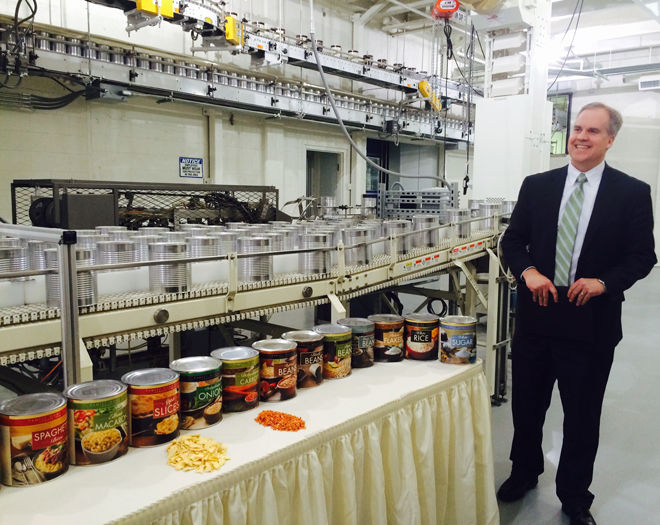
Andrew Seelos, president of the LDS Kaysville Utah Central Stake, shows some of the products that are packaged in Deseret Mill and Pasta Plant located in Kaysville. photo by Valerie Phillips
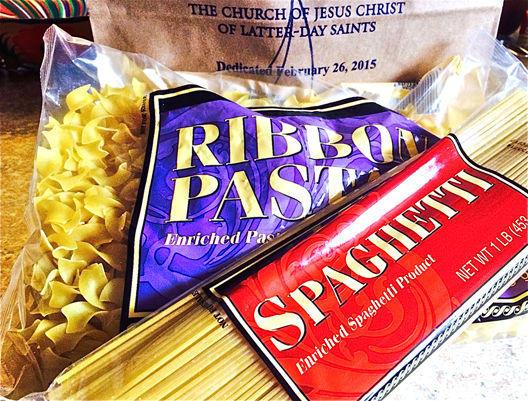
Spaghetti and ribbon noodles are made and packaged at the LDS Church's new pasta plant in Kaysville. It is the church's only pasta plant. Valerie Phillips
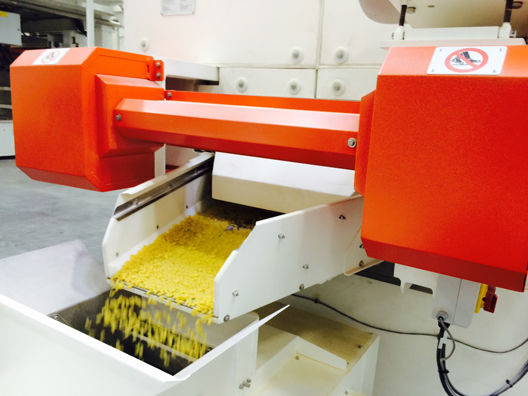
Italian-made machinery can turn out 1,300 pounds of macaroni in an hour at the LDS Church's Deseret Mill and Pasta Plant located in Kaysville. photo by Valerie Phillips
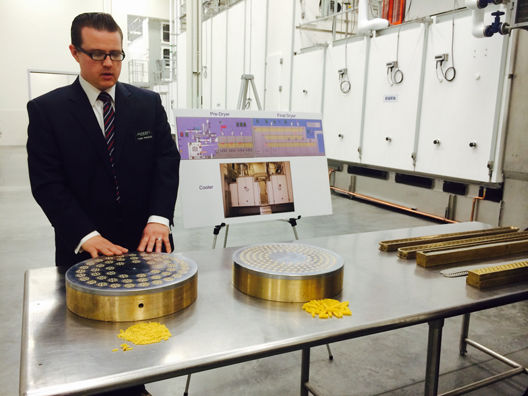
Tony Pruess of the LDS Church's Welfare Services shows how the semolina mixture is extruded through large metal dies with holes, to shape it. photo by Valerie Phillips
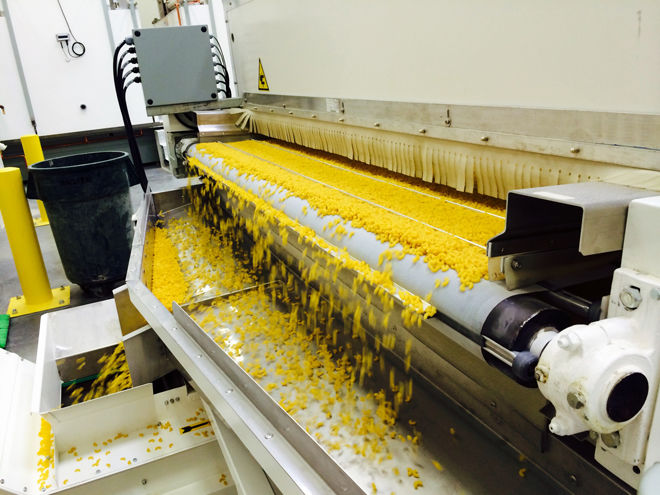
Italian-made machinery can turn out 1,300 pounds of macaroni in an hour at the LDS Church's Deseret Mill and Pasta Plant located in Kaysville. photo by Valerie Phillips

Gerald Causse, a member of the LDS Church's Presiding Bishopric, speaks at the opening of an LDS pasta plant in Kaysville on Feb. 26. Photo courtesy of the LDS Church.
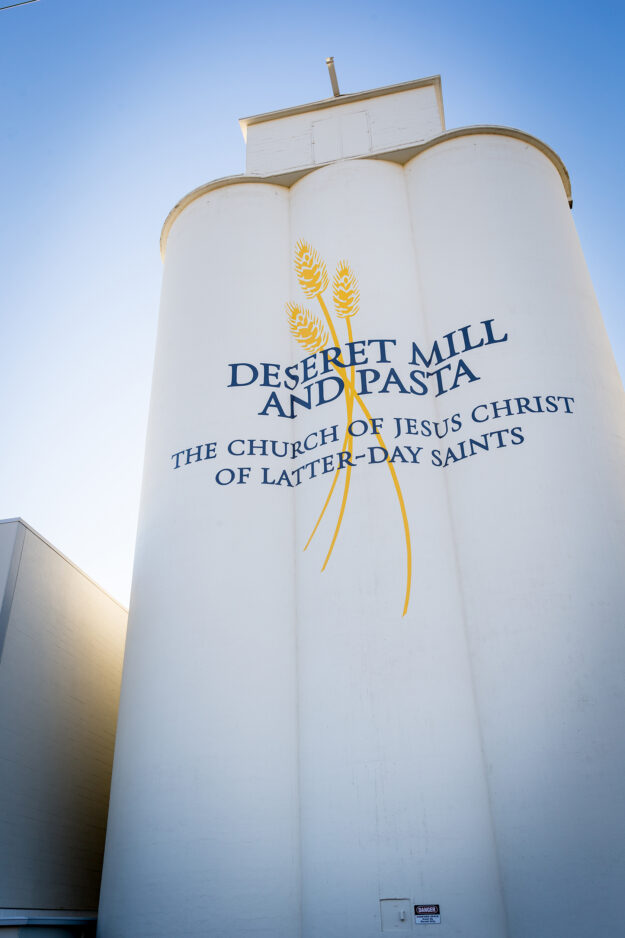
The LDS Church Deseret Mill and Pasta plant in Kaysville. Photo courtesy of the LDS Church.
KAYSVILLE — The LDS Church’s new pasta factory is daily cranking out thousands of pounds of spaghetti and macaroni to help feed the poor.
Although the Deseret Mill and Pasta Plant has only been in production a few months, the pasta’s quality was lauded by church officials during the facility’s dedication services Thursday night.
Gerald Causse, a member of the church’s Presiding Bishopric, deemed the pasta “finest quality.” He should know. Caussé, a French native, was once the general manager of Pomona, France’s largest food distributor.
“The church has always believed that we must provide only the finest quality to the Lord’s poor,” Causse said. “We could produce a lesser quality product. But when we serve the needy, we serve our brothers and sisters and sons and daughters of God. As a consequence, we produce the very best. … Maybe this is why the pasta is so good. It is made by people whose hearts are filled with love.”
Several hundred community leaders, church officials, employees and service missionaries gathered for the services that included tours, speakers and a prayer offered by Causse. The French native joked that he was probably asked by Church President Thomas S. Monson to dedicate the facility “because my accent was the closest they could find to Italian.”
The pasta’s quality was also praised by officials of the Italian company that makes the gigantic pasta-making machines, said Don L. Johnson, director of production and distribution for the church’s welfare services.
He said when the Italians visited, they asked where the durum wheat came from, because they had never seen pasta with such good color. The wheat is grown on church-owned farms in Montana and Idaho.
“We told them it was the Lord’s wheat, and we just help Him take care of it,” said Johnson with a smile.
The pasta, and the other products made at the plant, go to the 110 bishop’s storehouses across North America, where it is allocated to people in need. They are also sent as part of emergency relief efforts around the globe. Church members can buy the products for their own use at the 100 home storage centers located across North America.
The facility, just west of the Kaysville Interstate 15 exit at 63 S. 600 West, is the church’s only pasta plant. Previously, the site had a wheat mill, mixing facilities and a packaging plant for dry food items. The pasta-making addition more than doubled the size of the total facility.
The church’s old Kearns pasta plant, begun in the 1960s, was closed down. Johnson said that after 37 years of use, the equipment at the Kearns site was “tired.” Consolidating the plant alongside the existing wheat mill in Kaysville made sense, “so we don’t have to transport wheat across the Salt Lake Valley.”
The new machinery greatly increased the pasta-making capacity.
The grain silos hold 16 millions pounds of wheat. The mill processes 200,000 pounds of grain in 24 hours, including hard red wheat, soft white wheat and durum wheat. The durum wheat is ground into semolina, the raw product for the pasta.
The machinery has a continuous-flow design, where the pasta is extruded, dried and packaged. In just one hour, it produces 1,700 pounds of spaghetti and 1,300 pounds of “short goods” such as macaroni and ribbon. A third line packages macaroni and cheese at a rate of up to 60 boxes per minute. It operates on 24-hour shifts.
Kevin Smith, a line technician who helped conduct tours, said 100,000 servings of pasta could easily be made in a day.
Why pasta?
“Pasta is a staple of many diets, and you can use it in a lot of different meals. It’s relatively inexpensive to produce, and it stores well,” said said Andrew Seelos, president of the Kaysville Utah Central Stake. He oversees the plant’s volunteer workforce. There are 24 employees and 30 volunteer service missionaries. Hundreds of other church and community members volunteer for four-hour work shifts on an occasional basis..
In addition to pasta-making, the facility also produces pancake and cake mixes in 1,500-pound batches. It packages white and whole wheat flour, the cake and pancake mix, gravy, potato pearls granola, creamy wheat cereal, rolled oats, rice, beans, whole wheat, oats, potato flakes, sugar, apple slices, macaroni, spaghetti bites, dried carrots and dried onions.
The Kaysville site has a long milling history. The first mill was built by the Kaysville Milling Co. in 1905. The site was purchased by the LDS Church in 1942. In 1982, the church did a major upgrade to automate the plant.
Church officials who spoke at the dedication said the plant will help the Welfare Services in its purposes to care for the poor and needy, foster self-reliance and encourage service to others.
Carole M. Stephens, a counselor in the General Relief Society presidency, reminisced about her own experiences working on the Farr West LDS Stake Farm that grew green beans, potatoes and corn. The products were canned and used to feed the poor.
“It was fun to gather as families and pick as fast we could to get those beans picked,” she said. “We knew we were doing something more than just picking beans. We knew we were going to a sacred place and we were going to serve others. … Sometimes the greatest harvest is the harvest of souls — mine included.”
Local News
Powder Mountain public water district votes to put operations out for bid; resort has expressed interest in contract
Ribbon cut on official 27th Street Trailhead; location set to play host to new 5K series