Board revotes to dodge Utah auditor’s suit over plan to move her office
Katie McKellar, Utah News Dispatch
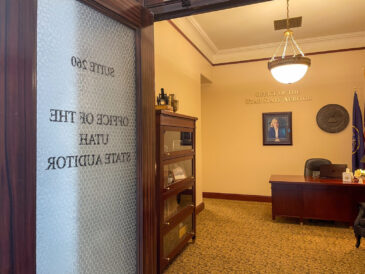
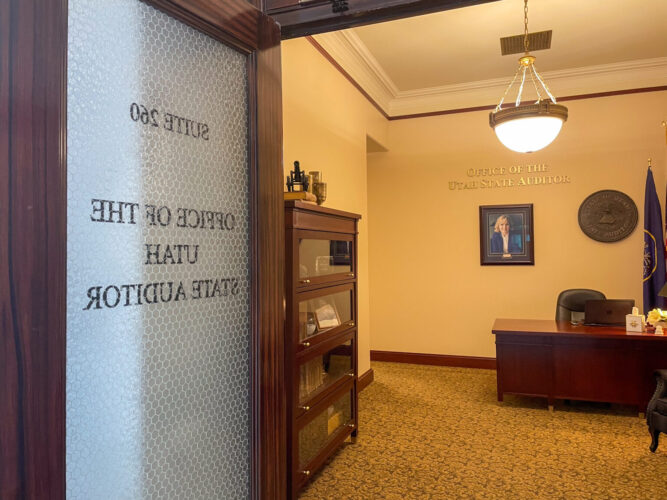
Utah Auditor Tina Cannon’s office in the Utah State Capitol in Salt Lake City on Friday, March 7, 2025. (Katie McKellar, Utah News Dispatch)As part of an ongoing clash with legislative leaders over the location of her office, Auditor Tina Cannon filed a lawsuit on Friday alleging the Utah Capitol Preservation Board violated open meetings laws in September when it voted to move her office to a lower level of the Utah Capitol.
Then, on Monday morning, the Utah Capitol Preservation Board — with Senate President Stuart Adams, House Speaker Mike Schultz, Attorney General Derek Brown and other lawmakers in attendance — met again to re-vote on the move.
Adams — who chaired Monday’s meeting because Gov. Spencer Cox was absent — said the board was meeting to vote again “out of perhaps a disagreement over the last meeting” and “perhaps even a threat of litigation.”
Cannon on Friday filed a petition to sue the Utah Capitol Preservation Board, asking a judge to block its Sept. 15 vote. She alleged that the board’s agenda that day did not explicitly say that it would be voting to move her office from her current space on the second level of the Capitol, known as the rotunda, down one level to the first floor to a partially vacated section of a space known as the Visitor’s Center.
The board’s Sept. 15 agenda only listed the discussion as “Visitor’s Center.” In her court petition, Cannon alleged that agenda didn’t meet the “reasonable specificity” requirement under Utah’s open meetings laws, and she asked a judge to void the vote.
During Monday’s meeting, Assistant Attorney General Paul Tonks said he had advised the board to re-vote “out of the abundance of caution” to resolve any question of potential violations of Utah’s Open Meetings Act.
During the September meeting, Utah Treasurer Marlo Oaks was the only board member to vote against the move — but he was absent from Monday’s meeting. The board voted unanimously to approve the move, relocating Cannon’s office across the hall from Oaks’ office and near the Capital’s east entrance, which is the main entrance for public access.
Later Monday afternoon, Cannon told Utah News Dispatch that she had pulled her lawsuit after the re-vote, saying she will no longer challenge the board’s adherence to open meeting laws.
“I’m told that they have complied,” she said. “At least, if nothing else, I have maintained through this whole thing, if you are going to do something like this, then do it in the open. Do not do it behind closed doors, do not hide it in a piece of legislation. Own it. And do it open and in the public. And that’s what they did.”
She added “I don’t like how they did it, but they at least did it in the open.”
Asked if she intends to continue to fight the move or file any additional legal challenges, Cannon said “I’m still weighing those options.”
She added that she has yet to get any details of her new office space or whether it’s reasonably similar to her current space, as required by state law.
“We have yet to see any of the documents indicating where the space is, what it looks like, when I’m supposed to move,” she said. “We have been excluded from all of that.”
The fight over the auditor’s office
Cannon, a Republican, has clashed with GOP legislative leaders, particularly Adams, over her current office space, arguing she should stay on the rotunda level near other independently elected offices, like governor and the attorney general. She has also argued the visible location helps encourage public access and transparency.
Cannon also argues that if Senate leaders want to move junior and Democratic lawmakers from the Senate Building to the main Capitol building, they should be moved to the Senate’s current staff offices instead of her suite on the rotunda, which she argues would require less remodeling.
Earlier this year, lawmakers drafted a bill to move Cannon’s office — but they abandoned it after Cannon fought it publicly, accusing Adams of bullying her. At the time, Adams and other Senate leaders expressed disappointment in Cannon. They said conversations around office space in the Capitol have been going on for years, stemming from construction of a new state office building to the north of the Capitol’s main building.
In her comments to the Capitol Preservation Board on Sept. 15, Cannon said Senate offices shouldn’t be moved into the main Capitol building at the expense of executive branch offices like hers.
“If there are Senate offices that need to be moved, the Senate staff offices should be moved before the executive branch official offices are moved,” she said, adding that her office space isn’t “grand” but “humble.”
“I’m happy with my office,” she said. “I would respectfully ask that you leave it where it is, or if you decide to move it, you would at least offer the respect to the Office of the State Auditor that is due, and that would be including me in the process of how you determine space usage at the Capitol.”
Adams, during the September meeting, pointed to a Utah law passed in 2024 that says beginning in January 2025, Cannon’s current office space would be “under the direction and control of the board and assigned for the use of the state auditor, until a substantially similar space in the State Capitol is assigned to the state auditor.” After which, that office suite would then fall “under the direction and control of the Legislature.”
“Is there objection to following the law?” Adams asked. “Because what I’m hearing today is the auditor does not want to follow the statute, and doesn’t want to follow the law. She wants to remain in space that the statute says will be moved.”
The same law also says that before Oct. 1, 2024, “the governor, the state auditor, the attorney general, the state treasurer, the president of the Senate, and the speaker of the House of Representatives shall assess the use of space in the State Capitol to determine the best use of the space.”
Cannon alleged she wasn’t adequately looped in on a space study on Capitol building uses, saying the last time the study was shown to her, it “left my space in the Capitol exactly where it was untouched.”
During Monday’s meeting, Adams said “my understanding is that requirement had been met.” Tonks agreed, saying “the statute just simply says a study, (and) does not require for people to sign off.”
“Again, it is the board that has the authority as per space allocation, according to the statute,” Tonks said.
Cannon’s supporters — including two Republican House representatives, Rep. Michael Petersen and Rep. Tiara Auxier — crowded into the Capitol Preservation Board’s meeting Monday.
Petersen said the auditor’s office “is an example of openness and sunshine and transparency” during a time when many people feel distrustful of the government.
“I think we ought to be doing everything we can to support and encourage .. and showcase (the auditor’s office),” he said. “Because of the good work that they do, I want them accessible, visible.”
Adams, in response, said “we agree,” while implying the freed up space in the Visitor’s Center near the east public entrance wouldn’t diminish that.
“We think the entry into the Capitol is a great spot to be able to showcase that,” Adams said.
When asked about the Visitor Center location and if it’s suitable for her office, Cannon told Utah News Dispatch the real question is why part-time senators need to be moved from the Senate Building to the main Capitol Building.
“Why do we need the expense of remodeling two sections?” she said. “If it is a great space downstairs, why is it not appropriate to put the legislators there?”
Remodeling two offices, she said, “is unnecessary.”
“There’s no reason why it needed to happen,” she said. “Obviously I do not rule the day, so they have a different opinion, and it won today.”
Move has chilling effect, Cannon says
Cannon said she worried the vote to move her has larger implications on her office and whether it’s able to maintain its independence to audit the Capitol Preservation Board.
“The vote today has brought into question whether or not any report that I release, regardless of what it says, is tainted by the vote today,” she said. “If I am able to be swept from my space without my input, that is a chilling message to send to the state auditor. And how I will handle that message will take some careful consideration, and that will take me some time.”
Cannon noted that she has oversight over the Capitol Preservation Board’s spending, which she said has totaled about $327 million in recent years, mostly because of the new state office building construction to the north of the main Capitol building.
“Because of their vote today … whatever report that I release (on that spending), the question will be there for the public. Did she pull back or was she harder because of their actions?” she said. “That taints that independence.”
Cannon said now “the only option I feel like I have at this point” is to scrap the work her office has already done to audit the Capitol Preservation Board’s spending and to hire an independent auditor for the task “so that there is no concern over the independence of the report.”
Utah News Dispatch is part of States Newsroom, the nation’s largest state-focused nonprofit news organization.