
Judge rules to unseal closed Oct. 24 Tyler Robinson hearing with some redactions
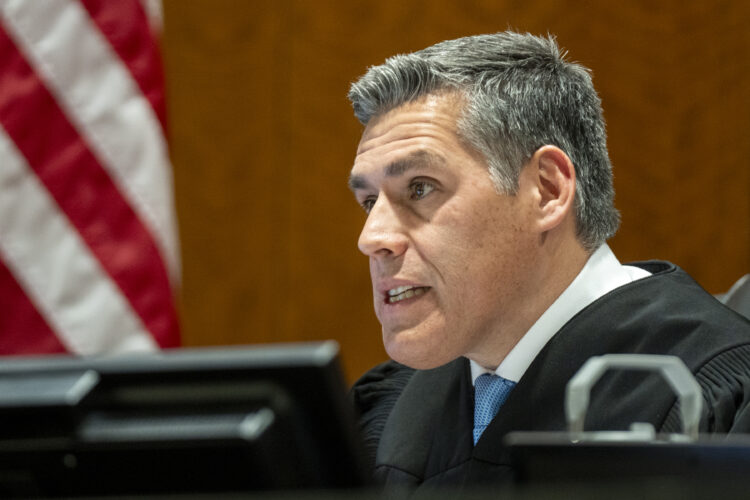
(Rick Egan | The Salt Lake Tribune) Fourth District Court Judge Tony Graf presides over a hearing for Tyler Robinson in Provo on Thursday, Dec. 11, 2025. Robinson is accused of fatally shooting Charlie Kirk.
Two motions regarding media access to the Tyler Robinson case were decided by the Provo 4th District Court in a virtual hearing Monday morning.
Judge Tony F. Graf ruled that an 83-page transcript from a Oct. 24 closed door hearing will be released to the public, barring 246 redacted words.
“The carefully limited redactions ordered are narrowly tailored and designed to protect (constitutional) interests while preserving the public’s ability to understand the substance, context and significance of the proceedings,” Graf said.
Graf also denied a request from two groups of media outlets to intervene in the case and receive access to closed or sealed court information, citing that the media is not an actual party in the case, and that the press already has ways to access court records.
Graf also reiterated that parties in the case are ordered to serve “all motions to closure hearings on members of the press who have requested notice,” and that media must file objections to a closure hearings within seven days of receiving notice.
Robinson, 22, of Washington, Utah, faces seven criminal charges, including aggravated murder, after he allegedly shot and killed conservative activist Charlie Kirk at a Sept. 10 event at Utah Valley University in Orem.
Early hearings in the case have primarily focused on courtroom procedures and public access. Monday’s hearing was a continuation of a Dec. 11 hearing, where Robinson made his first in-person appearance in court.
During a closed session in the Dec. 11 hearing, the defense team, prosecution and council for the news media made arguments on a motion filed by the prosecution and defense to keep the transcript and audio from a closed Oct. 24 hearing private.
Graf said a joint status report filed by the defense and prosecutors identified approximately 20 provisions in the Oct. 24 transcript for redaction, approximately half of which addressed courtroom security measures.
On Monday, Graf ordered the redaction of portions of the transcript, citing security measures; however, he denied two other requests for redaction, citing that the information is not highly personal or sensitive.
“Privacy interests do not outweigh the public’s interest in the case,” Graf said.
The redacted transcript will be filed by the end of Monday, and the transcript audio will be available within approximately two weeks, Graf said.
Local News
The Wild Calls: Anthro Weekend Utah co-founder discusses ins and outs of setting up state’s largest furry convention as registration opens to the public
Clark G. Gilbert ordained as apostle in The Church of Jesus Christ of Latter-day Saints
