
Powder Mountain’s water district voted to outsource all operations and eliminate 5 district jobs
BRIAN NICHOLSON, Special to the Standard-Examiner
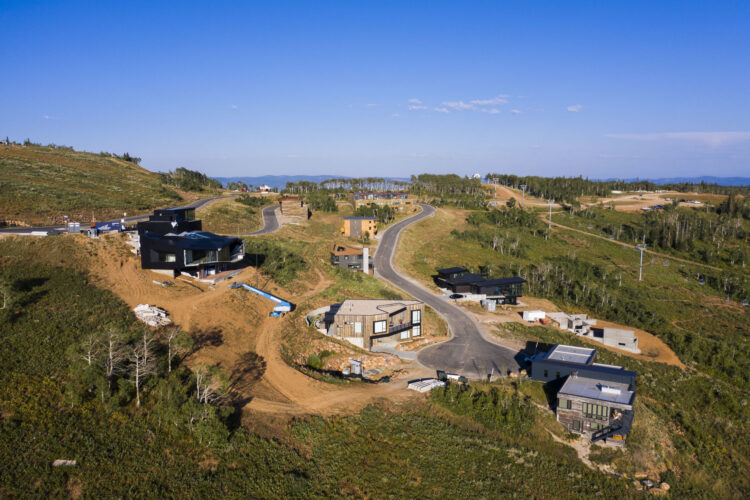
In this undated photo, construction can be seen in the Summit Village area of Powder Mountain ski resort.This article reports on the next step in the process first examined in “Powder Mountain Water District Moves to Outsource All Operations,” published April 4, 2026
The sewage from approximately 800 homes, lodges, and condominiums on and around Powder Mountain flows downhill to a set of treatment lagoons on the valley floor in Eden. The lagoons are the property of the Powder Mountain Water and Sewer Improvement District, a public entity. The ground beneath them is not.
As of October 6, 2025, that ground belongs to Eden Rise, LLC. Eden Rise shares its mailing address with SMHG Landco LLC and SMHG Management LLC, the entities that operate Powder Mountain ski resort under majority owner Reed Hastings, the co-founder of Netflix. Federal motor carrier records list SMHG Management’s trade name as Powder Mountain Resort.
The person who signed for Eden Rise on the warranty deed recorded with the Weber County Recorder is Anne C. Winston, Powder Mountain’s Chief Development Officer. Winston was quoted alongside Hastings in a Salt Lake Tribune profile of the resort published in September 2023.
Six months after that land transfer, on April 3, 2026, the district’s board voted unanimously to issue a Request for Proposals seeking a private contractor to take over all day-to-day operations: water systems, sewer management, billing, financial recordkeeping, customer service, and board meeting coordination.
The RFP, posted April 9, specifies a 90-day transition after which the district would have no employees.
A District Without Its Own Water
The land transfer and the outsourcing vote occurred against a backdrop that predates both: the district has not had an independent water source since 2016.
For roughly forty years, the district relied on Pizzel Spring as its primary drinking water source. The state historically assumed the spring produced 70 gallons per minute. In December 2014, two days before Christmas, the mountain ran out of water. The district was forced to haul drinking water up the canyon in tanker trucks.
Measurements by the Utah Division of Drinking Water recorded the spring at just 25 gallons per minute. DDW Director Ken Bousfield wrote in January 2015 that the system was providing only about 30 percent of required source capacity.
By June 2016, DDW ordered Pizzel Spring completely offline due to severe risk of surface water contamination and the detection of E. coli. The adjacent Cobabe Well was also contaminated.
Both of the district’s own water sources were gone. The district was forced into total reliance on the Hidden Lake Well, which sits near the top of the mountain in a parking lot. That well is privately owned by the developer. Even with it online, the system was operating at only 75.6 percent of state-required source capacity, according to a July 2016 letter from Bousfield.
The public water district is unable to serve a single new customer without drawing from a privately owned well. The developer now owns the ground under the district’s sewer lagoons, owns the district’s only functioning water source, and stands as the expected respondent to an RFP for all remaining operations.
What the District’s Attorney Wrote
In a February 6, 2026 memorandum to the Board of Trustees, district attorney Ari Bruening of Parr Brown Gee & Loveless wrote that Powder Mountain had “expressed interest in serving as the Contractor.”
Bruening wrote that while an arrangement with the resort “would likely generate significant efficiencies,” the resort, as the district’s largest customer, “could from time to time act in its own interests to the detriment of other customers.”
Utah Code authorizes a special district board to contract for services that “cannot satisfactorily be performed” by the district’s own employees. On April 10, the Standard-Examiner filed a public records request asking for any resolution, motion, or written finding in which the board documented that current employees cannot satisfactorily perform the services proposed for outsourcing.
District Clerk Carrie Zenger responded the same day: “No such record exists. No final decision has been made with regard to the referenced outsourcing.”
The board voted unanimously on April 3 to approve the RFP and a contract of services in a single motion.
Who Owned the Land Before
The land under the lagoons was not always in the resort’s hands. For nearly two decades, it belonged to a Las Vegas-based family investment office.
Eden Heights, LLC was formed in Utah around the time Western American Holdings purchased Powder Mountain from the Cobabe family, which founded the resort in the 1970s. Eden Heights was managed by GY Property Holdings, a Nevada entity. Ben Yamagata, a Washington, D.C. energy and natural resources attorney who retired from VanNess Feldman, served as manager of GY Property Holdings. Yamagata also serves as executive director of the Coal Utilization Research Council.
Eden Heights held the valley-floor property through three ownership changes at the resort: from the Cobabe family to Western American Holdings in 2006, to the Summit Series group in 2013, and to Hastings, who invested $100 million for a controlling stake announced in September 2023.
On October 6, 2025, Eden Heights sold the portfolio to Eden Rise. Yamagata signed for the seller. Winston signed for the buyer. The transaction included a separate assignment of a Revenue Sharing Agreement that Eden Heights held with Weber County.
Federal Money on the Site
The district has used federal pandemic relief money to improve sewer infrastructure on this land.
A subrecipient agreement between Weber County and the district awarded $2.4 million in American Rescue Plan Act funds for the “Pizzel Springs Redevelopment Project.” The district’s application described the project as “critical to protecting the water supply source for Powder Mountain and the Upper Ogden Valley,” citing the E. coli contamination that had taken Pizzel Spring offline. The agreement was signed by then-board chairman Robert Bingham and attested by District Clerk Carrie Zenger.
A separate construction contract addressed the lagoons directly. The “Powder Mountain Sewer Lagoons Maintenance Project” covered embankment stabilization, missing interior roadways between ponds, failed overflow structures, and the absence of control valves to isolate treatment cells.
The federal money improved infrastructure on land the developer’s affiliated entity purchased five months before the board voted to outsource all operations.
The district’s capital facilities plan describes a long-term goal of replacing the lagoons with a mechanical treatment facility at a location called the Wolf Barn property. Weber County planning records associate the Wolf Barn site with Summit, the parent ownership group behind Powder Mountain.
Two Systems on One Mountain
The district’s sewer infrastructure is not one system. It is two.
The original network, built during the Cobabe era, is entirely gravity-fed. Wastewater flows downhill naturally from homes and lodges to the treatment lagoons on the valley floor. It requires minimal mechanical intervention.
The newer infrastructure serving Powder Haven, the luxury residential development under construction by Hastings and Meriwether Companies, relies on mechanical lift stations. The homes sit in topographical bowls and along ridgelines where gravity does not carry wastewater to the mainlines. It must be mechanically ground and pumped uphill.
The 2021 sewer impact fee facility plan from Gilson Engineering identifies 910 total Equivalent Residential Connections at buildout. Over half, 479, belong to the Summit/Hastings development. Maintenance items attributed entirely to the developer’s side of the system include freeze protection retrofits, manhole repairs, lift station repairs, and pressure main repairs.
The district currently has five employees. The RFP, however, invites a private contractor to take over responsibility for both systems.
The Board
The district’s five-member board was entirely reconstituted between January 2025 and January 2026 through appointments by the Weber County Commission. Andrew Stark was elected chair on January 13, 2026, the same meeting at which he, William Donovan, and Michael Mayra took their oaths of office. James Harvey and Francis Xavier Helgesen had been appointed the prior January.
Harvey sits on both the Weber County Commission and the PMWSID Board of Trustees. County commission resolutions from December 2025 and January 2026 show Harvey present and voting on the appointments of his fellow PMWSID trustees.
Weber County Assessor records show the Mayra Family Trust owns two parcels in Eden on the Powder Mountain resort.
At the April 3 meeting, Stark acknowledged that multiple board members own real estate in Powder Haven, the luxury residential development being built by the resort.
Asked in writing before the meeting whether any board members have a financial, employment, or business relationship with Powder Mountain or any affiliated entity, Stark wrote in an email: “We are not aware of any… relationships.”
Developer Michael Moyal, a former board member and ratepayer, told the board at the April 3 meeting that the geographic concentration in the resort’s luxury development created a conflict of interest. Stark responded that the board had treated the district as unified rather than divided between neighborhoods.
Jamie Lythgoe, a fourth-generation Powder Mountain property owner and granddaughter of resort founder Dr. Alvin Cobabe, said she does not know three of the five current board members. She has lived on or around the mountain for decades and worked for the water district in the 1990s.
According to Lythgoe, her grandfather personally put up his own property as collateral to save the water district from a bond default in the late 1980s. He pledged twelve condominium pads, seven acres, and twenty-one building sites. For five years, fifty cents from every lift ticket at the resort went toward paying off the debt.
The Water Fight Downhill
The outsourcing proposal is not the only large-scale action involving the district and the developer.
In November 2023, two months after Hastings’s $100 million investment, the district filed exchange application E6560 with the Utah Division of Water Rights. The application seeks to consolidate over 600 acre-feet of water and proposes five new mountaintop wells. It includes snowmaking for the first time at Powder Mountain.
A previous exchange application, filed in 2014 during the Summit era, had drawn protests from nearly two dozen entities and resulted in a 2016 mitigation agreement. Five downstream water users spent approximately $450,000 in legal and engineering fees to secure limits on mountaintop pumping, including protections for Wolf Creek flows.
The 2023 application proposes reducing those Wolf Creek mitigation flows by approximately 38 percent.
A hearing was held at the North Ogden City Offices on February 22, 2024. The State Engineer has taken no action. Division of Water Rights records show three of the original protestants have since withdrawn: Bar B Ranch, Middle Fork Irrigation Company, and the Whitehead Trusts.
The application remains unapproved.
The Tower on Borrowed Land
The Revenue Sharing Agreement transferred to Eden Rise has its roots in 1968, when Weber County placed a public radio and television transmission tower on land owned by Alvin and June Cobabe for the Sheriff’s Office. The county did not record the deed. For 40 years, it operated communications infrastructure on land it did not legally own.
The error surfaced in 2008. By then, Eden Heights had acquired the property.
On September 19, 2017, the Weber County Commission voted unanimously to approve a 25-year agreement with Eden Heights. The county received the tower footprint. In exchange, it agreed to pay Eden Heights 35 percent of any commercial lease revenue earned from the tower site.
That revenue stream now flows to Eden Rise through the assignment recorded on October 6, 2025.
Commissioner Jim Harvey voted on the 2017 agreement. He now sits on the board of the water district whose operations are proposed for outsourcing to an entity sharing Eden Rise’s mailing address.
The Public Record
The warranty deed is recorded with the Weber County Recorder. The ARPA subrecipient agreement is a public grant filing. Eden Rise’s corporate registration is on file with the Delaware Division of Corporations. SMHG entities’ registrations are on file with the Utah Division of Corporations and the Nevada Secretary of State. The Revenue Sharing Agreement and its assignment are recorded county documents. The September 19, 2017, commission minutes are public record. The exchange application and protestant records are filed with the Utah Division of Water Rights. The April 3, 2026, board meeting was conducted publicly on Zoom.
The district serves approximately 800 accounts, according to District Clerk Carrie Zenger. The RFP invites proposals from private contractors to take over all operations. Proposals are due April 30, 2026.
Local News

Powder Mountain’s water district voted to outsource all operations and eliminate 5 district jobs

Scouting America honors Weber State alum, Paralympics champion David Blair with rare award