Fifth fifth local option sales tax not ‘an absolute no-brainer’ for Davis County Commissioner Lorene Kamalu
Ryan Comer, Standard-Examiner
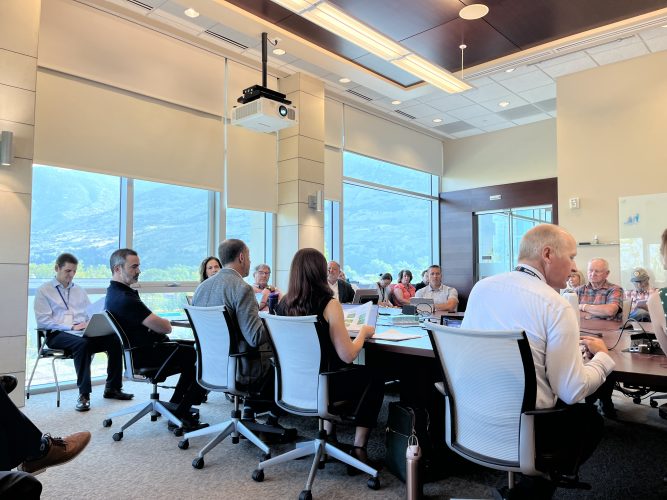
The Davis County Commission meets during a work session Tuesday, Aug. 4, 2026, to hear a proposal on and discuss a potential fifth fifth local option sales tax at the Davis County Administration Building in Farmington.Editor’s Note: The following is the second in a series of stories on the Davis County Commission’s work session Tuesday, which included a presentation and reaction to the possible imposition of a fifth fifth local option sales tax. The following story focuses on the reaction from Commissioner Lorene Kamalu.
FARMINGTON – Clearfield City Manager JJ Allen said he was going to be more blunt than polite as he asked about the possibility of imposing a fifth fifth local option sales tax in Davis County during Tuesday’s Davis County Commission work session.
He said it seemed “like an absolute no-brainer” and wondered why there was “consternation” from the commission.
Davis County Commissioner Lorene Kamalu proceeded to explain why it wasn’t such an easy decision for her.
“I’ve thought about this for a very long time, and I’ve studied tax policy. I’ve lived tax policy. And so I do have some questions and concerns, because it does at first seem like a no-brainer,” she said.
Kamalu started by addressing transit funding and data.
“We invested in a transportation planner several years ago, and we have had a fantastic current one, fantastic previous one. And so there’s some good data. It’s important to use all the data. Right now, there’s already $400 annually going to transit from every household in Davis County. $400 annually from every single household.
“And there’s a lot of data. I’ve got a handout. WFRC has the same handout. So, to this point, or at least as of a couple years ago, Davis County is paying 10% of the cost but only receiving 4% of the service. So, the recommendation from the former transportation planner was to redefine transit in Davis County with more internal circulation.
“And I’ve had a robust conversation with both Andrew (Gruber) and Miranda (Jones Cox), and there’s a lot of brilliant minds in this room, which is why I want to bring up kind of even more of the consideration from my standpoint. I’m definitely aware, and we are aware as a county, of how much money is already going to transit.
“We are, in a good way, challenged to use all the money that is already coming to us. We’re not struggling.”
She then addressed service concerns.
“We have also had needs in this county for bus service to areas that, really, it seemed obvious to us that have needed it,” she said. “There’s a food pantry on Highway 193 with no stop for people who need to go to that food pantry with open doors and we’ve let that be known, but the food pantry is now gone. Service never got there.
“We do have needs east and west for sure. There’s always the question about what comes first, the chicken or the egg, when it comes to ridership and inducing ridership and making those good decisions that UTA tries to make where will that ridership come if we build it? If we build it, will they come? How do they make those decisions? I know there’s modeling. I know it’s not easy. I’m not criticizing, But we’ve been waiting a long time with the funding that’s already been going from every single household to the transit effort.”
Kamalu said she had concerns about some tax policy that was above her pay grade.
“We all know there’s an imbalance,” she said. “The state has been cutting income tax because income tax is dedicated in the constitution to education, which I don’t have a problem with, but because we have such a robust economy, we’ve had a lot more revenue in income tax than we’ve needed, and, there was a little effort … to try to open up some other uses in income tax. And so, honestly, I have experienced frustration that we as locals, cities and counties, have been getting a ton of unfunded mandates, not necessarily having as much collaboration as we would desire, and then we have to raise our hands to raise taxes.
“We have this on billboards even, ‘We cut taxes. We cut taxes,’ and yet we as locals have had to raise taxes. We have had to raise taxes because we are the ones that deliver the services robustly to every single individual and every single household in this county. The lion’s share of the services are delivered by cities and counties. And so the unfunded mandates have hurt, and so has just this big blasting out of the state cutting taxes, and we have to raise taxes. I have a philosophical problem with that.”
Kamalu also addressed timing and pressure.
She said something could be tweaked so the current commission isn’t pressured to “yet again” raise taxes.
“We have a new commission coming in really soon, and I am super happy that we have some of those candidates in the room because they are the ones probably to need to make the decision rather than this (commission),” she said. “Whether it’s intended or not, I believe that our county is being pressured and that I am being pressured unless we have a unified commission.”
Kamalu said she knows capital funds are required for buildings but that she is “not happy with the tax policy of just expecting the locals to suck it up.”
She said she is a public transit fan and sees the need but is concerned about tax policy. She said it was “super interesting to hear that the electorate could vote on it” and there was still time to put that in place.
“Always, the challenge is to get the education out to all the people who need to make an informed vote,” she said. “Davis County lacked the staffing to do that well and properly with the revenue increase that we needed to do to just provide the basic services required by law. So I would love to see some other entity educate this public so it’s not a burden on the locals to just try to slip it in but to actually educate the people.
Concluding her comments, she addressed Allen specifically.
“So it’s a great question, JJ,” she said. “Yes, if every single city sent a letter and how this was all very publicized and very public and the public embraced it, that would be amazing. But right this minute, we can collect the money and have it saved for capital reasons, which we very much need, and same with public safety, very much need, but I feel like we have a problem with tax policy at the top, and so therefore, I am pretty concerned. You can tell I’m not necessarily thinking this is an easy no-brainer decision.”
At the end of Kamalu’s remarks, Commissioner Bob Stevenson asked if she was a yes or a no. Kamalu said she was “on the fence.”
Contact Standard-Examiner editor Ryan Comer at rcomer@standard.net.
Local News
A place to learn: Weber State’s MARS Center hosts its first open house
From dust to display: Earl Ferguson exhibit honors legendary Box Elder football coach