Davis County Commissioner Bob Stevenson: Support for fifth fifth proposal about ‘doing your duty with what you were sworn to office to do’
Ryan Comer, Standard-Examiner
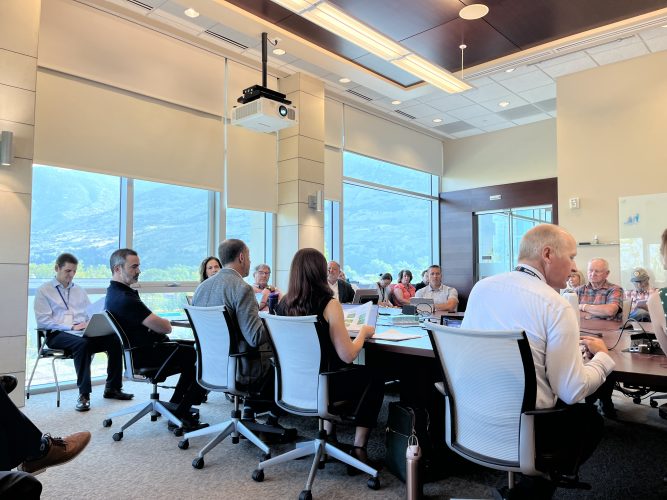
The Davis County Commission meets during a work session Tuesday, Aug. 4, 2026, to hear a proposal on and discuss a potential fifth fifth local option sales tax at the Davis County Administration Building in Farmington.Editor’s Note: The following is the fourth in a series of stories on the Davis County Commission’s work session Tuesday, which included a presentation and reaction to the possible imposition of a fifth fifth local option sales tax. The following story focuses on the reaction from Commissioner Bob Stevenson.
FARMINGTON – Davis County Commissioners Lorene Kamalu and John Crofts may have hesitation regarding the potential imposition of a fifth fifth local option sales tax, but Commissioner Bob Stevenson does not.
Stevenson directed sharp criticism toward Kamalu and Crofts during Tuesday’s work session.
“I’ll be very frank with both of you,” he said. “I think that for you guys to turn around and not be supportive and not want to do this, you are not doing your duty with what you were sworn to office to do. You are walking away from something that needs to be there, because this is something that supports not only this county government, it supports the city government, and it also supports what the state needs. This is one of those things that are there that basically is 100% team player.”
Stevenson also made his position clear earlier in the meeting in response to Clearfield City Manager JJ Allen’s question about “consternation” among the commission regarding the proposal.
“Well, obviously, I am in favor,” Stevenson said. “That’s a given.”
During the meeting, Stevenson highlighted the benefits of the increase to city and county coffers. He referenced the third quarter that was implemented in 2019 and asked Davis County Community and Economic Development Director Kent Andersen how many total dollars have been brought in since then. Andersen said about $100 million.
“So that’s $100 million that the county doesn’t use,” he said. “The county disperses it throughout all the cities, and I think all of you have seen funds that are there, that are in place to be used when things come along. If the commission would not have done that at that point in time, you can minus a lot of those projects out of your cities because the fact that there would have been no dollars there.”
Stevenson went through the history of the local option sales tax, mentioning that it was originally 100% for the Utah Transit Authority. He said cities didn’t like that, but Salt Lake County stepped up and demanded flexibility, which is when public safety became an option.
He said Utah County then put it in place, but Weber and Davis counties continued to hold out.
“And part of the reason was because we needed to have flexibility throughout the county to be able to utilize these funds,” he said. “If we were going to put it in place, we wanted help. And so leadership in both the Senate and the House started to push a lot wanting to get this in place.”
He said a factor in the push is the 2034 Olympics and the state wants to have transit ready.
“This is one of the funding mechanisms that can be there,” he said. “So, this past legislative session with a couple of bills that were there, Davis and Weber counties started working very closely with a couple of the authors of the bills to try to get a little more flexibility for things that we want, and we were able to get this stuff put in place with the idea that we would turn around and we could make this work within our counties.”
Stevenson noted the amount of money that would go to each city from the proposal. The estimated annual total distribution, as noted on a slide, ranged from $41,004 for Sunset to $974,760 for Layton.
“You saw dollar figures that were there going into the cities based upon size, and, again, that’s an ongoing – in a sense forever – type thing, and it can add up to definitely help a whole lot in your different (cities) over a period of time,” he said.
One specific use Stevenson mentioned that had to do with public safety was the sheriff’s department.
“The demands upon the sheriff’s department continue to grow and grow and grow,” he said. “One of the major hits is basically the jail. We have to run a jail. And it’s one of those things as growth comes, it’s not like the inmates are going down as far as it goes. It just continues to grow.”
Stevenson also highlighted the need for an attorney’s building.
“One of the things that we have to have in this county, we have to have an attorney’s building,” he said. “We’ve got attorneys spread out in what four or five different locations? And with all the growth, we have to have a new building. These dollars that would generate over three years is something that we could turn around and build that building, which really takes the burden off not only this commission but also off the next commission, because somebody’s got to do something on it. You just can’t throw people out on the street.”
Elaborating on Stevenson’s comments, Davis County Attorney Troy Rawlings said that the number one priority for the Administrative Office of the Courts and State Facilities is a new courthouse in Farmington to be built on the Justice Complex campus across from Station Park. He said the building that the attorneys are primarily in is owned by the state and that the state was going to kick them out.
“We’re going to be nomadic,” he said. “We got nowhere to go.”
In an interview with the Standard-Examiner, Court Facilities Director Chris Talbot said there have been three different concepts, but the current plan is for there to be a single building for the courthouse and the attorneys rather than separate buildings. He said that the court and county attorneys would be able to stay in their current location until the construction of the courthouse is completed.
Talbot said a consolidated building that included the state court, justice court and county attorneys made sense because of parking. He said the original project, which called for a separate courthouse, would have required a $20 to $30 million parking structure.
“If we are able to combine those buildings, we’re able to provide enough surface parking and save the project that amount of money, which is already a very expensive project,” he said. “So it is a combined building. That’s what we’re going to be presenting this next legislative session again for consideration.
“And the county is looking to bond the entire project and the court will be going to the legislative branches to try to get annual funding to pay bond payments towards our portion of the construction.”
Also during the County Commission meeting, Stevenson said it was a possibility the bill could be tweaked so that Davis County doesn’t lose what amounts to roughly $2 million in what Miranda Jones Cox, government affairs manager for Wasatch Front Regional Council, called “maximum flexibility” due to already being a quarter behind.
When Weber County voted to impose the tax, it started a three-year clock where the later Davis County waits to impose the tax, the less maximum flexibility it has – maximum flexibility meaning the revenues are not limited to transportation or public safety.
Of the 0.2% increase, 0.1% would have maximum flexibility, which over the first three years would amount to about $24 million.
As it stands now, according to Andrew Gruber, executive director for Wasatch Front Regional Council, if Davis County imposed the fifth fifth before Oct. 1, the 0.1% would generate about $22 million to be used for any purpose.
“I have been in conversation with one of the authors of the bill who says, ‘Davis County gets this put in place during this period of time, we may be able to amend it to make that quarter up as far as that goes,'” Stevenson said.
Stevenson emphasized the significance of the opportunity based on the flexibility.
“This is an opportunity that comes from the state, and I want you to know, it’s taken a lot of work to get this flexibility into this,” he said. “We flat out would not support – Davis and Weber counties especially – when this was all transit. Until that opportunity for the flexibility to be there, we would not do anything on it, and they knew it, and that’s why they were willing to make the adjustments on this because of the needs both the cities and the counties have.
“And you go down this – 0.05 for the counties and 0.05 for the cities, again, that is something that goes on and on and on, and as the growth comes in and there’s more and more people and more dollars being spent on goods and services, that just continues to help bring those dollars in, to be able to utilize what needs to be there, whether it is transportation or public safety.”
Contact Standard-Examiner editor Ryan Comer at rcomer@standard.net.