Layton City Manager Alex Jensen gives strong support for fifth fifth local option sales tax
Ryan Comer, Standard-Examiner
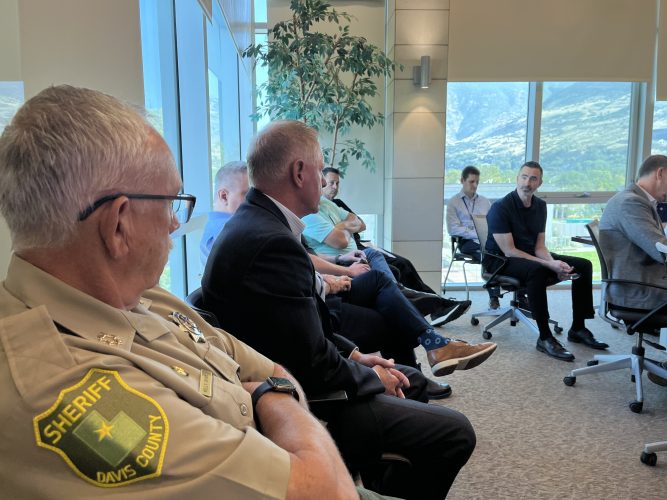
Layton City Manager Alex Jensen, second from left, during the Davis County Commission work session Tuesday, Aug. 4, 2026, in Farmington.FARMINGTON – Davis County commissioners weren’t the only ones present at the county commission’s work session Tuesday to hear a proposal on a fifth fifth local option sales tax.
Various mayors and city officials were also in attendance.
The support from those officials was largely supportive of the proposal, with Clearfield City Manager JJ Allen saying it seemed “like an absolute no-brainer.” He wondered why there was “consternation” from the commission.
Layton City Manager Alex Jensen agreed with Allen.
According to a slide that was displayed during the meeting, the estimated annual total distribution to Layton City would be $974,760.
For Clearfield, it would be $299,466.
“I guess what I don’t understand from the county’s perspective is, we’re all involved in running a business, and that’s the people’s business, and we have to make business decisions,” Jensen said.
He said political leaders are needed, not politicians.
“And political leaders have a vision and have the ability to make decisions that are good for the community,” he said. “Every decision … generates people who support that decision and who don’t like that decision. But if we live in fear of the ones who don’t like it in the interest of the greater good, then we’re in the wrong jobs.”
He said serving the broader community was the purpose of the commissioners.
“You have articulated significant demands and needs that are central to your core function – health, safety and welfare,” he said. “That’s what we’re talking about here. And I don’t think this is a philosophical issue at all. I think it’s a very practical issue. The state has limited local entities, counties and cities to a very narrow set of revenue streams.”
Jensen said property taxes are “generally a one-way ticket out of office” and noted the commission just went through that, but he said this tax was different.
“I don’t think in my experience, which is a bit, that that same standard applies to sales taxes,” he said. “As an example, in this county, I believe, and what happened in Layton, where there was such a fervor against property taxes, which makes some sense, that RAMP taxes, which are discretionary and are a discretionary part or elective part of sales tax, passed with flying colors. And so I think the electorate is smart enough and genuine enough and knowledgeable enough to make distinctions between (the taxes).”
He said he thinks people understand “there are appropriate taxes that can provide benefits to people that aren’t onerous” and said sales taxes involve discretion.
“If I don’t want to pay the tax, I don’t buy that,” he said.
Andrew Gruber, executive director for the Wasatch Front Regional Council, said in a follow-up message to the Standard-Examiner that the fifth fifth local option sales tax does not apply to groceries.
“I would just say to the county again, ‘How are you going to replace this infrastructure that has to be done?” Jensen said. “You’re certainly not going to do property tax, or the next commission will go out. That’s just the reality of it. So, what are the funding streams? We can talk about tax policy of the state. You think our discussion here – I’m saying this respectfully – is going to change the mindset of the state legislators with regard to tax policy? There’s not a chance in heck.
“So … in my opinion, I think … we have an opportunity to control our destiny. … Usually, cities and counties complain about not having flexibility from the state. The state tells us, ‘You can use this. You can use this. You can’t do this.’ … So here we are where they’re saying. ‘We’re going to give you some flexibility that you’re always complaining you don’t have, and now we’re wiffling and waffling about whether we actually use that flexibility. Sorry. I think that’s not on them. I think that’s on us.”
Jensen emphasized how much inflationary pressures have affected transportation and public safety for cities.
“You buy a ladder truck; you’re talking about over $2 million, which 10 years ago, five years ago, was half that,” he said. “Infrastructure – 30% to 40%, and all of our utilities, the costs are going up and up and up. There has to be a revenue stream that provides for this. So, I think the Legislature is wise and we ought to be wise in saying if this were just being used, in my opinion, to build pickleball courts, it’s not worth it, but we’re talking about things that are essential to the health, safety and welfare of people. It’s the core of our responsibility as public servants is to have these kind of facilities.”
Contact Standard-Examiner Ryan Comer at rcomer@standard.net.