
Davis County Sheriff’s Office chief deputy discusses ALPR tech controversy after county commission votes for MOU
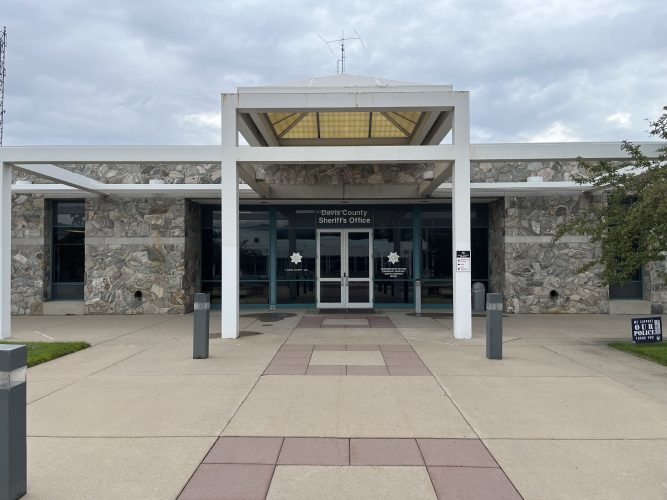
The Davis County Sheriff's Office, pictured on Thursday, Aug. 13, 2026, in Farmington. (Ryan Comer, Standard-Examiner)
FARMINGTON – Davis County Sheriff’s Office Chief Deputy Arnold Butcher spoke to the Standard-Examiner on Tuesday about the increased attention being put on automatic license plate recognition technology.
“I understand, and I get it that people feel like their right to privacy is just being blown away,” Butcher told the Standard-Examiner. “It’s also because it’s grown so fast and the rules and regulations are playing catch up. And so you have seen some things that push the boundaries, push the lines and ended up in lawsuits. …
“And I think there’s a lot of concern about where is this going? Who has access to it? Where is it being shared? Because people were grabbing it, agencies were grabbing all the technology as it comes along and thinking, ‘Man, we’re doing such a great thing,’ and I think they had best intentions, but they weren’t thinking, ‘Well, where is this being stored?’
“… There were people out there, agencies out there … some of that information was being stored on a hard drive or computer servers and everything at their office, which meant maybe people from their IT departments could access it, or did the secretaries have access to it? And then it was being shared inappropriately. As mentioned, there’s anecdotal stories out there about ‘I believe my spouse is cheating on me. I am a cop or I work for the sheriff’s office and I know that we’ve got this server in our office that contains this. I’m going to see if I can find out where my husband was or where my girlfriend was.'”
Butcher’s comments to the Standard-Examiner came after he delivered a presentation at the Davis County Commission meeting seeking approval of a Memorandum of Understanding related to automatic license plate recognition and sharing information for law enforcement purposes.
The vote passed 2-1, with Commissioners Bob Stevenson and Lorene Kamalu voting in favor and John Crofts voting against. Davis County Sheriff Kelly Sparks spoke during public comment in favor of the MOU, calling it “an important safeguard.”
Butcher told the Standard-Examiner he appreciated that Jeff Hassett, information services director for the county, explained where the data is stored during the county commission meeting.
“The data is stored in the government cloud in Virginia, so not on any international servers,” Hassett said during the public comment period. “This is the same system of data that all of our sheriff’s information goes into, so if a sheriff is behind a car and he types in a license plate to look up that license plate, this is in the same place that that data is.”
According to the MOU, ALPR systems use cameras to capture images of license plates, which are converted into a text file and compared against a “hot list.”
“This system is only used by law enforcement as authorized by Utah Code § 41-6a-2003, for example, part of an active criminal investigation, to apprehend an individual with an outstanding warrant, to locate a missing or endangered person, or to locate a stolen vehicle,” the MOU reads.
Governmental entities that enter into the MOU, referred to as “Agency Parties,” “seek to share Plate Data and Hot List information with each governmental entity executing a duplicate of this MOU.”
The MOU goes on to say that access to any other agency party’s plate data and hot list information is restricted to “authorized employees who have an approved login and password.”
The full Memorandum of Understanding is included in the agenda packet for Tuesday’s meeting at daviscountyutah.gov.
Contact Standard-Examiner editor Ryan Comer at rcomer@standard.net.
Local News
Trevor Lee resigns from Utah House as AG charges him with fraud

Literacy milestone: Ogden School Foundation set to celebrate 30th annual Fall Author Event this week