Most of this Utah county’s license plate camera data is searched by out-of-state law enforcement
The Utah Civic Compact wants those searching data to adhere to Utah privacy laws
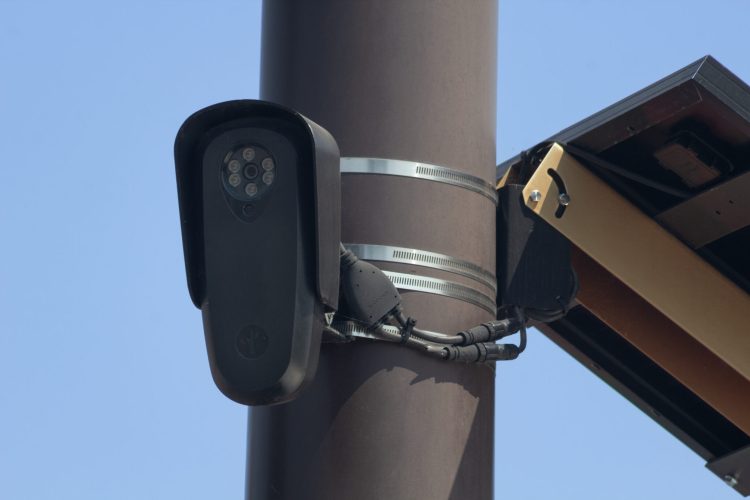
A Flock Automated License Plate Reader on Overland Road in Boise, as captured on Aug. 5. (Valentin Termite/Idaho Capital Sun)
License plate cameras are under scrutiny as questions on misuse and surveillance emerge throughout the country. In Utah, a political action committee is sounding the alarm, after having found that the vast majority of the camera records searches in one county originated outside the state.
The records of 10 license plate cameras from the Flock Safety network installed in Weber County streets were searched 5.1 million times between February 2022 and July 2026. Almost 97% of those searches came from law enforcement agencies outside of Utah, an investigation from the Utah Civic Compact found.
The No. 1 searcher of Weber County camera records was the Houston Police Department, which accounted for over a third of all activity.
“When the Flock cameras were proposed, it was pitched to the public as a mechanism by which public safety can be protected, and how technology can make us safer,” Clark Dice, communications director of the Utah Civic Compact said on Thursday. “The more that we dive into this issue, the more we’re learning that these cameras and this technology and the data is being utilized to surveil people who either live, work, or visit Utah.”
It’s not clear how many license plate reader cameras there are in Utah, but the website lprmaps.com has logged 944 in the state, ranking it No. 28 in the nation for total cameras.
The Flock network uses license plate recognition technologies and vehicle data to help law enforcement investigate crimes. According to its website, the company says its platform is currently used to solve about 2,000 crimes per day.
The Utah report comes at the same time as Flock Safety’s announcement of changes to its platform to address privacy concerns and “documented abuses of its system by some members of law enforcement,” according to a report from the Associated Press.
Among the updates set to be implemented next year, all law enforcement customers must establish an audit tool to flag abnormal search behavior. Retention of the data the cameras capture will also be reduced from 30 days to seven, unless it is evidence tied to a case, and law enforcement will need a case number to do a search.
The Utah Civic Compact isn’t alleging any unlawful activity, Dice said. It is possible they have an automatic procedure to use the data available in the network. But that’s unclear so far. The Houston Police Department didn’t immediately reply to a request for comment on Thursday.
However, members of the compact worry about the disproportionate number of out-of-state searches, and wonder what laws those agencies have to adhere to before getting access to Utah data.
Utah law limits searches to active criminal investigations, outstanding warrants, or to search for a missing or endangered person or a stolen vehicle, the Utah Civic Compact said in a release.
“Save for conducting individual audits of 3,343 agencies (that have searched for Weber County data) there is no mechanism to even know if searches by non-Utah agencies are adhering to Utah’s ALPR search restrictions,” the group said in a release.
The Utah Civic Compact is asking for a legislative audit of the license plate cameras operating in the state, as well as other actions to close the “jurisdictional gap” that happens when out-of-state agencies search for Utah data.
“We want it codified into Utah state law that if you’re going to surveil this very sensitive data, there must be an established process by which you can do it,” Dice said. “Right now, it is our understanding that there’s a bit of a loophole that’s being utilized and we want that to stop as soon as possible.”