
Davis County city councils discuss fifth fifth local option sales tax with varied reactions
Ryan Comer, Standard-Examiner
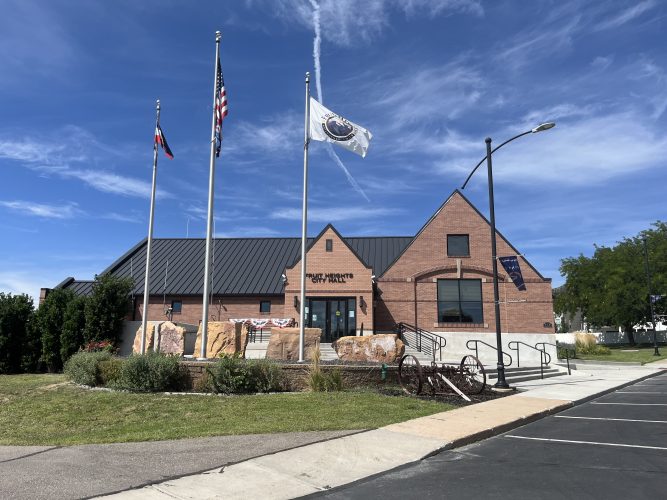
The Fruit Heights City Hall building, photographed on Wednesday, Aug. 19, 2026.FRUIT HEIGHTS – The Fruit Heights City Council is one of several city councils in Davis County grappling with whether to support a fifth fifth local option sales tax that is being considered by the Davis County Commission.
The question for the city councils is whether to send a letter of support to the county commission, and reactions have been varied. In some cases, they’ve been dramatically different.
On Tuesday, the Fruit Heights City Council voted unanimously to table the decision on sending such a letter and bring it back in two weeks, while the Centerville City Council voted unanimously to send the letter.
The North Salt Lake City Council discussed the tax on Aug. 4, and the Clinton City Council discussed it on Aug. 11.
The North Salt Lake City Council was split, while the Clinton City Council voted unanimously to send a letter stating its nonsupport of the tax due to lack of details and specificity.
The issue was also on the agenda for West Bountiful’s City Council meeting Tuesday, and Centerville City Manager Brant Hanson said at Centerville’s meeting Tuesday that Farmington had submitted the letter in support.
At Fruit Heights, Mayor Jeanne Groberg presented a document from the Wasatch Front Regional Council explaining the background and details of distribution.
The tax involves a 0.20% countywide sales tax increase, with the revenue being split between the cities and the county. Cities would receive 0.05% for transportation, while the county would receive 0.05% for transportation and public safety.
What each city receives is based on taxable sales.
The county would also receive the remaining 0.10%, which it could use “for a purpose determined by the county legislative body” for the first three years, a clock that started when Weber County imposed the tax earlier this year. After the first three years, that 0.10% gets split by the county with 0.05% going to transit, as determined by the county legislative body, and 0.05% going into a TTIF commuter rail subaccount.
Groberg pointed out that the tax equates to two cents on a $10 purchase and 20 cents on a $100 purchase.
“You can do the math going up; it’s not very much,” she said, also noting that it doesn’t apply to food, gasoline or real estate.
She said that it applies to people visiting from outside the county and is a revenue stream other than property taxes.
“I know that none of us, generally speaking, are like ‘Yay, more taxes,'” she said. “I don’t relish that at all, but the reality is … we have growing community needs and things do cost more money all the time.”
She also cited public safety, like fire, police and the jail.
Council member Eileen Moss wanted to hear more balance regarding the proposal.
“We’ve had a lot of information saying why we should do it. I haven’t heard cons, and I’d like to have the opportunity to have more discussion,” she said.
She said she wanted to speak with members of the community and county commissioners.
Council member Blake Winslow said he was uncomfortable with supporting it.
“I’m just a little bit concerned about the framing of it being that this is better than a different type of tax because we don’t have to go through a truth in taxation potentially,” he said.
He also said he didn’t love not having specificity and mentioned the timeline of three years where the county commission “is able to make decisions with it that could potentially be funding that goes almost anywhere.”
He said he supported transportation and being ready for the 2034 Olympics but wanted more time to dig into the tax proposal.
“If you say that on $10 this is two cents … I think most of us would just say, ‘Well, OK,’ but whenever we’re talking about taxes, I think that we need to have a little bit more data to bring to our neighbors and to the residents that we represent,” he said.
At Centerville, the tax was mentioned as being fair. The effect of Weber County imposing the tax was also emphasized.
“As soon as one county adopts it, it sort of sets off a domino for the same reasons that are stated in this letter,” Council member Cheylynn Hayman said. “Why should our residents go to another county and they get the benefit of our residents shopping there, and then when they come here, if we don’t adopt this, then we get no reciprocity. We get no benefit out of it, so it feels like as soon as one county does it … Anyway, I’m supportive.”
Centerville City Council member Brian Plummer said the county commission should take leadership and do what it feels is right.
“I’m frustrated with the commission not being able to work together as much as it has in the past, and so I think this can help showing there is support for this,” he said. “That being said, we’re putting ourselves out there and … if they don’t pass it … it puts us in an awkward position with the commission maybe a little bit.”
Contact Standard-Examiner editor Ryan Comer at rcomer@standard.net.
Local News
Antelope Island State Park celebrates expanded visitor center
Utah House speaker ‘extremely disappointed’ in how JCC handled Hagen investigation