
Effort to repeal Prop 4 in Utah will meet statewide threshold, but still lags in some districts
Katie McKellar, Utah News Dispatch
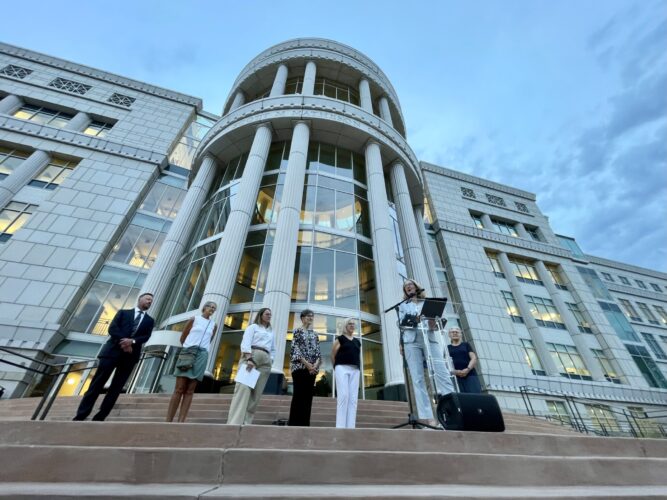
Plaintiffs in an anti-gerrymandering lawsuit hold a news conference outside the Matheson Courthouse in downtown Salt Lake City on Aug. 25, 2025.The effort to repeal Utah’s voter-approved, anti-gerrymandering law known as Proposition 4 is on the cusp of hitting the statewide signature threshold needed to qualify for the November ballot.
However, signatures are still lagging in some Senate districts — and voters still have up to 45 days to remove their signatures. So nothing is certain yet, and Utah voters are still likely at least a month away from officially knowing whether the question qualifies for the November ballot.
As of Wednesday morning, clerks had verified 140,662 signatures — 86 away from the needed statewide minimum of 140,748, according to the latest tally posted on the lieutenant governor’s website.
However, the group pushing the repeal, Utahns for Representative Government, still hasn’t met signature thresholds required in at least 26 of Utah’s 29 counties. So far, enough signatures have been verified in 14 Senate districts.
Signature thresholds still need to be met in at least 12 more Senate districts — but the effort is getting close in several. At least seven districts are more than 90% of the way there, according to a tracker posted by The Salt Lake Tribune. In two districts, however (Senate District 9 and 14) the effort is the furthest behind, with just over 50% of needed signatures having been verified so far.
Earlier this month, Utahns for Representative Government (founded by Utah Republican Party Chair Rob Axson) submitted more than 200,000 signatures before the petition deadline, and Axson expressed confidence that the repeal effort will indeed qualify.
Clerks have until the end of the day March 8 to verify the remaining signatures, but the final tally won’t be posted on the lieutenant governor’s website until the morning of March 9. Then, voters will have up to 45 days to remove their signatures.
Unless the effort fails to meet thresholds in at least 26 Senate districts come the end of next week, Utahns likely won’t officially know whether the repeal question will appear on their ballot until at least April. If the petition is successful, Lt. Gov. Deidre Henderson is required by state law to declare so on April 30, but if it fails she can announce that determination before then.
Lawsuit seeks to block pre-paid signature removal requests
Meanwhile, the fight over Proposition 4 is also heading to court.
Utahns for Representative Government this week filed a complaint in 4th District Court against Henderson and all of the state’s county clerks, urging a judge to require them to reject signature removal requests aided by the anti-gerrymandering group Better Boundaries, which has mailed envelopes with pre-paid postage to signers.
The lawsuit alleges the “prepaid removal statements unlawfully pay an individual to remove their signature” by covering the cost of postage for voters who submit removal forms.
“This prepaid, pre-filled removal letter scheme violates Utah law in at least two independent ways,” the lawsuit alleges. “First, providing prepaid postage unlawfully pays an individual to remove their signature. Second, pre-filling information unlawfully alters the mandatory, individualized verification requirements for signature statements and cause signer confusion.”
In response to the suit, Elizabeth Rasmussen, executive director of Better Boundaries, issued a statement calling it a “desperate and shameful effort to prevent Utahns, including those who may be victims of fraud, from exercising their rights.”
“Thousands of Utahns are exercising their legal right to remove their signatures from the petition to repeal Proposition 4,” she said. “This is unsurprising given the many reports of misleading signature gathering tactics and fraud, including an ongoing criminal investigation into signature gathering fraud in Utah County.”
Attempts to reach Axson on Wednesday were not successful, but on Tuesday Utahns for Representative Government announced on social media it was suing “in order to stop these deceptive and misleading practices.”
“Mailing a letter complete with misinformation to prevent Utahns from exercising their First Amendment right is, at best, unethical,” the post said. “Providing payment (in the form of pre-paid stamped envelopes) to entice Utahns into removing their signatures is ILLEGAL.”
So far, nearly 3,000 Utahns have filled out requests to their county clerks to remove their signatures, according to Better Boundaries. Most of those requests have been sent to the Salt Lake County clerk.
“We are continuing to let Utahns know that they have a right to remove their signature from the petition if they were misled, or if they simply changed their mind,” Rasmussen said.
‘Let the people decide’
In a media availability with reporters on Wednesday, Sen. Scott Sandall, R-Tremonton — the Senate chair of Utah’s redistricting commission — criticized Better Boundaries for encouraging voters to remove their signatures, arguing voters should have the final say on whether Proposition 4 stays or not.
Better Boundaries is the group that originally successfully petitioned to put Proposition 4 on the 2018 ballot in the first place.
“These are people that say, ‘Let the people decide,’ to now say, ‘Let the people not decide,'” Sandall said. “I just think that’s a hypocrisy I cannot get around. … They’re afraid to take something to the voter again, to re-decide? I think that’s hypocrisy, guys.”
Senate President Stuart Adams, R-Layton, argued that Utah voters should weigh in on Proposition 4 again now that Utahns have an idea of the problems it poses in practice.
“They don’t want the people, now that they’ve experienced it, to vote on it again?” Adams said. “That seems a little bit disingenuous.”
More than 500,000 Utahns voted in favor of Proposition 4 in 2018, but it passed by a fraction of a percentage point. However, Utah voters technically have never seen a redistricting cycle with Proposition 4 fully intact with how it was drafted on the ballot.
Ahead of Utah’s 2021 redistricting cycle, the Utah Legislature repealed and replaced Proposition 4 with a law that turned its independent redistricting commission into an advisory body that lawmakers could ignore, and they made its neutral map-drawing standards meant to guard against gerrymandering nonbinding.
That same year, Utah lawmakers ignored independently drawn maps proposed by the independent redistricting commission and instead adopted a map that cracked Salt Lake County into four Republican-majority districts.
The move led groups including League of Women Voters of Utah and Mormon Women for Ethical Government to sue, and so far the courts have agreed with their claims that Utah lawmakers violated Utahns’ constitutional rights to change their form of government through a ballot initiative.
That lawsuit also led to a “remedial” court process to replace the 2021 boundaries, which a judge ruled “unlawful” because they were drawn using an “unconstitutional process.” Ultimately, that case led to a court-ordered congressional map that created one Democratic district and three Republican districts — a map that has survived multiple challenges so far and is likely to stay for the 2026 elections.
While Utah’s Republican legislative leaders continue to fight those rulings in court, the Utah Republican Party and Utahns for Representative Government are pursuing a ballot initiative to ask voters to repeal Proposition 4 for good.
Republican leaders continue to argue that the Utah Legislature has the sole authority to draw political boundaries — and Proposition 4 is in direct conflict with that constitutional mandate.
More reports of fraud, misleading statements
Also on Wednesday, Better Boundaries issued a news release detailing hundreds of “firsthand accounts documenting a widespread pattern of deception, intimidation, and potential forgery by paid signature gatherers working to repeal Proposition 4.”
“The reports, collected from Utahns statewide, describe a coordinated pattern of misconduct ranging from outright lies about the petition’s purpose to physical intimidation at grocery stores and forged signatures on behalf of absent family members,” Better Boundaries said. “The coalition is releasing these accounts so that Utah voters can recognize these tactics, verify whether their names appear on the petition, and take action if necessary.”
Some examples listed by Better Boundaries included:
- A mother in Ogden said she discovered her son’s name on the petition, even though he couldn’t have signed because he has been serving a two-year mission for The Church of Jesus Christ of Latter-day Saints in Peru.
- One Utahn signed after signature gatherers said the petition was to create a new animal shelter in Salt Lake County.
- Some people only saw their names appear on the petition online after receiving text messages from the Utah Republican Party thanking them for signing.
- Signature gatherers reportedly told students at Utah Valley University that the petition was to raise awareness for childhood cancer.
- One voter in Logan said signature gatherers said it was to lower taxes.
- Another said “my boyfriend was told at a Home Depot that the petition was to get ICE out of Utah.”
Utah News Dispatch is part of States Newsroom, the nation’s largest state-focused nonprofit news organization.
Local News
Effort to repeal Prop 4 in Utah will meet statewide threshold, but still lags in some districts

Ogden-area officials report on recent trip to northern Italy to observe inner-workings of the Olympics
