Why the Utah System of Higher Education may get redesigned into ‘regions’
The restructure may allow students to make easier moves throughout the state’s higher education system
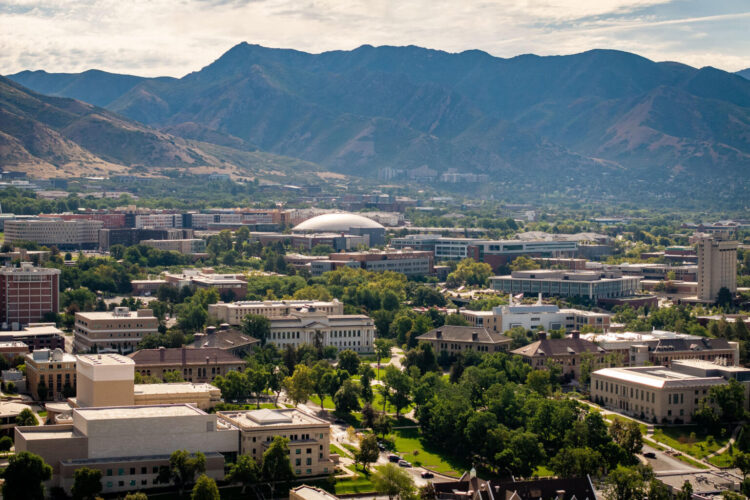
Photo by Spenser Heaps for Utah News Dispatch
The University of Utah campus in Salt Lake City is pictured on Saturday, Aug. 23, 2025. (Photo by Spenser Heaps for Utah News Dispatch)When a legislative audit on the efficiency of the Utah System of Higher Education was first introduced to the public in 2024, it prompted cuts and reallocations for academic programs, but it also pointed to a longstanding frustration for higher education leaders — a lack of collaboration between public universities.
“We have exceptional institutions of higher education, really amazing leaders, amazing faculty, serving the needs of our regions, yet I watch them all competing against each other. And what I see is a lost opportunity,” Geoffrey Landward, Utah commissioner of higher education told lawmakers then.
Now, the Utah System of Higher Education is aiming for change, planting the seed to turn the group of institutions into a real unified system, potentially starting during the legislative session that begins Tuesday.
“There will be potentially legislation this session about it, but it will be a very bare bones bill,” Landward said on Monday. “The intent would be to essentially just set up the very broad infrastructure.”
The draft would essentially direct the Utah Board of Higher Education to organize the system into regions with “vertical integration,” or some streamlined operations.
The makeup of those regions and how the institutions would collaborate is still undefined, Landward said. The idea is that the board will work over the next couple of years with all interested parties to start building on that structure.
But, Landward already has a good guess about how the plans could end up looking. He visualizes a set of regions organized geographically. For example, he can see the Wasatch Front divided into three regions, with one encompassing Salt Lake County and Tooele, another grouping northern counties, and a third with institutions in southern counties. Rural areas may see other structures.
“If we can develop the system in a way where we can get better access to programs and institutions in rural Utah through this, that’s the whole point, or at least one of the primary points of doing this kind of reorganization,” he said.
Each region would have a technical college, either a regional or research university, and in some cases, also a community college, Landward said. Within the regions, there are opportunities for integrated admissions, or academic advising, and also integrated degree and certificate programming, specifically designed for students to move through the system.
“So if you’re admitted into Tooele Tech, for example, or Salt Lake Community College, that means that there’s automatic admission pathways for you to the University of Utah, and that the advising is done in partnership with the University of Utah,” Landward said.
There are currently partnerships between schools like Salt Lake Community College and the University of Utah that make transfers better, “but it’s not as seamless as it could be,” Landward added.
The system redesign could, for example, allow a community college to design associate degrees to align with a university’s bachelor’s degree program. And university students could take general education courses at community colleges at a lower cost.
Landward described the current system as “a loosely affiliated group of institutions” that capture some benefits of being a unified system, “but just on the edges.” Without change now, the system could face a series of shutdowns and mergers in the coming decades, he said.
“I still have institutions trying to be all things to all students, competing for students trying to grow, and that’s the way the system operates right now. I don’t think that’s sustainable,” Landward said. “I think that we have to make some drastic changes over the next few years, because demographics will shift. There’ll be fewer students enrolling and fewer resources to go around, and we have to be more efficient and smart about how we’re operating.”
Utah News Dispatch is part of States Newsroom, the nation’s largest state-focused nonprofit news organization.