
Kaysville City Council OKs director position after mayor, council member debate
Ryan Comer, Standard-Examiner
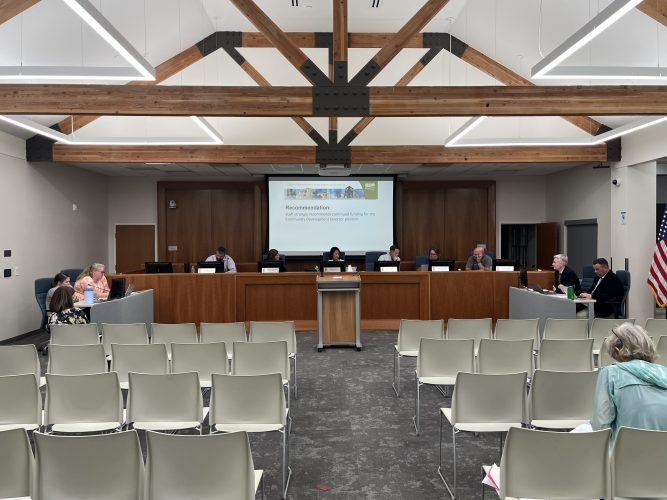
The Kaysville City Council meets in Kaysville, Utah, on Thursday, July 16, 2026.Kaysville Mayor Tami Tran began a discussion during Thursday’s City Council meeting regarding continued funding for a community development director position by saying she was certain it would be “robust.”
Indeed, it was.
Council member Mike Blackham advocated against the position, while Tran provided the staunchest support for the position.
Ultimately, the council voted to support the position, with only Blackham opposing.
“You know, obviously I’m always looking for a way to save money,” Blackham said during the discussion.
Blackham read from a prepared statement his reasoning, but before that, City Manager Jaysen Christensen explained the justification for the position.
“This is a position that has been funded over the years, and the consideration is should it be continued as a position,” he said.
Christensen said the main reason for the recommendation to continue funding was land use, which he said is one of the most important things a city does.
“It’s very complicated and sometimes very nuanced,” he said. “It’s one of those areas where I think can get cities into trouble, maybe more than most areas, and we’ve seen just even tonight how when you fill a room full of people, it’s usually or often about land use issues.”
Blackham said his recommendation was to eliminate the community development director and have a senior planner, a planner and the business license officer. He said the overall department head would be the building official, who oversees two full-time inspectors and two full-time permit techs and is in a supervisory position.
“I have discussed this with him, and he feels very confident and capable of taking on these additional responsibilities,” he said. “I have asked Jaysen to include the job description of a senior planner and the planner … to show you that most of the issues with community development and code enforcement fall under the purview of the senior planner, who would directly oversee a city planner, and combined would both cover 99.9% of all community development and code enforcement issues.
“This model, using the middle pay scale, would save the city close to $110,000 a year and approximately $550,000 over a five-year period. I want to clarify, my numbers are very conservative.”
Blackham acknowledged other cities have a community development director but said Kaysville is different.
“We shouldn’t worry so much about how other cities operate,” he said. “If we can get the work done in a more fiscally responsible manner, maybe we will become a new model for other cities to use. This is one of those rare opportunities we have to modify one of our high-level, high-cost positions and still get the work done efficiently.”
Blackham said he knows there will be a learning curve and hiccups but there will be ongoing cost savings and not just a one-time budget reduction.
Tran said she appreciated Blackham but had a different perspective.
She said Kaysville is at a crossroads.
“We’ve just approved a small area plan, which will require a lot of technical proficiency – not only technical, but also, it requires a lot of front-facing leadership skills in order to be able to implement these plans,” she said. “I really believe that from my experience working in the city, but also in other organizations, including my own company, that we need a director-level position to lead out in the city community development department, mostly because it’s a very front-facing, very visible position.”
She said this individual oversees the Planning Commission and attends City Council meetings and “is probably one of the most visible people in the city.”
She said it’s important the person has managerial and leadership skills. She said she would love to save money, but this is not the right cut.
“And I also think it also sets sort of a precedent or sort of maybe an expectation to other departments that maybe we would do the same thing to their departments, and I don’t think that that’s good for morale in addition to just the fact that I think we need someone with a lot more experience than just a planner would bring,” she said.
She said Kaysville is different, but the needs of the city are complex and sophisticated.
“We look at Kaysville and think, ‘Oh, we’re just a small little hometown,’ but we’re a very sophisticated, very high-maintenance little town,” she said. “And the things that we do and the way that we move forward is really going to be dependent upon this department being able to manage and carry its own weight. And right now Jaysen’s doing a lot of the work, (Senior Planner) Anne (McNamara) is fantastic. She’s absolutely exceptional. I just think that the person that we would need in order to get the experience in the different areas – economic development, community development, as well as planning – we need to hire a director. Because I think that unless the person is given that director title, they’re not going to be applying for this job thinking that this is a step up from wherever they are currently working.”
She called her argument her “plea” and expressed hope the council could “come together to do that.”
Blackham said everything Tran talked about is among the essential functions of a senior planner.
“That’s the expectations in the senior planner that we have hired, that we have all those expectations exactly what you have just said,” he said. “It’s just a matter of whether we’re going to say … ‘That’s the job description. Those are our expectations. That’s what we expect from you.’ That’s where I’m coming from.”
Tran said the director title “elevates the position to somebody who also has the leadership experience” that she thinks is required of the role.
City Council member John Adams said “you get what you pay for.”
He also addressed the relationship between the city and the state as a factor.
“They’re trying to take away our legislative power to zone,” he said. “And our compromise has always been, ‘We will do this and we’ll send you a report,’ or, ‘We’ll send you what we’ve been doing’ to accommodate. And that’s how the bills seem to be shaking out, is that becomes the compromise. And in order to do that, we need somebody that’s staying on top of that and doing those things because if we don’t fulfill those reports, then they come back and say, ‘See, you guys aren’t doing it. You aren’t doing your job. We’re going to take this away from you.’ And I think we need someone in that position that’s going to be really doing that. So, regardless, I feel like after looking at it, I feel like we do need to have somebody in that higher echelon of pay.”
Speaking to Adams’ point, Council member Nate Jackson said he thinks “it comes down to authority and the confidence in someone that can speak for the city with authority and interpret and maneuver the state laws that are ever-increasing and coming down the pipeline.”
Council member Abbigayle Hunt said one of the biggest drivers for her was feeling like the city’s code did not protect the residents.
“And I could read sections 15, 17 and 19 of the code 20 times, which is some of the main ones that a community development director would go through, and I would not be able to see all of the pitfalls that we could fall into,” she said. “And I’m not saying that a community development director is going to be able to see all of them either, but I do feel like if we can put leadership in that position and if we’re willing to invest in that position, that we do a better job of protecting our residents and the investment that they’ve put into the city. The people have built their lives here.”
Toward the end of the discussion, Blackham acknowledged that “some of the high-level things would be overlooked,” citing the small area plans, the CRAs and the community redevelopment, but he said rezones and plats would get done, as well as code enforcement, which he said would get done more effectively with a planner and senior planner.
“And right now, going through the budget process, we just don’t have enough revenue for expenditures,” he said. “And I’m just trying to find ways that we can somehow get our revenue closer to our expenditures, and this was one of those ways that it could happen but still get the work done. Maybe not get all the gee-whiz and the wish list things done, but we would still be able to get the work done.”
Tran responded by saying state code required “those gee-whiz things” that Blackham had mentioned.
“We have to have these plans in place,” she said. “We have to do this reporting, so we have to have someone that can do it.”
Contact Standard-Examiner editor Ryan Comer at rcomer@standard.net.