Policy perspective: Ogden mayor, police chief discuss demand related to ICE activity
Ogden mayor, police chief discuss demand related to ICE activity
Rob Nielsen, Standard-Examiner
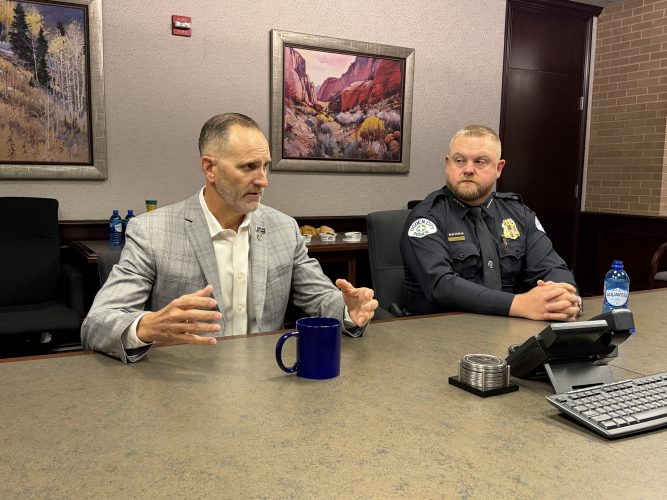
Ogden Mayor Ben Nadolski and Ogden Chief of Police Jake Sube speak with the Standard-Examiner editorial board on Thursday, Sept. 10, 2026.Editor’s note: This is the third of three stories following a Standard-Examiner editorial board interview with Ogden Mayor Ben Nadolski and Ogden Police Chief Jake Sube. Discussion topics included Immigration and Customs Enforcement and Automatic License Plate Recognition, or ALPR, technology.
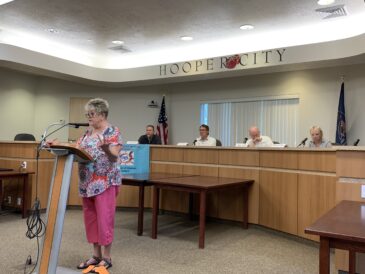
OGDEN – A theme of the public comments at the Sept. 1 Ogden City Council meeting was a desire for a written policy regarding the Ogden Police Department’s involvement in situations related to Immigration and Customs Enforcement.
The meeting came in the aftermath of a situation in August that involved an ICE agent, an Ogden police officer and a person who was subsequently taken into custody by the ICE agent.
According to Ogden Mayor Ben Nadolski, being pushed for a policy is not new.
“That’s something that we had already been looking into and already considering, just like every other department right now is,” Nadolski told the Standard-Examiner. “But those sort of things happen on their own trajectory and their own timeline. They evolve as needed. We put those things in place based on need, and we don’t jump to conclusions and put something in place that’s not going to work for us.”
Nadolski said his role in the process is to make sure he’s representing the people who elected him. He said it’s a “day-to-day management leadership duty” working with the police chief on what a policy may look like.
“But what a mayor will quickly find out, or any elected official will quickly find, is these are very complicated topics,” Nadolski said. “The law is not simple, and we hire professionals for a reason. These are public safety professionals, of which I’m not. That’s where I’m counting on the chief to bring his expertise to bear and to create and to evaluate options that reflect the need of the people that I have been elected to represent, and that’s how we make it work.”
Ogden Police Chief Jake Sube called that a “very fair” characterization of how they work together.
“And it is difficult because … people expect a policy to policy every aspect of every scenario that we’ll ever come across, and that’s just not reality,” Sube said. “We have a policy manual that covers a lot of topics across law enforcement, but there’s always times that we … go, ‘Wow, that’s not.’ ‘That’s not.’ ‘This isn’t.’ ‘That isn’t.'”
Sube used the word “complicated” to describe the exercise of considering a policy – if it’s needed and what it might look like.
“It isn’t just state law,” Sube said. “It’s federal law. There’s case law. There’s a lot of different elements in there that we have to know and understand. So, of course, we’re working with our city attorney’s office. We’re talking to prosecutors. … We’re talking to a myriad of people to try to get to a real understanding of what is appropriate direction for our officers and what format that is best provided in.
“Right now, we’ve been very verbally focused on providing them the guidance they need based on what our state laws require us to do and our role in that and what federal law and our role in federal law. So now it’s like, do you codify that in some fashion? Well, that’s what we’re trying to determine now. What is best practice?
“But I can tell you right now. We will never get every element of every scenario into a policy. It is just not possible.”
Sube acknowledged that a policy would provide guidelines so “officers understand their role and responsibility in various types of situations” but said he has to be founded in what the law tells him.
“I can’t just arbitrarily make decisions,” he said. “That’s not my choice. They don’t put me in here to become the judge, jury and executioner in every scenario. My job is to come into this scenario, look at it and go, ‘OK, what is the law telling me that I have to do? Where does the law give me leeway? Where does the law give our officers leeway? Where does it not give us leeway? Where does federal law cross state law? And are there times that federal law appears to conflict with state law and vice versa, so how do we navigate that? So I use experts when it comes to the law in that sense to get that down.”
Sube said that if he responded just because the issue has become a hot-button topic and just threw a policy out there, he would get it wrong and he doesn’t want to get it wrong.
“It’s too important to get wrong,” he said.
Speaking of the situations that the Ogden Police Department has encountered involving ICE, Sube said they’re all very unique and there’s “no way” he could put a line in them. He emphasized that public safety is the role.
“So, I want to be fast; I want to be quick to those things,” he said. “But I also want to be realistic that the time that it takes and the necessary research, and again, not just looking at code, but talking to other agencies. What are other agencies seeing? Do they have policies? Do they not? If they have a guideline, what are they saying? How is that working for them? I think that’s all a big part of this conversation. I’m not going to pretend because I’m the chief that I know the answers to everything. I don’t. I utilize the resources that are available to me – not only other chiefs, other leaders in the community, other legislative leaders, but also just within my own department, experts in various fields from our training bureau, use of force bureau.”
Nadolski emphasized context, saying that there are over 50,000 calls for service per year and that there have been fewer than a half dozen situations involving the Ogden Police Department and ICE.
“That’s a small sample size for us to start developing and codifying policies and directives on,” he said. “And so if we jump to a conclusion and put a policy in place based on very limited understanding, that’s not leadership. That’s an emotional decision. It’s a political decision, not a leadership decision. And I’m not going to lead in a way that is reactive. We have to be very smart and deliberate when we make these kind of calls. And so a policy will come, potentially, in the future. In terms of assigning a timeline, I don’t have one because it comes when it’s ready, if it’s needed. That’s just a day-to-day decision.”
Sube said his officers “are doing fantastic things,” “hard things” and that “they’re doing them the right way,” but as the chief, he needs to make sure they have confidence to operate without concerns about their decisions.
“What I can say is, even if there is a little bit of that concern in them, they’re still responding the way we would expect them to respond,” he said. “I have not looked at any of these situations and felt, ‘Oh, if we wrote a policy, there would be a policy violation somewhere in here.’ I think our officers have done the right thing. I think our policy, if we ended up with a policy or a written directive or something, whatever that becomes, I believe all of these would fall within justifiable means within that guidance, and they’ve fallen within our guidance now and what we’ve explained and asked our officers to do.”
Sube pointed out that officers are making decisions in the moment.
“Somebody’s walking up to them or pulling up to them or asking them to do something, and they’re making those decisions right now,” he said. “We all get to sit in rooms and look at every second frame by frame and tell us, ‘Ooh, did you hear how he said that?’ ‘Ooh, did you hear the tone in his voice?’ ‘Oh, did you see how he walked over there?’ … All that happened in a matter of 30 seconds, but we got three days, three weeks, three months to scrutinize it, and that’s just not fair.
“So, as the chief, I want my officers to have a good understanding and be confident to do what they can do and know the role and the purpose of why they’re doing it, and that’s public safety.”
Sube said the human element of this issue isn’t lost on him.
“Because we have to follow law does not mean we’re in conflict with the human side of this topic,” he said. “We’re not immune to that. We get that. But we still have to provide that resource in that environment through the law, through public safety, and we’re committed to that, and we’ve been committed to that, and I don’t think we’ve done anything counter to that since the first situation like this.”
Sube acknowledged that over the last several weeks, the topic of a policy has been “a huge occupying portion” of what is being discussed to figure out what the community and law enforcement need.
“It’s not like we’ve just put it on the back burner and we’re like, ‘OK, we’re not doing anything,'” he said. “But I think there’s a group that feel if we don’t have a policy out tomorrow, then we’ve just thought this isn’t an issue, and that’s not the case. And I want to convey that this is important, we understand the elements of this situation, we understand the human side of this situation, and we want to try to get it as close to right as we possibly can.”
In light of the challenges of crafting a policy given all the various circumstances that could occur, Nadolski said officer discretion is important.
“Officer discretion in that moment is there for a reason,” he said. “That’s why it’s allowed and relied on in this industry, because no set of policies could ever dictate how an officer is to respond in every single circumstance, and that’s why it’s so important that we hire the best of the best, and that’s why we have the best of the best, so that their leadership in that moment can get us through those situations.”
Sube said he does not want people in the community to “fear in any way” that they cannot call the police, report when they’re a victim of a crime or report when they see a crime occur.
“So, whatever this final outcome is of policy, directive, whatever that is, that will be a part of this,” he said. “That, I know unequivocally and factually, will be a part of it. … So I just I hope to convey that because we hold community events year round, and I want every member of our community, whether you’re an immigrant, whether you’ve been born and raised here your whole life or you moved here yesterday, I want you to show up to those events, interact with our officers, see who the officers are. They are just people. Believe it or not, they’re all just regular human beings, and when you talk to them and you hear their stories and the life that they were brought up in or about their families, I think it breaks down that barrier.”
Contact Standard-Examiner editor Ryan Comer at rcomer@standard.net.
Local News
Policy perspective: Ogden mayor, police chief discuss demand related to ICE activity

Ogden City announces agreement to preserve historic Forest Service Building