
COMER: Choosing who to cheer for in Olympics
-

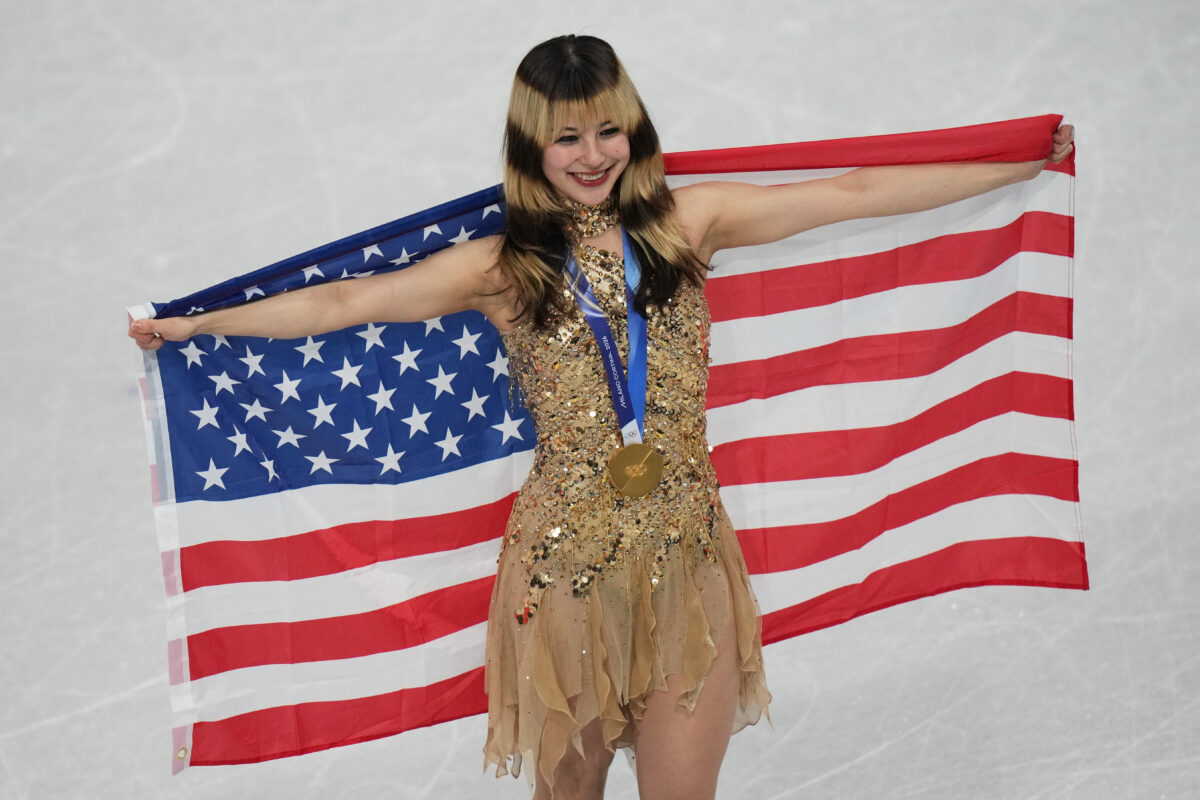
- Gold medalist Alysa Liu of the United States celebrates her medal after competing in the women’s free skate program in figure skating at the 2026 Winter Olympics, in Milan, Italy, on Thursday, Feb. 19, 2026.
-

- Ryan Comer
Francisco Seco, Associated Press
Gold medalist Alysa Liu of the United States celebrates her medal after competing in the women's free skate program in figure skating at the 2026 Winter Olympics, in Milan, Italy, on Thursday, Feb. 19, 2026.
I’ve always been partial to figure skating in the Winter Olympics. It’s probably the only Winter Olympics sport (well, aside from hockey) that I really care about knowing who won.
A lot of that has to do with my mom. She watched figure skating when I was a kid and I ended up watching with her sometimes. I think she’s still probably upset that Michelle Kwan didn’t win Olympic Gold, especially in 1998.
When I saw that Alysa Liu had won the gold medal last week, I immediately wanted to see her performance.
I thought there was no doubt that she earned her victory. I was mesmerized by not just the technical ability that she displayed but the performance quality. This wasn’t just a performance that involved skating around and landing triples; it seemed designed to truly entertain. I wasn’t impressed as much by what she was able to do, though what she was able to do was pretty impressive, as much as I was by the style in which she did it.
When she flipped her ponytail after the performance as the crowd cheered, it was obvious she knew what everyone else who watched it knew, that she had aced it.

Ryan Comer, Standard-Examiner
Ryan Comer
The commentator noted afterward that it was like Liu was “just playing on the ice, not even performing anymore.”
I could have done without her jubilantly screaming the “F” word into the camera as she was skating off the ice, but it was nice that it was silenced out and the commentator followed up by saying “Language, Alysa.” Frankly, I blame Tom Brady for normalizing that in sports more than anyone, but that’s a topic for another day.
Besides being partial to figure skating, what makes an Olympic athlete someone that I think is worthy of cheering for?
This has been a question throughout the Olympics as certain athletes have chosen to compete for certain countries and certain athletes have chosen to talk about the United States in a certain (not exactly positive) way.
For me, my support of an individual in the Olympics basically boils down to two criteria:
- Does the person represent the United States?
- Is the person unifying or divisive?
My logic for these two criteria is pretty simple.
First, I’m an American, and so I’m going to cheer for Americans and those who represent the United States. Just like because I’m from the Seattle area, I’m a Seattle sports fan, because I’m an American, I’m a supporter of athletes who represent the United States. It’s pretty straightforward.
Second, the Olympics are supposed to be nationally unifying. At least, in my mind they should be. So if someone is divisive, I think that person violates a core aim of what the Olympics should be about. I won’t cheer for someone simply because they are from the United States if I find them to be divisive and not the best representation of the United States.
By the way, that logic also applies to my Seahawks fandom. I don’t celebrate every Seahawks player simply because they wear the Seahawks jersey. If I find them to be a knucklehead who doesn’t represent the team or the city well because of their personal conduct, I tolerate them as part of the team, but I don’t celebrate or cheer them.
So how do I decide if a person represents the United States well? How do I decide if they are unifying or divisive? I just listen to what they say and watch what they do. If someone speaks negatively about the way things are in the United States while at the Olympics, I’m probably not going to think that person is very unifying and the best representation of the United States.
Some would argue that it shouldn’t matter if someone speaks negatively about what is happening in the United States. If that’s how they feel, they should say it, and it shouldn’t matter if they do so at the Olympics.
First of all, I wonder if anyone who thinks that would also think that if there was an athlete who was saying things at the Olympics that they didn’t like or agree with. It’s very easy to support someone whose ideology matches your own.
Second, I get to choose who I cheer for and support. That’s my personal right. I’m not obligated or forced to cheer for anyone. If I don’t like how someone behaves or talks, I don’t have to cheer for them.
If an athlete doesn’t care that I, or perhaps a very large number of people, don’t want to celebrate or cheer for him or her because of how he or she talks or behaves, that’s their right as well. They don’t have to care that I care about what they say or do.
If they think that it’s that important to air their grievances about the way things are in the United States that they alienate a very large number of people, that’s their prerogative, I guess.
But I will note, I don’t cheer for failure. And when I see someone falter, I’m saddened. Like when I saw Amber Glenn (a figure skater who had been critical of how things have been in the United States) fail to land a jump cleanly during her free skate program. I wasn’t celebrating all the numerous triples she successfully landed, but when I saw her put her hand on the ice to prevent a fall and I saw the visible disappointment on her face, both immediately after and right when the program ended, I felt sad for her. I wished that hadn’t happened because I could see how much the moment meant to her and how close she was to having the performance she really desired.
She still got very good scores and seemed very happy with them, and as she celebrated, I felt happiness for her.
Ultimately, I just want to watch the Olympics and feel national unity. I want to watch great American athletes and enjoy their talents.
Is something so simple really too much to ask for?
Contact Ryan Comer at rcomer@standard.net.