
Taser touts ‘less lethal’ product, still warns of medical risk
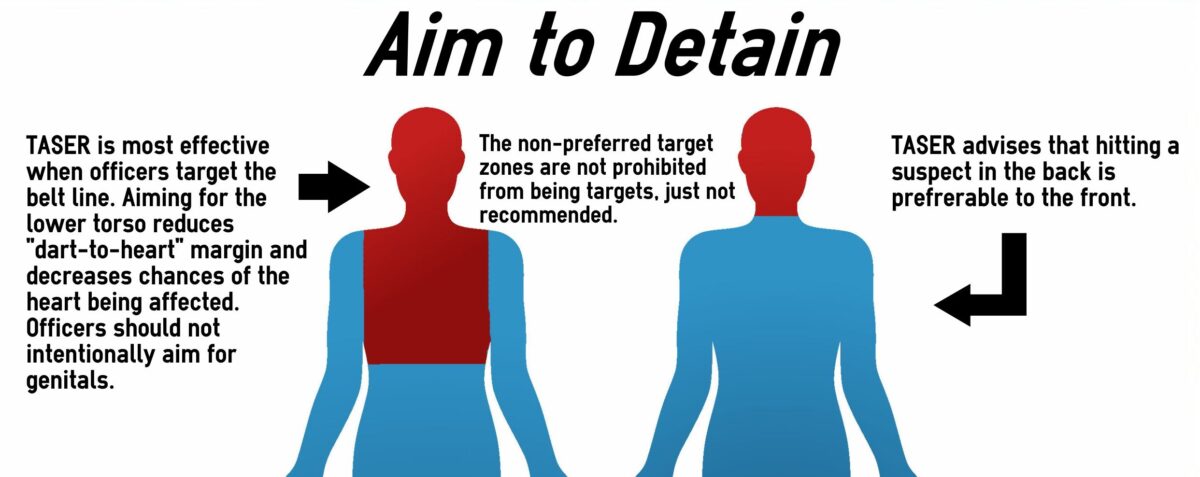
TASER International recommends users aim for the back, below the neck and avoid hitting areas like the head, heart or groin area.


Shane Gormley in McKay-Dee Hospital following an altercation with the Utah Highway Patrol. Gormley went into cardiac arrest shortly after being Tasered six times.
The cause of Shane Gormley’s death hasn’t been publicly confirmed but it’s clear complications began July 6 after he was tased six times by Utah Highway Patrol officers after he tried carjacking a woman in Ogden.
The popularity of Tasers and other conducted energy weapons (CEWs) have skyrocketed in U.S. police departments from just 7 percent of law enforcement agencies possessing them in 2000 to 80 percent in 2013, according to a study by the U.S. Department of Justice.
EDITOR’S NOTE: This is the third in a four-part series examining use of Tasers, law enforcement policy and the difficult situations police encounter when dealing with non-compliant, potentially dangerous subjects. The reporting centers around Shane Gormley, a 30-year-old Ogden man who died after Utah Highway Patrol Troopers tased him repeatedly as he tried to carjack a woman. Gormley suffered a severe medical issue after getting tased and died days later in an area hospital. Read Part I and Part II.
The most popular model in police stations is the TASER X-26 — the same kind used to subdue Gormley. The handgun-shaped device fires prongs that penetrate clothes and skin in order to deliver a 5-second electric current, which causes the muscles to contract in effort to gain control over combatant or non-compliant subjects.
(Story continues below graphic)

The electrical current from a Taser is 2.1 milliAmps. The lethal amount of current for a human being is 100 milliAmps, according to a study by Ohio State University.
TASER International classifies its device is a “less-lethal” law enforcement tool, but still warns there is risk of injury or death with misuse of the product. It advises law enforcement to avoid aiming for a suspect’s chest or head. The weapons maker also advises officers to provide medical care as needed after someone is shocked.
Policies from one department to the next vary when it comes to Taser usage and training. Some media and advocacy groups have documented Taser-related deaths in recent years, but there is no national database. Without that, it’s difficult to determine if policies regarding usage are flawed or if there is a need for standards on state or national levels.
It is the Utah Highway Patrol’s official policy that anyone shocked with a Taser be assessed by medical personnel prior to booking. Additionally, some victims should, “as soon as practicable,” be assessed by medical personnel — including, anyone suspected to be under the influence of drugs or alcohol, a person who is pregnant, if the Taser darts were lodged in the face, chest or groin, and anyone who requests medical attention, according to the Utah Department of Public Safety’s policy manual.
The UHP training guide also recommends that a subject should not be exposed to the device for more than 15 continuous seconds, or three 5-second cycles.
“Several law enforcement groups such as the Police Executive Research Forum, and the International Association of Chiefs of Police have set out 15 seconds (multiple applications or continuous) of CEW exposure as a significant safety point,” according to the materials. “Personnel should use an CEW for one standard cycle (5 seconds) and then evaluate the situation to determine if subsequent cycles are necessary. Personnel should consider that exposure to the CEW for longer than 15 seconds (whether due to multiple applications or continuous cycling) may increase the risk of death or serious injury.”
Gormley was only exposed to 5-second cycles but, combined, received 30 seconds of shock.
In Gormley’s case, UHP reports say the 30-year-old was seen by medics after he was handcuffed, but minutes after the initial check a trooper noticed he had stopped breathing.
UHP says Gormley had a stroke, then a heart attack. He died six days after the initial incident.
A medical examiner’s report, which would state an official cause of death, has not been made public and it is unclear if the Weber County Attorney’s Office has yet received the report.
The UHP policy and several studies on Tasers also mention a condition known as “excited delirium” and advises officers to take note if a person exhibits extreme agitation, violent irrational behavior, profuse sweating, extraordinary strength and appears to be impervious to pain, according to the manual. In those cases, there is a high risk of sudden death and the manual says those people need to be examined by medical personnel.
A May report from the Washington Post highlighted controversy about the condition — critics claim it is most often cited as a cause of death when police use of a Taser is involved. They report excited delirium is recognized by the American College of Emergency Physicians and the National Association of Medical Examiners but the American Medical Association and American Psychological Association have not taken a stand on the legitimacy of the condition.
- READ THE FULL STORY: ‘Excited delirium’ cited in dozens of deaths in police custody. Is it real or a cover for brutality?
None of the reports mention excited delirium in Gormley’s case, but do note his apparent lack of pain-response to being tased and, even after the six shocks, it still took three troopers to wrestle him out of the SUV and into handcuffs. His girlfriend said Gormley was in a heightened, agitated state in the days before and the morning of the chase. She also mentioned that he used methamphetamine and may have been on drugs the morning of the chase.
According to a training powerpoint provided to new hires of the Utah Highway Patrol, each use of the Taser — meaning the initial deployment of the prongs and each subsequent shock cycle — must be individually justified. Troopers who used the Taser on Gormley noted each cycle and reported that they saw Gormley as a danger to fellow officers and the woman he was attempting to carjack.
At one point earlier in the chase, one of the troopers reported he drew his gun in concern for his own safety, but holstered it and opted for the Taser instead.
The UHP materials also mention a federal court case, Meyers v. Baltimore, in which a Maryland man died after being tased 10 times. The officer involved in the case was held liable under excessive force.
“It is an excessive and unreasonable use of force for a police officer repeatedly to administer electrical shocks with a CEW (TASER) on an individual who no longer is armed, has been brought to the ground, has been restrained physically by several other officers, and no longer is actively resisting arrest,” the training powerpoint quoted from the case.
The training materials state that the risk of causing cardiac damage are small enough that accurate estimates are difficult.
Contact reporter Andreas Rivera at 801-625-4227 or arivera@standard.net. Follow him on Twitter at @SE_Andreas.