
UDOT cuts the ribbon on the end of 2000 West project in Clinton, West Point
Rob Nielsen, Standard-Examiner
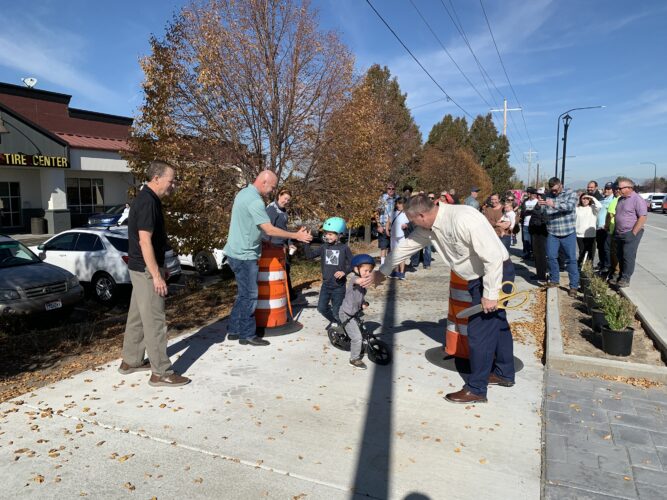
Young bicyclists and roller bladers get high-fives from Clinton Mayor Brandon Stanger (blue shirt) and West Point Mayor Brian Vincent as UDOT celebrated the completion of the 2000 West project in Clinton and West Point with a ribbon cutting on Friday, Oct. 31, 2025.CLINTON — Orange cones have been monuments of sorts along the 2000 West corridor through Clinton and West Point for the last couple of years.
However, these monuments are close to falling.
On Friday, UDOT held a short celebration and ribbon cutting in Clinton to commemorate the inevitable opening all of the lanes on 2000 West (SR-108) which was widened from two lanes to five lanes (including center turn lane) with a multi-use path along the corridor from 300 North in West Point to 1800 North in Clinton in northern Davis County. Infrastructure upgrades to water and sewer were also made during the construction process.
Mitch Shaw, senior communications manager with UDOT, told the Standard-Examiner there were no major snags along the way.
“We finished on budget and on schedule,” he said.
While the celebration was held on Friday, he and other UDOT officials noted that it will still be another one to two weeks before all of the cones are removed to allow for striping at points along the route. Other finishing touches such as landscaping, wiring and lighting will be completed in the coming months but aren’t anticipated to have an impact on traffic.
Shaw said the expanded corridor is important at a time northern Davis County is seeing rapid growth.
“This area in particular is seeing a tremendous amount of growth,” he said. “This is part of our duty to keep up with that growth.”
During a short ceremony ahead of the ribbon cutting — a ceremony that included a ribbon strung between two construction cones on the multi-use path — UDOT Region 1 Director Rob Wight said the project went smoothly because it was a collaborative effort.
“It wouldn’t have been as good of a project had we not gotten input from the mayors here and also you citizens and the city councils,” he said. ‘We recognize that we are in your city and this is your front door as it were, so our goal is always to work with the cities to make sure things get done the way you’d like to see it.”
He said that projects like 2000 West might not make the history pages, butt hey are still extremely important.
“One of the things that got me into engineering was big, cool projects like the Golden Gate Bridge or the Hoover Dam,” he said. “This isn’t the Hoover Dam and it’s not the Golden Gate Bridge, but it means a lot to you in your community. For those of you who have sat in traffic on these roads when they were one lane before construction, this is going to make a big difference.”
Clinton Mayor Brandon Stanger said there’s little doubt a lot of work went into the project.
“I always love that everybody complains about how long it takes, but they don’t realize how much of a job it is to do this big of a project with every single little connection for water, for sewer, for electrical and we’re even going to have water in our planter boxes and all of these other things that go into it,” he said. “They’ve just done such an amazing job.”
He noted that there are some very Clinton touches along the route through the city.
“Every other light pole you’ll see is going to be our city pole,” he said. “That’s where we’re going to hang banners to highlight different seasons. I’d like to see us be able to put our veterans up there, sometimes even our active duty just to highlight them and say we’re thankful for all that they do for us in Clinton.”
West Point Mayor Brian Vincent pointed out to the UDOT and construction officials gathered that road construction is hardly a new thing to deal with, but the goal remains the same.
“Roads have been built for 4,500 years,” he said. “Your guys’ jobs are probably pretty safe for a while. When the first roads were built, they weren’t dealing with afternoon traffic, they weren’t dealing with the orange cones but they were built for one reason — connecting people. This project right here, that’s what this is doing — it’s connecting our two cities together.”