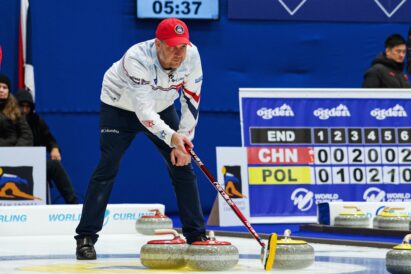
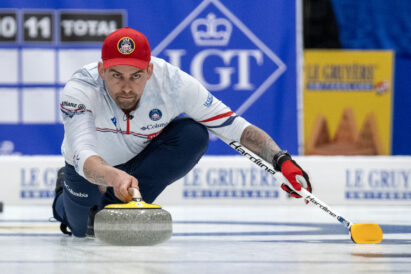
Hundreds of hours go into creating, maintaining championship curling ice
-
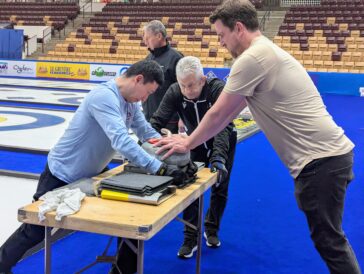
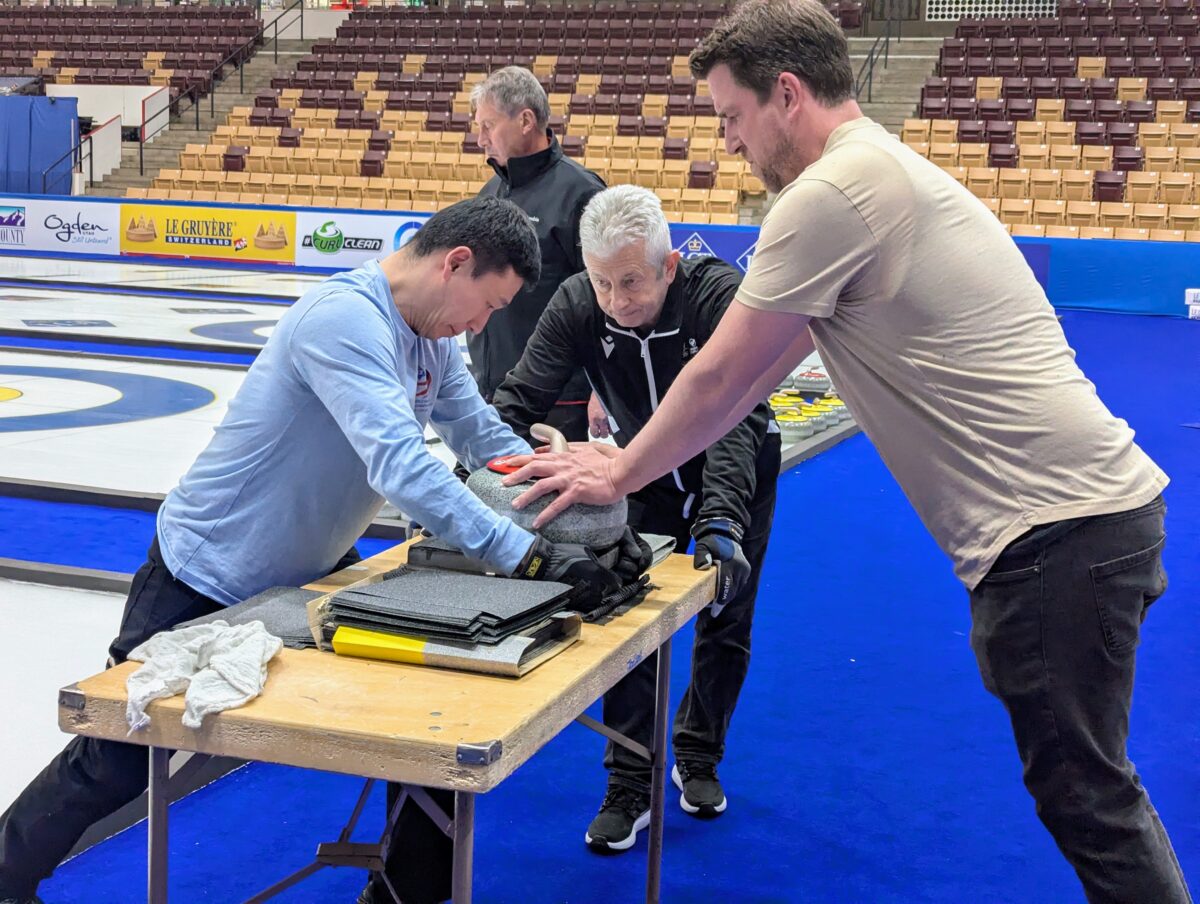
- From the left, Jason Lee, Mark Callan and Cody Hall work to paper one of the curling stones at the 2026 World Men’s Curling Championship in Ogden, Utah, on Tuesday, March 31, 2026.
-
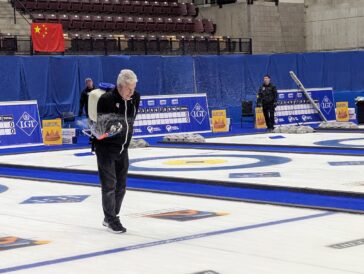
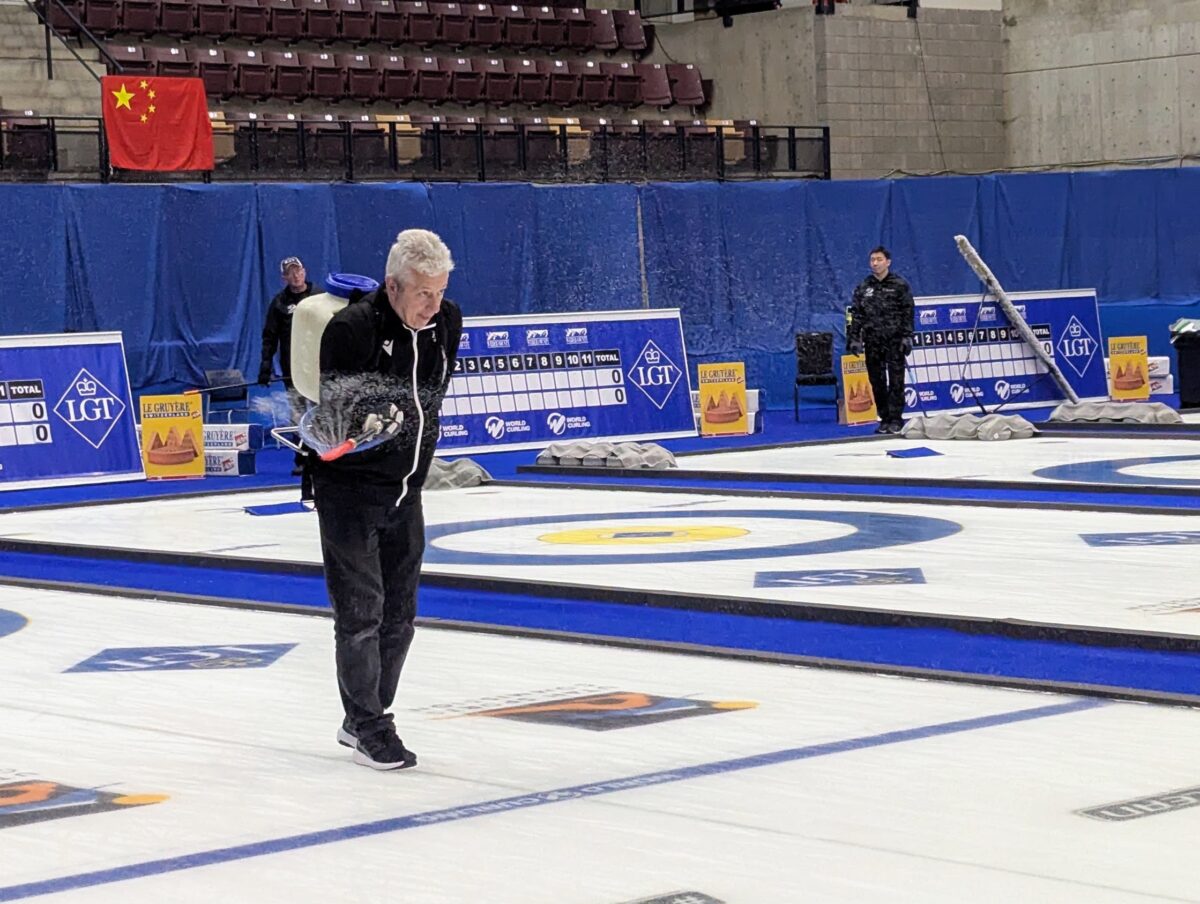
- Chief ice technician Mark Callan pebbles the ice ahead of a draw at the World Men’s Curling Championship in Ogden, Utah, on Thursday, April 3, 2026.
-
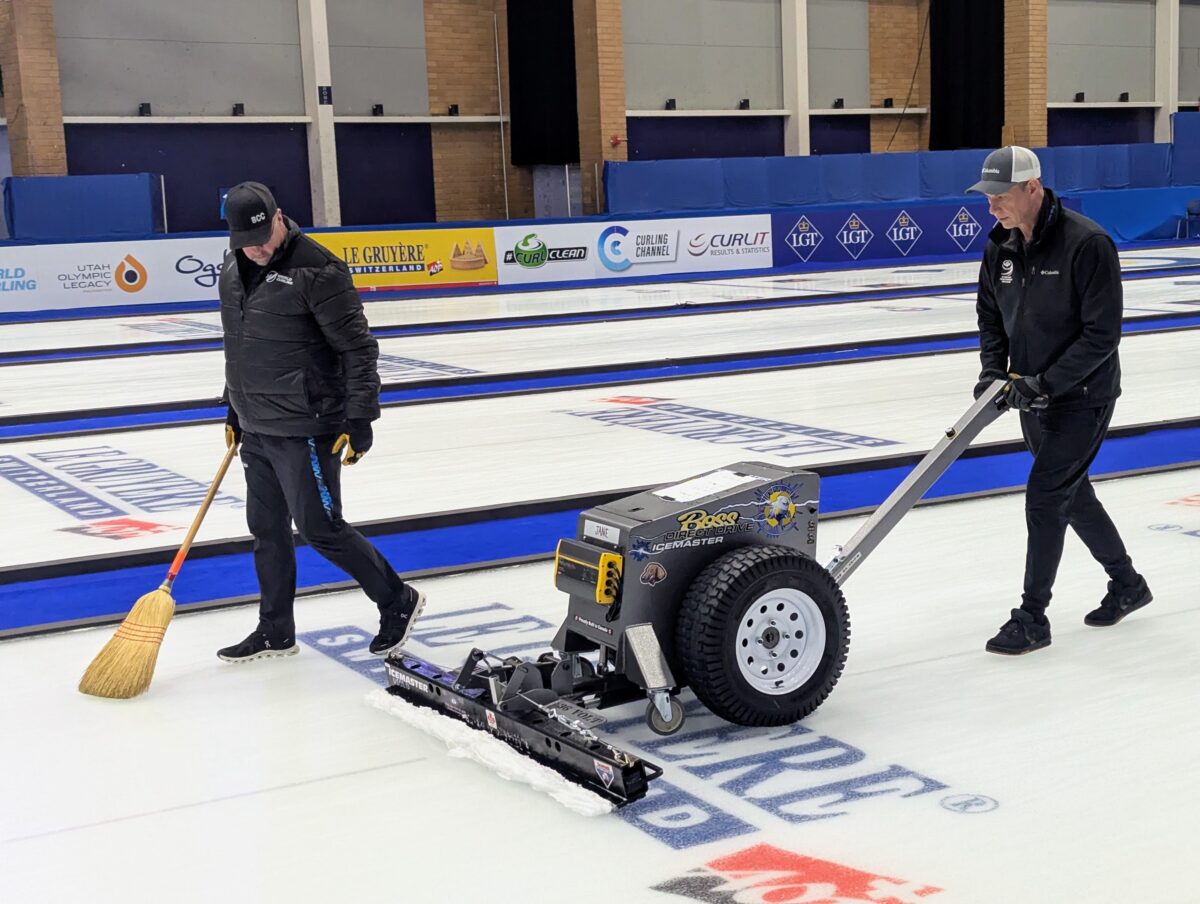
- The ice crew scrapes the ice ahead of a draw at the 2026 World Men’s Curling Championship in Ogden, Utah, on Thursday, April 2, 2026.
Ever since curling was first played on the frozen rivers and lochs of Scotland over 500 years ago, the sport’s essential elements have been rocks and water.
That sounds simple, but it takes a lot of time and effort to create the ice conditions at the World Men’s Curling Championship this week at the Weber County Ice Sheet.
One could not simply throw a curling stone on ice normally prepared for skating and hockey and expect the rock to effortlessly glide over 100 feet and curl 5 feet across the width of the sheet to sit buried on the button around a guard.
In fact, if someone delivered a stone on hockey ice that wasn’t prepared for curling, they shouldn’t expect the stone to go very far.
“If you’re throwing from the net, it might not make the first blue line,” Cody Hall said.
That’s a distance of 64 feet, while the playing area of a curling sheet is 126 feet long.
Hall is the deputy chief ice technician for the world championship. He normally works on the ice for Curling Canada at the Saville Community Sports Centre in Edmonton, Alberta.
As other ice techs and volunteers worked to prepare the ice prior to one of the draws last week, Hall discussed the detailed process of creating championship curling ice.
He said casual fans might see the curling ice — four white stripes surrounded by a sea of blue carpet — and think that event organizers took out the hockey ice or perhaps rolled something on top of the preexisting surface and were ready to go in a few hours.
The curling surface was actually built on top of the hockey ice already in the building.
The change is dramatically different, according to Todd Ferrario, assistant department head for Weber County Culture, Parks and Recreation, which oversees the county’s public-facing venues, including the ice sheet.
“You go from an ice rink with banners for your local clubs to carpet on the ice and TV cameras and production crews, so it’s visually very different and stunning,” Ferrario said.
Lengthy preparation
Getting the ice ready for world-caliber competition started months ago with an initial site visit with facility officials to go over preliminary technical details.
The hard work begins in earnest about a few days before the event, including a technical meeting ahead of everything else. Ferrario said the facility started its work on the ice about 10 minutes after the last learn-to-skate class on March 18 — about six days before the ice needed to be ready for practice.
Ice techs will begin by measuring ice to determine how level it is, Hall said. A Zamboni or other ice surfacing machine is used to cut down high points to make it more level and crews will begin repeatedly flooding the ice with water to level things further.
While that is happening, the facility worked to store the hockey netting and the glass that lined the arena. Dark curtains were also put up to keep sunlight out of the arena area.
Once the ice level is within a desired tolerance, crews will begin painting the entire ice surface white to conceal the hockey markings and then apply the decals and other curling elements you might see embedded in the ice, according to Hall.
Crews constantly apply water to seal all the decals and markings. As the curling sheets take form, crews add the foam bumpers that run along the perimeter of each curling sheet and put down the blue carpet.
Throughout the five-day process, Hall said there were 20 people on hand working about 18 hours a day on the ice. That adds up to about 1,600 hours of labor.
Sometimes, the ice technicians will stay overnight during part of the ice-making process, but Hall said they didn’t need to do that in Ogden.
Ice techs keep track of nearly everything, including how much treated water they’re using. Hall said they put down 5,900 gallons of water for this event.
Creating consistency
All of the work is geared to create conditions where rocks will travel at brisk pace down the ice — around 15 seconds to travel the 72 feet between the hoglines in the middle of the ice while curling about 5 feet from start to finish.
Before every game, crews will scrape the ice to help keep it level and apply fresh pebble — the frozen water droplets that curling stones travel on. They will also do things to help get the ice up to playing speed as quickly as possible, including running a set of stones up and down the ice to break in the pebble before the game.
Maintaining these conditions is the challenge as the tournament gets underway. Ice techs need to be prepared for various elements that could affect ice conditions, Hall said. That could include the number of spectators increasing the air temperature and causing the pebble to melt.
As they account for the number of people in the building, ice techs also keep an eye to the sky. This week’s rain and snowstorms posed a challenge as the increased humidity can lead to more frost, which can slow stones down.
Hall said ice techs often seek to refine conditions to make them as good as possible, but they had been happy with how things went in Ogden.
“It’s like one of the few times where we’ve just gotten to the point going ‘I don’t think we want to change anything,’ which is just a nice pocket to be in,” Hall said.
One thing ice techs did work on the middle of the round robin was papering the stones, where they run every stone briefly on sandpaper to slightly roughen the bottom of the rocks.
Hall explained that they paper the stones so that the rocks will still curl as expected through the gold-medal game.
“Every time a stone is thrown, it gets slightly straighter,” Hall said. “And you just get to the point where we don’t want the finals to be 2 feet of curl. It’s not fun for the players. It’s not fun for TV.”
The papering was done after the last game on Tuesday night, enough time for every team to play at least two games with the updated stones before the conclusion of round robin.
The rocks for this event were last used at a championship in Finland in 2019. Hall explained the rocks are an essential element to a good event.
“You could have the best ice in the world, and if you have terrible rocks, your ice will never look good and vice versa,” Hall said.
A working relationship
Both Hall and Ferrario praised the cooperation between World Curling and the facility staff. Hall said Ferrario has been on hand throughout the event, ready to help.
“Every time we’ve needed something, they’ve either had an answer for us or brought in professionals as fast as possible,” Hall said.
Ferrario said everyone has collaborated extremely well.
“There’s many people in here doing different jobs, and you can either fight to get your piece done in the way of the other one or you can work together,” he said. “The team they’ve put together has been honestly a joy to work with.”
After the final rock
While recreational curlers in Utah would have liked to see this championship ice stick around for a little longer, crews will quickly work to restore the hockey ice immediately after the medal ceremony on Saturday afternoon.
The clean-up process will start before the gold-medal game as Hall noted that stones that weren’t scheduled to be used in that game will be packed up. All of the materials used to prepare the gold-medal ice surface will also be stored after they’re used for the last time.
After the game ends and the medals are awarded, crews will take up the black foam bumpers and blue carpet and pack up everything else, including the sponsor boards and the cables used for the TV broadcast. Temporary stands also need to be removed.
Ferrario said his crew would come in by Sunday afternoon to start cutting the ice back to reveal the hockey markings.
“We will be back to a rink by Tuesday,” Ferrario said.
The curling stones from this championship will go into storage, likely remaining in North America, awaiting their next opportunity to be played on championship ice prepared by ice techs like Hall.
Ryan Olson is lead designer for the Daily Herald and Standard-Examiner. He is also a part-time curling instructor for event organizers, the Utah Olympic Legacy Foundation, but was not involved in the event aside from teaching schoolchildren. Ryan can be reached at rolson@standard.net or on Bluesky at bsky.app/profile/quesoguapo.com.