
World Curling Championship in Ogden: Q&A with a curling expert
Certified curling instructor answers a few questions ahead of the World Curling Championship at the Ice Sheet
-
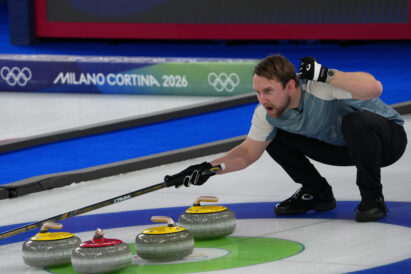
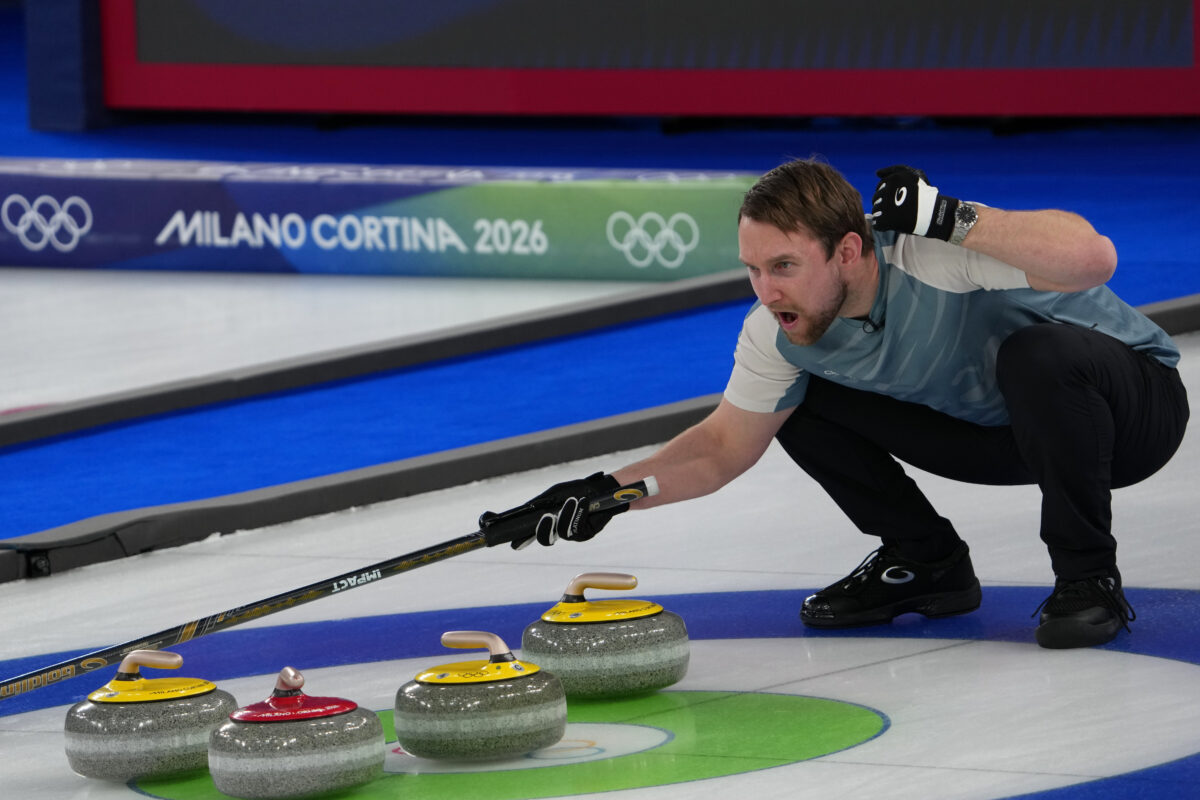
- Norway’s Gaute Nepstad competes during a men’s curling bronze medal match between Norway and Switzerland, at the 2026 Winter Olympics, in Cortina d’Ampezzo, Italy, Friday, Feb. 20, 2026.
-
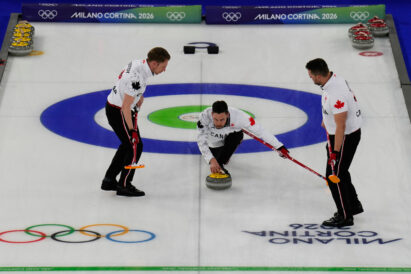
- Canada’s Ben Hebert, Brett Gallant and Marc Kennedy compete during the men’s curling gold medal match against Britain at the 2026 Winter Olympics, in Cortina d’Ampezzo, Italy, Saturday, Feb. 21, 2026.
Misper Apawu, Associated Press
Norway's Gaute Nepstad competes during a men's curling bronze medal match between Norway and Switzerland, at the 2026 Winter Olympics, in Cortina d'Ampezzo, Italy, Friday, Feb. 20, 2026.
The 2026 World Men’s Curling Championship is set to begin Friday afternoon at the Weber County Ice Sheet on the campus of Weber State University, running through Saturday, April 4, concluding with medal-deciding matches.
Curling is a fun sport, but one many might not pay attention to outside of the Olympics. So if you’re wanting to get the most of the experience, a refresher could help. We’ve enlisted our staff curling expert, lead designer Ryan Olson, to answer questions from sports editor Brett Hein and shed light on various curling topics.
Olson has been playing at Oval Curling Club in Kearns for 10 years. He’s a certified curling instructor through USA Curling and does so part-time with the Utah Olympic Legacy Foundation. (While UOLF is the organizer of the World Curling Championship, Olson is not involved in the event other than participating in educational visits to area schools.)
HEIN: So I’m a curling novice. Let’s start with the basics: how many people, and in what roles, comprise a curling team?
OLSON: Surprisingly, there are different varieties of curling that call for two-, three- or four-member teams. The version that we’re going to see this week at men’s worlds is the four-person game, which is the most popular format that you might see at the Olympics (along with mixed doubles).
David J. Phillip, Associated Press
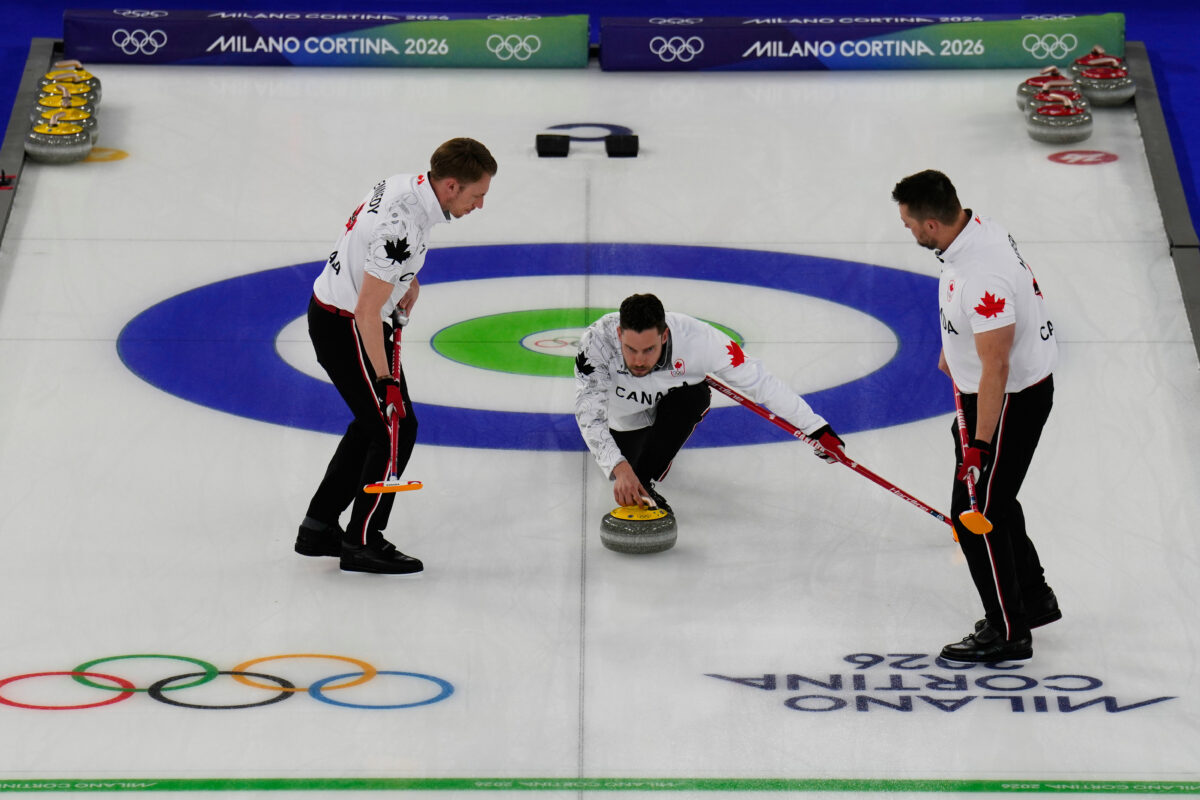
Canada's Ben Hebert, Brett Gallant and Marc Kennedy compete during the men's curling gold medal match against Britain at the 2026 Winter Olympics, in Cortina d'Ampezzo, Italy, Saturday, Feb. 21, 2026.
I view curling as one of the ultimate team sports because everyone plays key roles throughout the game. During a round, or end as we call them, every player will deliver two stones. If you’re not throwing stones, you will likely be sweeping your teammate’s rocks as they glide down the surface.
Each team, or rink, has four positions — lead, second, third/vice and fourth/skip. The lead and second comprise the front end and are key for throwing stones to set up an end — most often guards or draws into the house, or rings. The team’s skip, or captain, and vice skip make up the back end and are usually called upon to throw more complicated shots, including takeouts, and generally call game strategy. It’s important to note that the skip can throw at any position, but it’s most common to see him throw last.
HEIN: I imagine many, like me, stayed up late to watch John Shuster (who represents Team USA at this event in Ogden) and company win Olympic gold in 2018. But if I roll up to the Ice Sheet, I might find myself reaching deep to remember what I’m watching.
So at the basic level, how is the sport scored to decide a winner in a given match?
OLSON: Some joke that curling is “shuffleboard on ice,” but scoring in this sport is far easier than that. In curling, each rock is a potential point regardless of where it might be in the house.
After the last rock, or hammer, is thrown in an end, the vice skips must agree on which team scored. The team whose rock is closest to the button — the center of the house — gets a single point for that first rock. They would also get an additional point for each of their rocks that are closest to the center before reaching the first opponent’s stone. At that point, the scoring stops — only one team can score per end.
At the start of the next end, whichever team scored last throws first (even if no team scored in the just-played end). That means the team that didn’t score has the hammer advantage of throwing the last rock in the next end.
Whichever team has the most points after 10 ends is the winner. If the game is tied, an extra end will be played.
One nice thing about curling is that there isn’t much “garbage time” — a losing team can choose to resign early. That said, World Curling generally requires that a minimum number of ends be played at a championship event.
HEIN: When a stone is sliding, what’s happening when a person is shouting and two others are sweeping the ice? Why the shouting, why the sweeping?
OLSON: Sweeping is one of the most interesting and somewhat arcane elements of the sport — we’ve been doing it for centuries and it has an effect but we haven’t thoroughly studied how it all works. One controversy about 11 years ago was called “Broomgate” and led to the required use of a uniform, orange yellow-colored broom fabric at competitive events.
On a basic level, sweeping helps a curling stone go further and straighter. Elite curlers know how to sweep to make a rock curl more or maybe make it back up a little.
In any case, you can’t make a stone go faster or slower. Dumping debris in front of a rock to slow it down is a foul.
Sweeping is a powerful tool — elite sweepers can get a stone to travel up to about 12 feet — the width of a curling house. What I wouldn’t give for some sweepers on a golf green or at the bowling alley!
As for the yelling — it’s another reason why curling is such a great team sport. The best curling teams rely on clear communication between the sweepers and the skip or the person holding the broom in the house. When players are up to 140 feet away, that usually means there’s some yelling.
When the stone travels down the ice, sweepers are generally responsible for judging the rock’s speed, while the skip is monitoring the rock’s line as it curls across the sheet. The yelling keeps everyone informed.
HEIN: Canada won the men’s Olympic gold in Italy a few months ago. Are they the favorite at the World Championship in Ogden? Are each country’s teams the same as who represented them at the Winter Games, or are they different?
OLSON: Canada is expected to do well at this event, but it will be a different rink than the Team Brad Jacobs that won gold in Cortina. Canada recently held its men’s national championship — the Brier — and Team Matt Dunstone of Manitoba won for the first time. Jacobs finished third.
While this will be Dunstone’s first world men’s appearance, he’s been an elite curler for quite some time — including finishing second at the Brier in 2023 and 2025. He’s currently ranked fourth in the world men’s rankings — the highest in the field this week.
Speaking more broadly, the Olympics have become the dominant event for curling. That means the world championships held immediately after a Winter Games can be a time for nations to exercise some variety in team selection.
Many nations are sending their Olympic teams, including Sweden’s Niklas Edin and China’s Xu Xiaoming. For some nations, their Olympic teams did not participate in national championships — like the United States’ Danny Casper and Scotland’s Bruce Mouat — leading to other teams qualifying, like John Shuster for the USA and Ross Whyte for Scotland. For Switzerland, Olympic team Yannick Schwaller competed in the Swiss championship, but lost to Marco Hösli.
HEIN: What was the kerfuffle about “booping” a stone? Why did I see all those memes about an extended pointer finger?
OLSON: Ah, “Boopgate” — the controversy that launched a thousand global memes. To understand the controversy, one should understand how important sportsmanship is to curling. I like to joke that “Curling is a game of sportsmanship and honor. Like golf, minus the cheating.”
The foundational rule of the sport is the “Spirit of Curling,” calling for “good sportsmanship, kindly feeling and honourable conduct.” Part of that means that “Curlers never knowingly break a rule of the game, nor disrespect any of its traditions.” If a curler learns that they broke a rule, they should be the first to divulge the violation.
As I see it, there were two key elements to the situation where Canadian curler Marc Kennedy touched the stone with his finger as the stone appeared to reach the hog line. First, touching the rock with a body part, broom, shoe or other object at or beyond the hog line is a clear foul called “burning the rock.” Curlers are on their honor to call that foul.
The second element was less clear. Prior to the Games, rules stated the rock “must be delivered using the handle of the stone.” However, the throwing curler can sometimes adjust their hand prior to completing the delivery.
After Kennedy’s delivery was spotlighted, World Curling clarified the handle rule to specify that touching granite during forward motion wasn’t allowed.
Prior to this clarification, one might argue that Kennedy touching the rock with his finger wasn’t prohibited before the hog line.
Was it cheating? It’s highly debatable whether extending a finger on the rock provided any competitive advantage, although I could see some possibilities. At the very least, any contact on the rock at the hog line was a foul and that should’ve been called.
At the same time, some have put the onus on Team Sweden, who publicized the touching. Curlers that break the rules are generally supposed to be given the opportunity to “own up” to their violation and it can be bad form to call people out.
Curling is a weird sport sometimes.
HEIN: This men’s championship brings 13 teams to Ogden, one team per country represented. What is the format of this competition that will determine who can call themselves 2026 world champions?
OLSON: This year’s format is pretty straightforward. The initial phase is a full, round robin of all 13 teams — each team plays 12 games from Friday to April 2.
For the playoffs, the top six teams advance. There are no tiebreaker games. Playoff seeding is based on records, head-to-head and whichever team had their stones closest to the button in a pregame “draw shot challenge” contest conducted throughout the event.
The top two teams earn a bye to the semifinals while the teams ranked three to six face off in qualification quarterfinals held the morning of April 3. The qualification winners advance to the semis while the losers are out.
The semifinals on the evening of April 3 are basically seeding for the medal games. The winners will play for gold in the afternoon of April 4, while the losers will vie for bronze in the morning.
It should be an exciting nine days.