Opinion: Kjar hire bold for Weber State; green staff leaves room for questions
Hein: WSU banking on strong Utah ties to turn things around

-
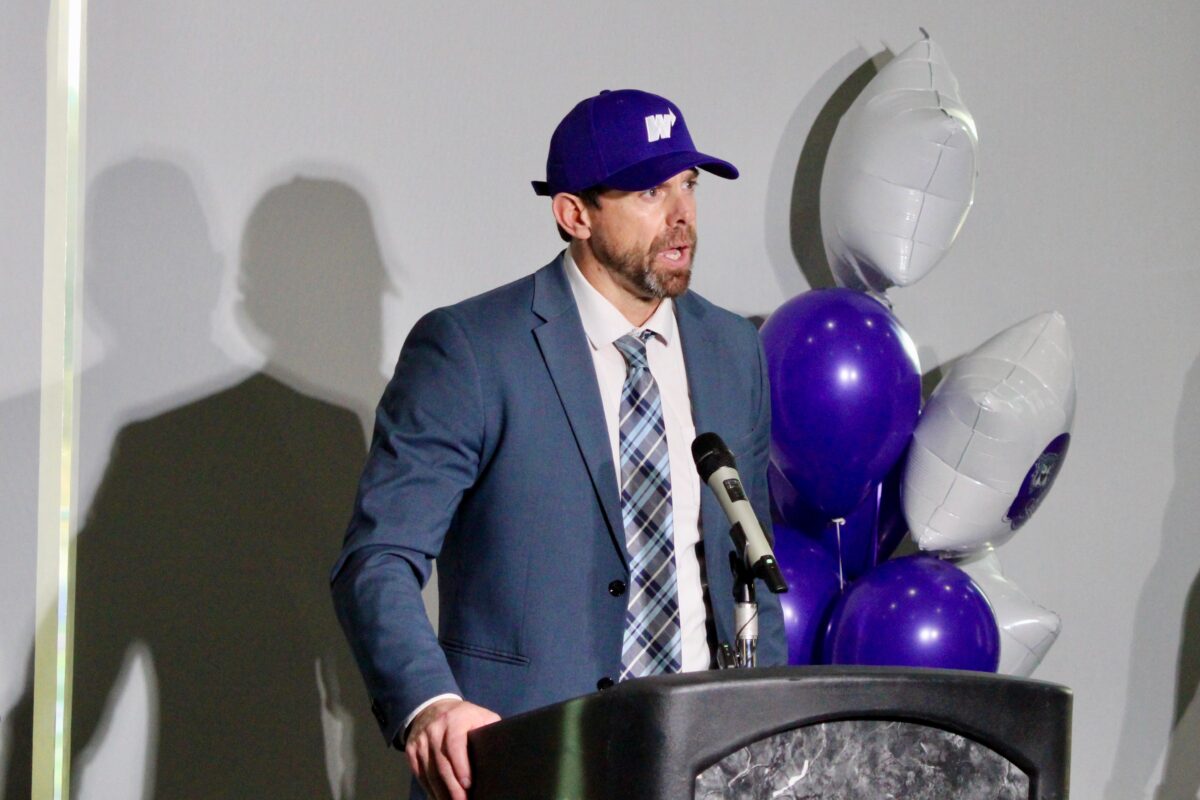
- Newly hired Weber State head football coach Eric Kjar speaks at his introductory press conference on Tuesday, Dec. 16, 2025, at Stewart Stadium in Ogden.
-

- Brett Hein, Sports Editor
It’s been a bit more than two weeks since Weber State announced its hire of Eric Kjar as its next head football coach.
Kjar’s hire was stunning in that rarely does a Division I college program hire a high school head coach directly to a head coach position. The ever-changing pool of potential candidates changes each year as money pours into the power conferences at the upper levels of DI football, meaning even mere position coaches (non-coordinators) make substantially more than most FCS programs can pay head coaches.
For example, Colton Swan’s name has been uttered hundreds of times between Weber State’s openings in 2022 and 2025 despite his salary already being double what WSU can pay, and now he’s on track to be Utah’s defensive coordinator.
Kjar, meanwhile, was one of the most successful high school coaches in the country. So given the needle Weber State needed to thread, it’s not an outlandish hire. Perhaps there were similar candidates with experience in college recruiting but, all things considered, Kjar’s a proven winner at Jordan and Corner Canyon high schools, with a knack for offensive prowess.
WSU’s hiring committee determined that of more than 80 applicants, of whom 16 were interviewed and five were brought to campus, that Kjar was the best fit.
What feels more surprising, to me, is the staff he’s assembling.
One thing was sure: retaining a bulk of the existing staff was not a sustainable approach. Weber State asked Mickey Mental to try that in 2022 and, despite combined experience across the sideline, it didn’t work.
The common thought, though, is that hiring someone with the college inexperience of Kjar would necessitate a couple of strong, experienced top assistants, one of whom would need to be the defensive coordinator. So it was surprising when 12-year WSU assistant head coach and four-decades-experienced offensive line coach Brent Myers was not retained.
Skyler Ridley, a 10-year WSU assistant, moves into the assistant head coach role. That experience remains, and Ridley has long been spoken of as a rising star in coaching circles.
Joe Dale (DC and safeties, eight years at WSU) and Robert Conley (tight ends, six) are both out. James Cowser (defensive ends, five) remains, as does Zach Larson (QBs, five).
Those decisions are not by themselves worrisome. Kjar certainly should be given the charge to build his coaching and bring in his guys. But it’s also surprising that Gavin Fowler, an assistant safeties coach at BYU, is being given charge of Weber State’s defense and not someone with either considerably more experience or considerably more responsibilities on the resume.
Tanner Jacobson may help level that out some; an incoming linebackers coach, he’s been head coach at Tyler Junior College (Texas) for the last four years.
Isaac Asiata is an intriguing addition. The former Utah and NFL lineman taking over WSU’s offensive line could bring plenty of fire and enthusiasm, and he’s been tutored by one of the best in the business, Jim Harding. Utah allowed just 14 sacks in 13 games and the Utes rushed for 266.3 yards per game in 2025, second nationally only to Navy’s option attack.
Asiata also gives WSU a strong connection to Polynesian communities in Utah and elsewhere, something the Wildcats missed in 2025.
Eddie Heckard (cornerbacks) and Isiah Jackson (receivers) are very green, to say the least.
But inexperience isn’t alone disqualifying, and perhaps the way FCS football and its salaries work now has changed faster than detected. Heckard, for instance, was a stellar college football player. There’s no way to say the staff won’t work; it’s possible coaches like Asiata, Fowler, Heckard and others could all be gems just needing their big shot. Some BYU fans on social media seemed very concerned about losing Fowler at the same time they lost Jay Hill.
I can’t tell the future, and don’t claim to know more than someone like Kjar, to say the least. Surprising, yes. Good or bad, only time can tell.
One thing is clear about Kjar’s new staff: he’s all in on the state of Utah.
On the offensive side of the ball, Kjar (Wyoming) and Ridley (California) are the only non-Utah natives. Zach Larson (Orem), Asiata (Spanish Fork) and Jackson (Sandy) hail from Utah.
On defense, Jacobson (Texas) and Heckard (Las Vegas) are the non-Utahns, with Fowler (Kaysville), Cowser (Kaysville) and Jace Campbell (Pleasant View) representing the Beehive State.
Kjar played college ball in Nebraska at Wayne State but has been a high school head coach in Utah for 17 years. All three of the other non-Utahns played college ball in Utah: Ridley and Jacobson at BYU, and Heckard at Weber State and BYU.
WSU still needs coaches to lead running backs and defensive tackles. Though not reported yet by me or announced by the university, Kjar’s target for running backs is a California native who played high school ball in Utah and has been on WSU’s staff before.
The numbers do spell it out; Weber State’s roster of Utah natives tallied this way over recent years:
2021: 54
2022: 52
2023: 39
2024: 34
2025: 32
Weber State’s new guard quickly offered several Utah preps in the 2025 that should have never gone without an offer for that long.
Mere days after Mental was fired, Larson and company offered Nate Dahle of Ridgeline High. He’s Utah’s No. 2 all-time passing quarterback, behind only Austin Kafentzis (Kjar’s last QB at Jordan High). Dahle signed to WSU in the early period one month ago.
With Kjar in the head seat, WSU offered Weber High’s Dyson Parker (who verbally committed); Parker totaled 2,746 rushing yards and 24 touchdowns on 6.13 yards per carry and 124.8 yards per game in his last two seasons, adding 916 receiving yards and seven touchdowns through the air.
Kjar also offered Herriman safety Troy Ellermeier, a 6A All-State First Team selection by The Deseret News; over the last two seasons, the 6-foot-1 Ellermeier totaled 147 tackles and 10 interceptions, with three returned for touchdowns.
Corner Canyon’s Weston Briggs, a First Team All-State running back, also got a WSU offer; in his last two high school seasons, the 6-foot-2 bruiser totaled 2,443 rushing yards and 26 touchdowns on 7.52 yards per carry and 106.2 yards per game.
Kjar has also offered a handful more of his former Corner Canyon players. Too many more? We’ll see, but going 4-8 with fewer Utah kids than ever certainly can’t be better than going 4-8 with Utah kids. (I’m making a point there; obviously, WSU wants to get back to winning records and playoff berths more often than not.)
To be sure, Weber State will still need a recruiting presence in Texas and, especially, in California; even Hill’s best teams had that (see: Rashid Shaheed, Taron Johnson). But losing a grip on the state of Utah has been worrisome and perhaps WSU is losing out on the next Winston Reids and Iosua Opetas of the state. A too-wide net is fine if you’re getting those players back.
With the transfer portal officially opening Friday, we’ll see, too, if this combo of coaches can be stronger magnets to FBS transfers.
Weber’s spot in the Big Sky landscape is somewhat unique. Montana and Montana State are the BYU and Utah of their state, and Idaho is in that pairing for its state as well (with Boise State). In Utah’s pecking order, Weber is behind both the power-conference duo and Utah State.
But each year, there are a handful of Utah, BYU and Utah State players who are looking for more playing time, perhaps players that once could not resist the bright lights of that biggest stage, but maybe fit better, at least for 1-2 years, at a place like Weber.
It seems to me that Weber State’s recipe needs to include the ingredient of FBS transfers, especially those native to Utah or from Utah’s FBS schools, and that could go a long way to impact winning if the new coaching staff makes it a priority.