Going 32-0: A perfect historical lineup for Weber State men’s basketball
Viral online basketball games lead to the question: What's Weber State's best historical starting five?
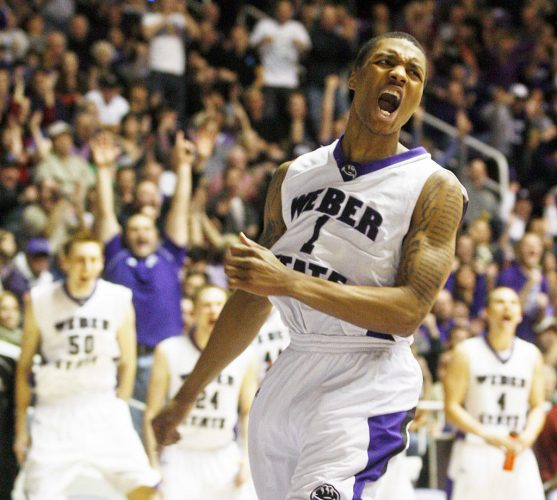
NICHOLAS DRANEY, Standard-Examiner file photo
Weber State guard Damian Lillard reacts after dunking against UT Arlington on Feb. 18, 2012, at the Dee Events Center in Ogden.Move over, “Who’s on your Mount Rushmore?”
When it comes to discussions of how to pick basketball greats, there’s literally a new game in town. Two games, in fact.
This summer has brought the perfect combination of “remember some guys” and historical sports simulations that have hoops heads addicted to games played online at 82-0.com and 32-0game.com.
The first, using NBA players, inspired the second, which uses college players. The setup is the same: with the press of a spin button, the game randomly assigns you a team (in the NBA game) or a conference (college) in a given era. As the player, you select the best player from the list to help your fictional team try to run the table.
It takes skill, though, because selections require you to fill one of five positions on the court and once you do, that position is spoken for. So if you pick Brook Lopez for your center but later spin the 1960s Celtics, you can’t pick Bill Russell for your team. The game allows you to slot some players in multiple positions, while others are one-position players.
I’ve spent considerable downtime on these games, especially since the college version emerged.
In 82-0, the quest is simple: build a roster that the game simulates would go 82-0 in an NBA regular season. Lots of online and podcast discussions have centered around players who are the “infinity stones” (referencing Marvel’s “Avengers” series) that can put you over the top.
For example, drawing the 1960s Warriors can get you Wilt Chamberlain and his averages of 41 points and 25 rebounds per game. Or, getting LeBron James (2010s Cavs, 2010s Heat, 2020s Lakers, take your pick) gets you an elite stat stuffer you can put at any position.
I’ve been able to go 82-0 a couple of times. My first team had the best rating, featuring Earl Monroe, Kobe Bryant, Jayson Tatum, Elvin Hayes and Wilt Chamberlain.
It’s an exercise in what-ifs and dreams for a basketball fan. With the right set of spins and selections, you can end up with a starting five of Hall of Famers, or at least a mix of Hall of Famers and other guys averaging 20-plus points per game and, say 10-plus rebounds per outing.
The newer 32-0 game is especially fun for college-focused enthusiasts like me.
My main goal when I started playing the 32-0 version, mostly for fun, was to draw the Big Sky in eras that allowed me to pick either Damian Lillard or Dillon Jones on my team. The benefit, though, is that either one puts you in position to build a winner.
It only took me four or five tries to draw the Big Sky and I had Do-It-All Dillon Jones for my power forward. In what honestly felt unfair to opponents, I also spun mid-2010s SEC, which let me select LSU’s Ben Simmons at small forward. I picked Utah State legend Jaycee Carroll at shooting guard, Arizona State’s Ike Diogu at center and, though the name wasn’t big, Southern Illinois point guard Xavier Johnson at point guard (22.2 ppg, 6.1 assists).
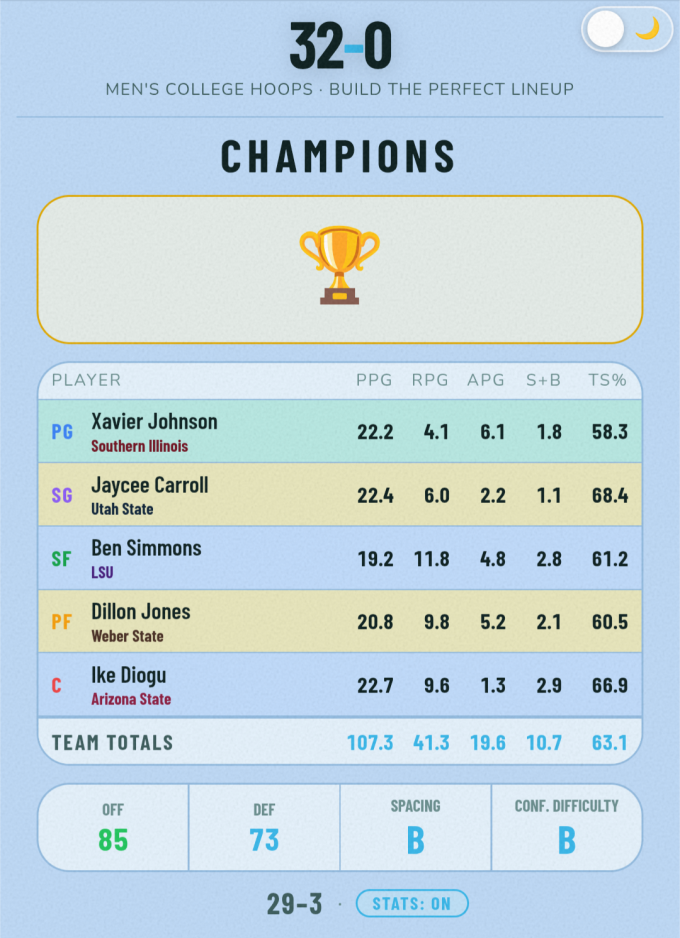
32-0game.com via Brett Hein
A screenshot from 32-0game.com as played by sports editor Brett Hein on June 10, 2026. The game lets users select players for a college basketball starting five in simulated historical games.
I’ve yet to go 32-0 in the regular season, but the college game has a fun addition: it lets you simulate the NCAA Tournament if your team makes the field. My above team went 29-3 and drew a No. 2 seed for the Big Dance. Scores rolled in from my tournament simulation and, while the margins got smaller, late-round victories over Purdue, Creighton and UConn meant my team was crowned national champion.
Of course, being in the Weber State world got me thinking: what would be my 32-0 historical lineup for Wildcat men’s basketball?
The answers came pretty easily. But before I dive in, it’s worth mentioning what is probably the greatest what-if in Weber State basketball history, because I think the Wildcats could have flirted with the dream scenario without cherry-picking an imagined roster of historical greats.
That what-if: Lillard returns for his final year of eligibility for the 2012-13 season, regained by a medical hardship waiver over his broken foot in the 2010-11 season. It’s a fever dream for WSU fans because after his final year, Lillard was always a lottery pick. It took the NBA side a few workouts and the Draft Combine to see it, but it seemed destined.
With Lillard off winning NBA Rookie of the Year, the 2012-13 Wildcats went 24-5 in the regular season and 18-2 in the Big Sky, ultimately winning 30 games. Looking at the schedule, it’s hard to see who Weber State loses to if Lillard was also on that team. WSU finished No. 71 in KenPom without Lillard, a program-best in the 30 years of Pomeroy’s database.
Lillard (24.5 ppg the year before), a returning All-American, would’ve joined Davion Berry (15.2 ppg) and Scott Bamforth (14.0 ppg, Big Sky-best 45.6% from 3) on the starting guard line, with Frank Otis (8.9 ppg, 6.0 rpg, Big Sky-best 63% field-goal shooting) at forward and Kyle Tresnak (11.8 ppg, 5.5 rpg, 1.2 blocks) at center.
Stalwart guard Jordan Richardson moves to a backup guard spot, and freshman Joel Bolomboy (7.0 ppg, 7.1 rpg, 1.7 blocks) still comes off the bench (as do Gelaun Wheelwright and James Hajek).
That’s a 32-0 scenario that wouldn’t have required picking guys out of the WSU record book.
But if you could pick from WSU’s historical roster, here’s what feels like the starting five:
PG: DAMIAN LILLARD (2008-12)
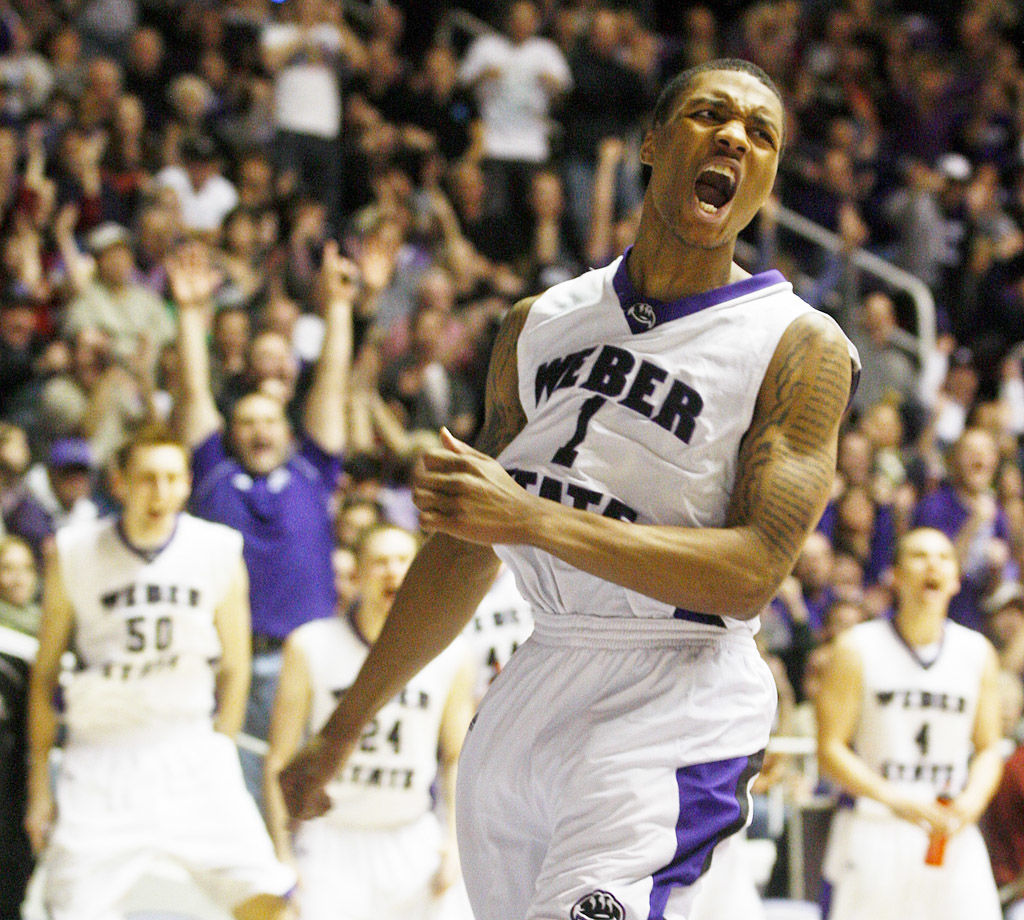
NICHOLAS DRANEY, Standard-Examiner file photo
Weber State guard Damian Lillard reacts after dunking against UT Arlington on Feb. 18, 2012, at the Dee Events Center in Ogden.
Best season, 2011-12: 24.5 ppg, 5.0 rpg, 4.0 apg, 40.9% from 3
WSU career ranks: 4th points, 3rd assists, 3rd 3-pointers, 1st free throws
Among what I felt are the five selections, Lillard is the most obvious of the group. The only All-American in school or Big Sky history, the only lottery pick in school or Big Sky history. He could’ve easily been a 32-points-per-game scorer in his final year if he chose to.
SG: BRUCE COLLINS (1976-80)
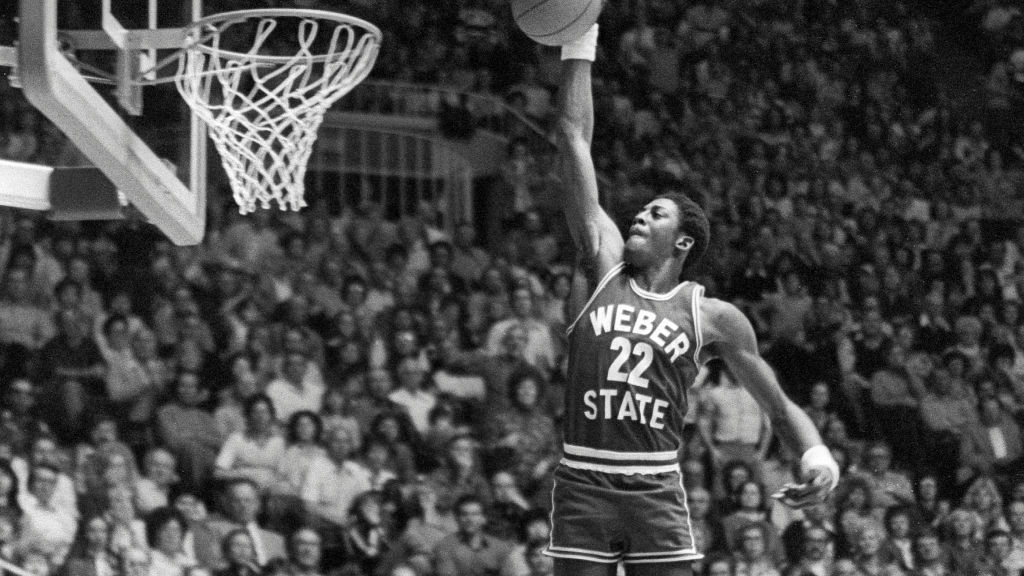
Photo supplied, Weber State Athletics
Weber State player Bruce Collins rises for a dunk in this undated photo at the Dee Events Center in Ogden.
Best season, 1977-78: 18.8 ppg, 8.4 rpg
WSU career ranks: 3rd points, 5th rebounds, 1st field goals
Collins held the title of WSU scoring king for 37 years and No. 2 career rebounder for 36 years as a 6-foot-5 player. And, his teams went 90-30 overall and went to the NCAA Tournament three times.
SF: DILLON JONES (2020-24)

ISAAC FISHER, Special to the Standard-Examiner
Weber State forward Dillon Jones (2) faces up to shoot against BYU’s Gideon George on Thursday, Dec. 22, 2022, in Provo.
Best season, 2023-24: 20.8 ppg, 9.8 rpg, 5.2 apg, 2.o spg
WSU career ranks: 5th points, 3rd rebounds, 1st steals, 2nd assists, 2nd free throws, 5th field goals
If ever a player was made for the 32-0 game, it’s the stat-stuffing Jones and his senior season — attested by his inclusion in my fictional national championship team above. Given his versatility, slotting Jones at the “3” position makes way for two all-time frontcourt greats.
PF: JOEL BOLOMBOY (2012-16)
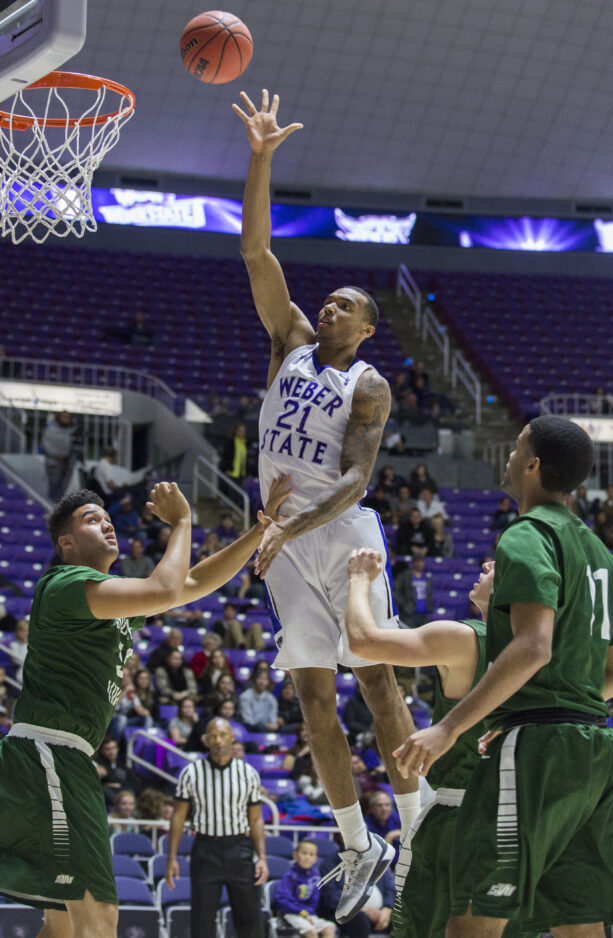
BENJAMIN HAGER, Standard-Examiner file photo
Weber State forward Joel Bolomboy (21) shoots over Southern Virginia defenders on Nov. 7, 2015, at the Dee Events Center in Ogden.
Best season, 2015-16: 17.1 ppg, 12.6 rpg, 1.2 blocks, 57.3% FG
WSU career ranks: 10th points, 1st rebounds, 1st blocks, 5th free throws
At 6-foot-9, Bolomboy was as imposing a forward the Big Sky has seen in the last 20 years. He was top-1o nationally in both offensive and defensive rebounding percentage as a junior, and dunked literally everything he could for four full seasons. A 17-12 average is perfect for the 32-0 game. Because he expanded his game and shot 35 of 96 (36.5%) from the 3-point line in his final two seasons, I put Bolomboy as the “4” forward, assuring the following player room in the lineup.
C: WILLIE SOJOURNER (1968-71)
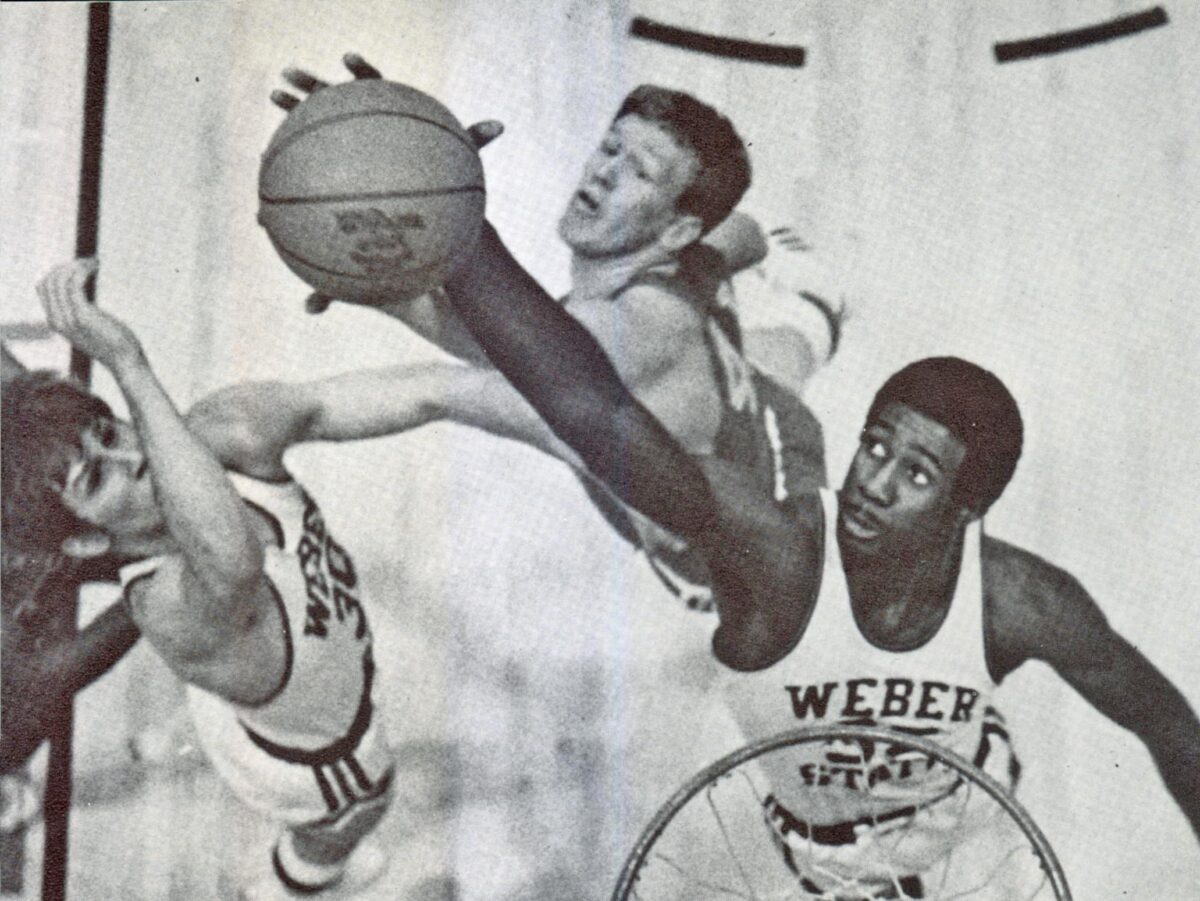
Photo supplied, Weber State
Weber State’s Willie Sojourner, right, hauls in a rebound in an undated photo during a game played in Ogden.
Best season, 1969-70: 21.2 ppg, 15.8 ppg, 52.6% FG
WSU career ranks: 8th points, 2nd rebounds, 6th FG%
Though one inch shorter than Bolomboy, his game translates as a classic current center, and excellently. Bolomboy and Sojourner would be the best rebounding frontcourt in the nation. Few could match Sojourner’s per-game averages, and that’s without even knowing how many blocked shots he recorded.
ON THE BENCH
Because the 82-0/32-0 games require players be assigned to specific positions that matched the positions they played, it makes for some tough calls because Weber State has a handful of other greats that can belong.
In fact, given the premium on elite per-game averages, several guys could contribute to wins just according to how the game works. So, here are eight guys who were tough omissions but could fill out a 13-man roster.
F Harold Arceneaux (1998-2000): A 22.6 points-per-game career average is No. 1 in WSU history and, at 6.7 rebounds per game, may play better in the game’s formula than Collins. But, given the guard-heavy history at WSU, I’d slot Arceneaux in as a small, stretch four for the purposes of this game.
G Jermaine Boyette (2000-03): His 20.5 scoring average as a senior would go a long way to building a 32-o team. He knows a bit about unbeaten runs, leading the Big Sky’s first team to go undefeated in the conference schedule.
C Rico Washington (1987-89): Not only does Washington provide depth in the frontcourt, but his 21.0 career scoring average is second in WSU history.
G Jerrick Harding (2016-20): Scored 22.2 points per game on bad legs as a senior, and may be the best tough-shot maker in WSU history. You have to be to become the program’s career scoring king at 6-foot-1 (as listed, likely more like 5-foot-11).
G Jeremy Senglin (2013-17): WSU’s No. 2 career scorer averaged 21.1 points per game on 44.7% shooting from the 3-point line as a senior. His career 41.9% mark from 3 is only sixth all-time at WSU, but if you saw him play, he’s one of the best tough-, big-shot makers Weber’s ever had.
F Jimmy DeGraffenried (1990-91, 1993-96): DeGraffenried would be a scintillating small-ball four in today’s game (for the purposes of the game, he’d be needed as a forward at 6-foot-6). As a senior, he averaged 21.2 points and 6.6 rebounds per game while shooting 47% from 3. He took 3.9 3-point attempts per game in the early ’90s and would surely shoot more in today’s game.
G Ruben Nembhard (1993-95): There’s a reason he was Big Sky MVP as a senior, with averages of 19.9 points, 5.2 rebounds, 4.2 assists and 2.2 steals per game.
F Jimmie Watts (1972-76): Watts is ninth all-time in career points and fourth in rebounds. The 6-foot-8 forward averaged 19.3 points per game as a senior and 10.9 rebounds per game as a junior.