Weber State basketball: Factors and some names for WSU’s head coach opening

-
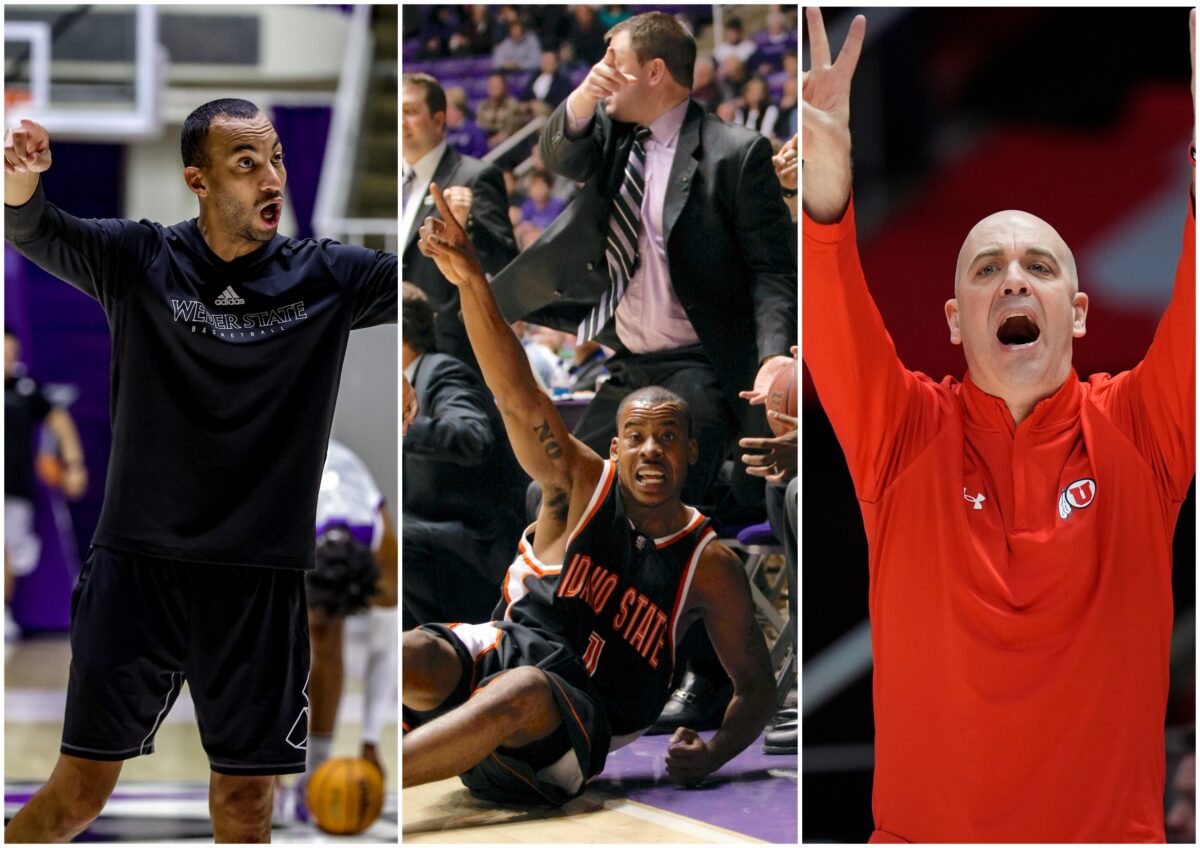
- Left: Former Weber State assistant coach Eric Daniels points during a 2022 practice. Center: Idaho State guard Amorrow Morgan gestures during a 2009 game in Ogden. Right: Former Utah head coach Craig Smith calls a play during a 2024 game in Salt Lake City.
-

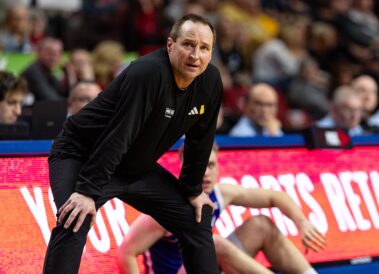
- Weber State head coach Eric Duft, right, gives instruction to players during a timeout against UC Irvine on Friday, Nov. 22, 2024, at the Dee Events Center in Ogden.
Weber State men’s basketball enters a new era with the university’s decision to put its head coach job out to hire for the first time in 20 years.
WSU announced Thursday it was moving four-year head coach Eric Duft into an “executive” role as president of basketball operations and beginning a national search for the 11th head coach in its Division I history. Duft was 66-65 overall and 38-34 in Big Sky regular-season games over four seasons.
Since Duft was promoted immediately following Randy Rahe’s surprise May 2022 retirement, this will be the university’s first men’s basketball coach search since 2006.
The Wildcats can and will want to cast a wide net, but there’s also a chance to headhunt coaches who have either proven or promising experience to take over the program. If it were me, there are a few guys I’d ring to at least see if there’s interest, and hope the search firm is proactive and not just a way to pool candidates on the receiving end.
There’s also a chance general manager Damian Lillard may have his hands on the net through his connections as an NBA player and through his Formula Zero elite camps.
A FEW FACTORS
A common route for a school of Weber State’s stature — WSU has never hired a sitting Division I head coach in football or men’s basketball — is to hire an assistant from a larger school who is either a young up-and-comer, or whose experience says “this guy needs a head coach job” like when they hired Randy Rahe in 2006.
But, like WSU faced in its last football opening, the gap between what a Big Sky school pays a men’s basketball head coach and what even third- or fourth-seat assistant coaches make at Power Four schools has never been larger. It’s a significant hurdle.
What do those salary numbers look like? Duft was paid $182,000 for the 2025-26 season, fairly consistent with pay across the Big Sky Conference. Rahe’s tenure and success earned him $332,000 per year when he retired; $140,000 of that came via yearly bonus, ostensibly pooled by boosters to retain him.
As just one example, a name some might put forward is Jeff Linder, the former head coach at Northern Colorado and Wyoming. He was on the staff that recruited Lillard to Weber State. He’s now at Texas Tech and is listed third on the team’s list of coaches (second assistant); per one report upon his hire, Linder is making $600,000 this season in Lubbock.
So that could steer the search toward someone like a successful Division II head coach, maybe a top assistant in the second tier of Division I below Power Four, or potentially create an out-of-the-box scenario. WSU certainly went there with high school head coach Eric Kjar for its football hire three months ago.
Or, could it cause Lillard and athletic director Tim Crompton to rally together booster support enough to make the job enticing, at least perhaps for a first-time head coach currently assisting at a Power Four school?
Lillard’s presence and active NIL role give Weber State a certain pull other Big Sky schools might not otherwise have. WSU also has the former coach in Duft still around in an administrative role.
So things could go any way.
What follows is not a sourced report of actual candidates, but rather those who might be positioned or interested in taking the job, or others who make sense. In other words: one guy’s shortlist in a vast sea of potential candidates.
HEAD COACH EXPERIENCE
CRAIG SMITH
Smith is said to have been caught up in an NIL predicament at the University of Utah, leaving him with fewer resources than Big 12 peers. After coaching South Dakota to its best-ever DI season in 2017-18, he left for Utah State where he took the Aggies to the NCAA Tournament in three straight seasons (USU won the 2020 MWC tournament but did not get to dance as the NCAAT was canceled).
Results at Utah were mixed, unable to get the Utes to the NCAA Tournament, but he was let go two weeks before the season ended with a 15-12 overall record and 7-9 mark in the Big 12. In Smith’s year away from coaching, Utah went 10-22 overall and 2-16 in the Big 12 with Alex Jensen taking over.
In 11 seasons as a DI head coach, Smith’s record is 218-141 (.607). At the sub-Power Four level, his record is 153-79 (.659). Smith could probably command jobs from schools in larger conferences, but perhaps his experience at Utah and one year away could have him interested in a spot where NIL doesn’t dictate nearly as much, and is in a place he’s lived for eight years. Smith’s son, Brady, was a walk-on at WSU this season.
STEVE SMILEY
Smiley is another former Weber State assistant and if there’s any sitting DI head coach that could even be possible, Smiley is it. He took over for Linder at Northern Colorado and just completed his sixth season there, going 109-83 overall and 62-44 in the Big Sky, with one regular-season title.
After that title in 2025, Smiley received a five-year contract extension through the 2029-30 season that pays him $185,000 per year plus a $30,000 yearly bonus, according to the Greeley Tribune. So he’s solidly in place at NoCo and generally has success each year. He’s been more successful than Duft in the win-loss column but, despite one regular-season title and finishing in the top-four in four of six seasons, has yet to take the Bears dancing.
JEFF LINDER
Alright, let’s detail out Linder, since I’ve already brought up his name — with the salary caveat explained above.
Linder took the Northern Colorado job with the program on probation and got the Bears to No. 75 in Ken Pomeroy’s rankings in 2019-20, the fourth-highest in the Big Sky over the last 30 years. He went there after stops at San Francisco, Weber State and Boise State, and left Greeley to be head coach at Wyoming. He’s 143-109 as a head coach, and left Wyoming to work at Texas Tech.
At this point, his candidacy is probably best described as pie-in-the-sky.
RECENTLY AVAILABLE
There’s always a short list of guys who recently reached the end of their tenures at power schools — say, Bobby Hurley at Arizona State. Would any of them prefer to retreat from the big business world of power college sports and into the world of mid-majors? Or are most of those guys going to land as top assistants at some other big program?
LONGTIME ASSISTANTS
CODY FUEGER
Fueger is commonly in “future head coach” discussions, especially those with Utah ties. In the second of a two-year contract as the third assistant at Kentucky, Fueger makes $525,000 per year. His buyout, according to a document made available by the university, would be about $40,000 if he were to be hired this month. He’s a strong target, if there’s interest.
He has other past experience, but he’s been a Mark Pope acolyte going back to Pope’s time as head coach at Utah Valley, then BYU, and now Kentucky. He started as a video coordinator at Utah, and then was director of operations at Louisiana Tech, UC Riverside, Utah State and BYU.
AMORROW MORGAN
Morgan has yet to be a head coach but has been one of the most sought-after assistant coaches in the country, as shown by his resume. His current salary at Tennessee is not publicly available.
The former Idaho State player (16.6 ppg as a senior in 2009-10) is in his first season on the bench at Tennessee, listed as third assistant to Rick Barnes. That follows his two seasons with Mark Madsen at Cal, two seasons as associate coach at Loyola-Chicago, three seasons (two as associate head coach) at South Alabama, and one season as an assistant at Nicholls State.
Upon hiring Morgan at Loyola-Chicago, head coach Drew Valentine said: “In addition to being an extremely passionate and high-energy individual, who excels both as a recruiter and on-floor coach, Amorrow is elite at building relationships. He is a future head coach and rising star in this profession.”
ERIC DANIELS
Few would have more recruiting ties in Utah than Eric Daniels. The son of former Utah assistant Donny Daniels has coached at every DI school in Utah except BYU and Utah Tech. That includes five years at Weber State (2019-24).
He coached one year (2008) at Southern Utah before five at Division II Regis University (Colorado) and one year in operations for the Orlando Magic. Then he coached four years at Utah Valley under Mark Pope, five years at Weber under Rahe and Duft, one at Utah State with Jerrod Calhoun, and now returned full circle to the University of Utah under Alex Jensen for this season. His complete salary at Utah is not publicly searchable for this season; he made $154,000 in his one season at Utah State.
DAN RUSSELL
Another Weber State guy would be current associate head coach Dan Russell. Many feel he’s ready to be a head coach; he’s not from the larger Stew Morrill/Rahe/Duft circle but has been at WSU for four years under Duft. However, the opportunity for WSU to travel a new path might work against him.
But in a vacuum, Russell would seem to be a good choice. He was on Montana State’s bench for three years before moving to Ogden. Before that, he was an 11-year coach at Casper College in Wyoming, including six as head coach. He began as a grad assistant at Wyoming. His profile is similar to Daniels, with less ties to Utah but more head coach experience.
WASHINGTON, TAKE YOUR PICK
There’s a confluence of Utah-tied assistants in their second year at Washington with Danny Sprinkle that could make sense.
Associate head coach Andy Hill was at Utah for 10 seasons, and worked at New Mexico, before hitching up with Sprinkle at Montana State, then Utah State, then Washington.
DeMarlo Slocum is well-traveled with 11 years at Utah over two stints as his main anchor, with other stops at USC, UNLV, Colorado State, Idaho at Utah Tech (where he played when it was Dixie State).
Tommy Connor was a 14-year assistant at Utah over two stints and was a 12-year head coach at Utah’s Westminster College, building it from scratch after it was reinstated in 1999. He’s a former four-year starter at Utah as a player.
UP-AND-COMERS
TJ BENSON
Benson played for two seasons at Weber State, including with freshman Lillard, finished his career at Grand Canyon, and was an assistant coach at Grand Canyon before a long tenure in operations/coordinator-type roles at Boise State, Gonzaga and now Arizona. In his fifth year at Arizona, this season is his second as a full assistant after returning to the bench.
Is that enough experience? He has more total years but less assistant experience than some on this list, but mentoring under Mark Few and Tommy Lloyd isn’t a bad way to make a resume.
ANDREW MAY
May is in his fourth season as head coach at Snow College, near his native Mount Pleasant, where he’s 100-24 (.806) through this season’s conference tournament. Snow has spent tons of time ranked in the top five of NJCAA Division I in the last two seasons; the selection for this year’s national tournament is Sunday.
He started as a student manager at BYU before being hired as an assistant at Salt Lake Community College for four years. He returned to BYU as director of operations, then worked three seasons as an assistant at Utah Tech before his hire at Snow. May identified several Utah-native players last year who moved on from Snow to solid-to-good roles at Division I mid-majors (Isaac Garrett at Oakland, Isaac Finlinson at Hawaii, Chance Trujillo at Utah Tech).
Depending on WSU’s ultimate head coach hire, either Benson or May could also make a strong option as associate head coach if the head coach ends up on the more experienced side of the continuum.