
Trump’s pick for Navy secretary acknowledges the Iran war is straining military resources
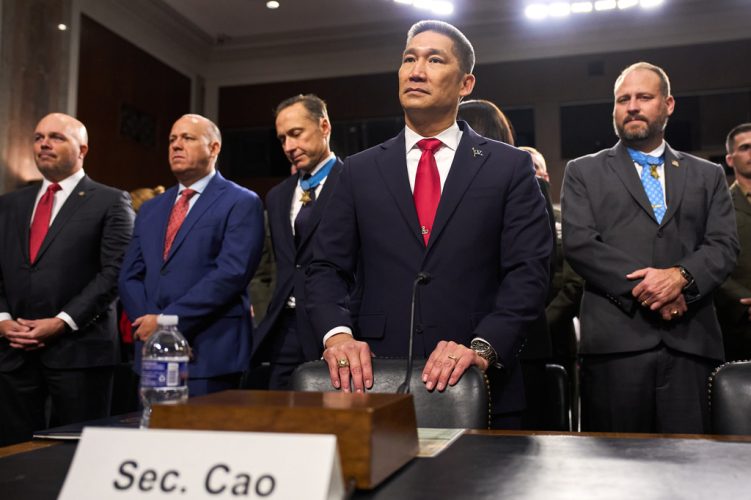
Acting Navy Secretary Hung Cao, center, arrives to testify before the Senate Armed Services Committee on his nomination as Secretary of the Navy, Tuesday, Nov. 17, 2026, on Capitol Hill in Washington. (AP Photo/Jacquelyn Martin)
WASHINGTON (AP) — President Donald Trump’s pick to lead the U.S. Navy acknowledged the strain of the Iran war on the service as senators from both major political parties pressed him in his confirmation hearing Tuesday about the impact of long ship deployments on sailors, drawdowns to stockpiles of advanced weapons and resources being shifted away from countering China.
Acting Navy Secretary Hung Cao, a Trump loyalist and combat veteran, is seeking the permanent top civilian job during a particularly volatile time in Washington. He also faces the extra hurdle of needing a waiver from Congress, because he left active-duty service less than seven years ago.
“This war, again, I know it’s a strain on our Navy,” Cao said, but he insisted that “it’s really set China back on their heels” to see all the services work together.
Lawmakers raised concerns about the lack of an aircraft carrier in the Asia-Pacific as the Trump administration has shifted resources to the Middle East. A third aircraft carrier recently arrived in the region.
In his opening statement, Republican Sen. Roger Wicker of Mississippi, who chairs the Senate Armed Services Committee, which is considering Cao’s nomination, said that “the challenges faced by the Navy are significant but so are the opportunities” but that he supports Cao.
The committee’s ranking Democrat, Sen. Jack Reed of Rhode Island, said he was “concerned, frankly about your leadership record as acting secretary” and expected Cao to speak to Defense Secretary Pete Hegseth’s firing of numerous naval officers “and whether you will defend the military leaders in the future from partisan meddling in their careers.”
The hearing also follows recent firings of Navy officials and a failed impeachment attempt in the House against Hegseth, which was launched in part over his handling of the 8-month-old conflict. And Republicans lost the House and Senate in the midterm elections, which were widely seen as a repudiation of the war and will put Democrats in control of Congress in January.
Cao faces questions over sailors’ mental health
Cao was asked to address concerns that lawmakers have raised over sailors’ mental health, following reports of crew stress and supply shortages on the USS Abraham Lincoln aircraft carrier. The warship endured a record-breaking deployment supporting the Iran war before returning to its homeport of San Diego in October.
Sen. Richard Blumenthal, a Connecticut Democrat, argued that Cao was “failing these sailors and their families, and your confrontation with them leaves me with the clear impression that you simply don’t care.”
Cao pushed back, noting that he doesn’t control the deployment lengths of Navy ships that have crept steadily closer to a full year at sea — up from a standard of six to eight months during the war on terror.
When asked about suicide attempts aboard the ships, Cao told Blumenthal that what he saw “as eight suicide attempts, I see as eight suicide mitigations.”
Democratic lawmakers also say the Navy failed to inform Congress that it fired the entire leadership team of a nuclear-powered attack submarine after an underwater collision. Separately, the sea service fired the commander of a destroyer deployed to the Middle East.
Cao made the case against the Navy’s traditional policy of publicly announcing the removal of commanders and instead argued that he wants “to make sure that we don’t destroy their careers.”
“We relieve commanding officers for everything from negligence to even just fraternization or, you know, harassment,” Cao said, “and I want to make sure that we’re protecting their livelihood afterwards as well.”
Trump nominated Cao for the permanent job in September. Cao has been serving as acting Navy secretary since April after John Phelan’s departure, which came with little public explanation. Before that, Cao was serving as Navy undersecretary.
Cao ran an unsuccessful Republican bid in 2024 to unseat Virginia Democratic Sen. Tim Kaine, who serves on the Senate Armed Services Committee, which is considering his nomination.
Cao fled Vietnam with his family as a child in the 1970s before attending the U.S. Naval Academy. He was commissioned as a special operations officer and went on to serve with SEAL teams and special forces in Iraq, Afghanistan and Somalia, according to his Senate campaign biography.
Cao will need a rare waiver for the permanent post
Cao left active duty in 2021. To take the secretary post, he needs a waiver from a law that prohibits military officers from serving as a service secretary until they have been retired for at least seven years.
A similar law, which has been on the books since the end of World War II, exists for the secretary of defense and is designed to ensure truly civilian control of the military. Congress has only granted exceptions three times for that post — twice in the past decade.
In 1950, lawmakers waived the prohibition for George Marshall, a former five-star Army general. Since then, Congress issued waivers for retired Marine Gen. James Mattis during the first Trump administration and retired Army Gen. Lloyd Austin under President Joe Biden.
In each case, Republican and Democratic lawmakers expressed an aversion to waiving the requirement and setting precedent for future exceptions. They raised concerns about further erosion of the already precarious concept of civilian control of the military.
The Republican Study Committee, an influential bloc of Republican lawmakers, said in 2021 that it opposed Austin’s waiver “based on the lessons learned after the House made the unprecedented move of granting a waiver four years ago” to Mattis.
Reed, the Rhode Island Democrat, supported Austin’s waiver. But Reed called it “a once in a generation exception” in a 2021 statement, which strongly indicated that he would not grant a similar waiver in the future.
Republican Sen. Tom Cotton of Arkansas told reporters during Austin’s confirmation hearing that he regretted voting for Mattis’ waiver and felt the 1950 exception for Marshall was a mistake. Cotton told Defense News in 2021 that “under no foreseeable circumstances can I imagine supporting such a waiver again.”