Church History Museum unveils new exhibits
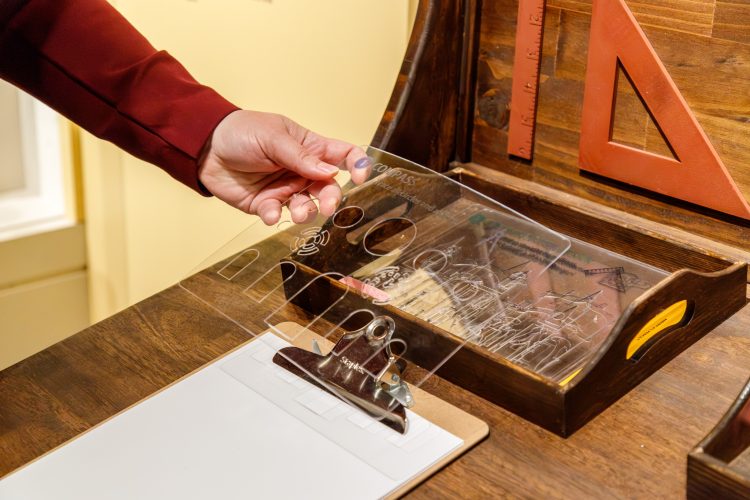
Photo supplied, Intellectual Reserve
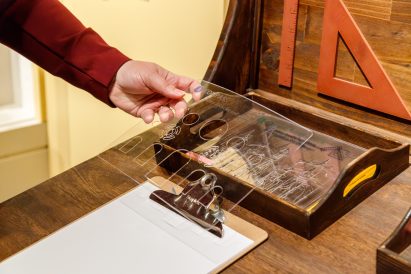
A drafting table and sketches are on display as part of the Truman Angell exhibit in “Fitly Framed Together: Stories of the Salt Lake Temple” at the Church History Museum. Visitors of all ages are invited to use the provided templates to sketch the façade of the Salt Lake Temple, imagining what it was like to sit at Truman Angell’s drafting table.In anticipation of the landmark Salt Lake Temple Celebration in April 2027, the Church History Museum of The Church of Jesus Christ of Latter-day Saints held a news conference and media preview on Wednesday, November 18, 2026, unveiling three major new exhibits: “Fitly Framed Together: Stories of the Salt Lake Temple,” “One by One: Gathered unto Christ,” and “All Nations Shall Flow Unto It.”
Journalists toured the finished galleries and interviewed key curators and Church leadership on-site. Together, the three displays explore the 40-year construction history of the Salt Lake Temple, celebrate the individual faith of Latter-day Saints across 40 countries, and demonstrate how sacred spaces foster a personal connection to Jesus Christ.
Stories of the Unsung Builders: “Fitly Framed Together”
The first new feature, “Fitly Framed Together: Stories of the Salt Lake Temple,” examines six distinct phases of the iconic building’s lifecycle: design, construction, beautification, dedication, use and ongoing renovation. While the exhibit showcases high-profile historic artifacts — such as original drafting plans by Church architect Truman O. Angell and a replica of the angel Moroni statue — its core focus centers on the everyday laborers whose sacrifices made the temple possible.
“What we really wanted was to have people come away from these experiences, understanding that the Salt Lake Temple is more than a beautiful building, more than a historic building,” said Riley Lorimer, director of the Church History Museum. “It’s a living, working building where Latter-day Saints can come after it’s rededicated to make sacred promises to God and strengthen their relationship with Jesus Christ.”
Church Historic Sites Curator Emily Utt explained that the curatorial team intentionally shifted focus away from prominent leaders to tell the stories of common workers.
“For so many years, we tell the stories of the leaders, the well-known, the people who made a big difference,” Utt noted. “I love this exhibit because we are telling the stories of the common people, the everyday people who gave their very best contribution to the kingdom of God.”
Utt highlighted how abstract spiritual visions were translated into physical reality. Brigham Young provided the overarching concept in an 1860s portrait, which Angell spent three decades turning into precise architectural blueprints. Angell, originally a carpenter without formal architectural training, learned on the job and collaborated with skilled draftsmen like William Ward.
Lorimer added that Angell was “not an architect by trade. He was a carpenter who worked on the Kirtland and Nauvoo Temples, but he became the architect for the Salt Lake Temple and had to learn on the job. You can see in this case a number of his original sketches for the Salt Lake Temple. It was his job to make Brigham Young’s vision of what the temple should look like a reality.”
To illustrate how Angell’s plans reached individual stonemasons and tradesmen, Utt pointed to a granite stone inscribed with Angell’s numbering code, 3W. Archival research revealed that one of the four stones bearing this code was carved by Antonio Scappatura, a Catholic immigrant from Italy who worked as a stonemason on the temple for five years alongside his uncle, early Italian convert Joseph Toronto. Beside Scappatura’s stone sits a wooden mortar shovel (a hod shovel) carved with the initials MK, belonging to John William Moses Kalanumoku — one of the first Hawaiian converts to the Church, who labored on the temple for a decade.
“I think every single person who built that temple, and I think all of us today, want to do something to show God that we love Him,” Utt reflected. “These Latter-day Saints were seeking connection, seeking communion with God, and they wanted to build something that showed God that they were consecrated to Him.”
Visitors can use the Church History Museum’s templates to draw the façade of the Salt Lake Temple as if they were Truman Angell seated at his drafting table.
Forty Years of Sacrifice and Sacred Promises
Exhibition Curator and Historian Scott Marianno emphasized that the 40-year construction period brought together workers speaking a variety of languages, many of whom joined the effort immediately upon arriving in the Salt Lake Valley.
“This exhibit became a tribute not just to the history of the temple, but to the people behind the temple who donated time, attention and sacrifice,” Marianno stated.
He drew attention to the exhibit section on the April 1893 dedication, which hosted 31 dedicatory sessions attended by over 70,000 Latter-day Saints. Featured in this display is the personal journal of Maria Zundel, a 24-year-old single Latter-day Saint from Box Elder County in Utah. Writing about her experience, Zundel recorded the spiritual impact of Church President Wilford Woodruff’s invitation for members to repent and receive forgiveness of their sins inside the new temple.
Inspired by that experience, Zundel remained active in temple worship and the Utah silk industry throughout her life, eventually raising nine orphaned children.
“We see an artifact that materializes a promise from a prophet of God,” Marianno explained. “Come and experience the historic nature of the temple in this exhibit, but walk away understanding that we have a long history of connecting ourselves to Jesus in sacred space.”
Gathering One by One Across the Nations
The remaining two exhibits expand the narrative from historical construction to the global impact of temple worship.
“One by One: Gathered unto Christ,” led by exhibit team lead Maryanne Stewart Andrus, presents 55 conversion narratives from 40 nations alongside historical treasures, including an original 1830 edition of the Book of Mormon and first editions in numerous languages.
To depict these personal turning points, the museum commissioned original artwork, such as a painting of Len Hope — a Black World War I veteran in the American South who stood firm against a hostile mob demanding he renounce his newfound faith.
“Len Hope had a revelation early in his life that he needed to be rebaptized by people with proper authority. And after he returns from World War I, he’s baptized into the Church, and not terribly long after, a mob arrives at his brother’s home demanding that Len renounce his faith,” Lorimer said. “We had this painting commissioned of Len staring down the mob, which he did, and he showed up to church the very next day and lived as a faithful Latter-day Saint for the rest of his life until his death in 1952.”
The third exhibit, “All Nations Shall Flow Unto It,” showcases international artistic depictions of the Salt Lake Temple. Among the pieces is a traditional Panamanian mola textile depicting the temple exterior at night, created by an artist who had never seen the building in person but revered it as an international symbol of holy covenants.
Speaking at the media preview, Church Historian and Recorder Elder Kyle S. McKay connected the museum’s new offerings directly to the millions of visitors expected for the 2027 Salt Lake Temple Celebration.
“We truly will welcome the world,” Elder McKay remarked, referencing the biblical prophecy in Isaiah. “We anticipate and hope that from this experience all nations will not simply flow unto it, but be drawn into it.”
Reflecting on the humble contributions of 19th-century pioneers and modern Saints alike, Elder McKay concluded with a principle central to all three exhibits.
“It’s a miracle that happens when we devote ourselves and consecrate our efforts to the Lord — He will take it and make it something way bigger than what we originally offered.”
These exhibits are open to the public from now until the end of the Salt Lake Temple Celebration in October 2027.
“All three of these exhibits center on the idea that every person has a role to play in building the kingdom of God and that each one of us needs to find our own way to come to Christ,” Lorimer said. “We hope that is the message that people get when they come to the Church History Museum.”