COMER: Christofferson’s lesson – and a personal one – on gambling
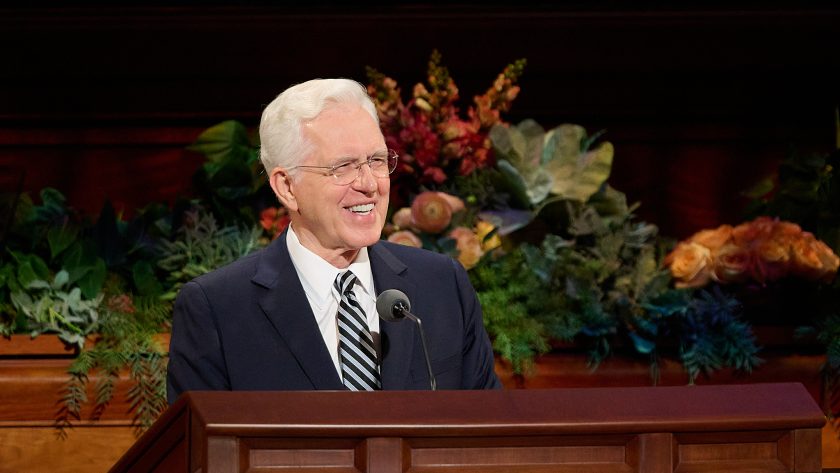
Photo supplied, Intellectual Reserve
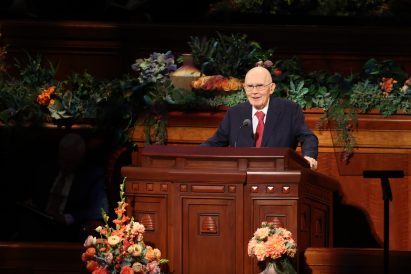
President D. Todd Christofferson, Second Counselor in the First Presidency, gives final remarks during the Saturday morning session of general conference at the Conference Center in Salt Lake City on Oct. 3, 2026.When I was in college, I took a road trip with some friends to the Grand Canyon. On our way, we stopped in Las Vegas.
I went into a casino and decided to try my hand at a game of blackjack.
“I’ll just play one game,” I thought to myself.
Well, that game ended up netting me $25.
That was the only game of blackjack I played. I took the money and left.
I still remember the surprised comments from the people around me.
“Are you really just going to quit after one game when you won?”
On a later date, I found myself in another situation where gambling was an option. I thought the same thing as I thought when I was in Las Vegas. I’ll just play one game and call it good.
Well, that game did not turn out so well. I played maybe two or three more games, realized I was not going to break even and called it quits.
I think all told – with my experience in Las Vegas and this other experience – I probably was even. But the lesson had been learned, and in the more than 15 years since, I have not gambled again.
Sure, it was fun when I won. But when I lost, it was decidedly not. As elated as I was to have won the $25, I was equally disheartened by the fact that I literally threw money away.
And it’s not that I lost a lot of money that second trip, because I didn’t. But I lost money, and I lost it to something that ultimately didn’t serve me or anyone else a single benefit – except the casino executives.
Gambling has been tangentially mentioned at general conferences of The Church of Jesus Christ of Latter-day Saints over the years, but during the Saturday morning session of conference last week, it was the central topic for President D. Todd Christofferson, second counselor in the First Presidency of the Church.
President Christofferson said gambling has become “incredibly pervasive” in recent years.
“The smartphone has transformed gambling from an occasional activity requiring a trip to a casino, racetrack, or lottery kiosk into an activity available continuously, privately, and almost anywhere,” he said. “This has led to an explosion in gambling. Worldwide surveys spanning multiple years indicate that 46 percent of adults gambled in the last 12 months–that is about 2.3 billion people. The global gambling industry generated estimated revenues of $758 billion in 2025. Of course, the industry’s revenue is the gambler’s loss. Simply put, the industry’s entire business model is built on its customers losing money.”
The primary drivers of the increase in gambling’s pervasiveness in recent years, President Christofferson said, were three new online markets.
“First is online sports betting, which involves wagers on sports scores, statistics, or events,” he said. “Second is online casino-type games, sometimes referred to as internet or iGaming: slot games, roulette, blackjack, poker, and so on. A third, relatively new platform is what are called ‘prediction markets’ that allow participants to bet on whether something will or will not happen and when. It could be tied to anything: interest rates, elections, sports, wildfires, or even, if you can imagine, the timing of the Second Coming. (Where would you go to collect on that bet?)”
President Christofferson highlighted the particular challenges youth and young adults face.
“For this demographic, impulsivity and peer influence are compounded by early exposure, easy online access, and intense marketing,” he said. “Widespread social acceptance only adds to the enticement. Sports betting is especially rampant among teenagers and young adults. It easily becomes consuming and often compulsive. It robs time from studies, relationships, and career development. It crowds out things of value and in their place fosters greed.”
President Christofferson said that in the United States, 36% of boys age 11 to 17 and 49% of boys age 17 reported gambling last year, and that there is a “substantial percentage” of 18- to 29-year-old women who gamble each year as well.
“Surveys reveal that people know that in gambling the odds are stacked against them, and the house always wins–they just don’t think it will win against them personally,” he said. “But the central risk of gambling is not merely that customers lose money on individual wagers. The larger concern is that continuous, mobile access can transform occasional entertainment into repeated behavior that displaces saving, increases debt, and creates far-reaching family and social costs. I have to agree with George Washington when he said of gambling, ‘It is the child of avarice–the brother of inequity–and father of mischief’ (although calling it ‘mischief’ may be too mild).”
President Christofferson emphasized looking at the bigger picture and also invoked a New Testament apostle.
“What is the opportunity cost of gambling?” he asked. “What do you forgo in terms of money, time, relationships, and worthwhile pursuits? Where does it lead?
“Perhaps you think your character and your commitment to divine covenants are sufficiently strong that, for you, wagers would never become more than occasional, casual fun. Maybe. But whether you are right about that or not, have you considered how your example might affect others?
“If your moral standing is secure, then undoubtedly there are others who look to you as a guide for upright living. That would certainly be true for your children but also others that you may or may not know who are watching and learning from what they see in you. They may be newer or weaker in the faith. A little gambling that seemingly has only a minor impact in your life may be more costly to them if they take license from your example.
“The Apostle Paul noted in his day that someone with a firm belief in Christ could eat food sacrificed to idols without intending it as a sign of idol worship; it would just be a meal. But he cautioned the disciples to abstain anyway.
“‘Take heed,’ he said, ‘lest by any means this liberty of yours become a stumblingblock to them that are weak.
“‘For if any man see thee which hast knowledge [of the gospel] sit at meat in the idol’s temple, shall not the conscience of him which is weak be emboldened to eat those things which are offered to idols;
“‘And through thy [conduct] shall the weak brother perish, for whom Christ died?'”
“In the context of my message today, Paul is saying, ‘Since your recreational gambling may lead a weaker brother or sister into temptation, just don’t do it. Every soul is precious, and Christ died for him, for her, as He did for you.'”
This wasn’t just a talk that challenged the wisdom of gambling; it was a talk that definitively stated the Church’s opposition to it.
Near the start of his remarks, President Christofferson referred back to the last general conference talk that focused on gambling, which was in 2005 by President Gordon B. Hinckley, then president of the Church. President Christofferson quoted President Hinckley, who said about gambling, “We are against it.”
Later in the talk, President Christofferson called gambling “morally wrong” and said that overarches all other concerns for Latter-day Saints.
“Gambling is built on the desire to obtain something for nothing,” he said. “Its structure requires that any gain comes at others’ expense. It’s hard to reconcile that with the commandment to love our neighbor as ourselves. In addition, our resources are stewardships, and the question is not merely whether a purchase is legal but whether it builds anything–in us, in our families, or in those around us. In the end, gambling produces nothing of value and enriches only its purveyors.”
President Christofferson pleaded for everyone to live on a higher plane.
“God has granted life and agency to each of us, and each of us is accountable to Him for how we live that life,” he said. “A key part of a life well-lived is contributing to the well-being of others. It is being productive in worthy endeavors. It is being and doing better without others doing worse. It comes by supporting and rewarding work rather than idle pursuits. Work leads to prosperous, just, and equitable societies. Gambling, even for fun, leads in the opposite direction.”
He prayed that gambling would not be treated lightly and for people to be wise.
Footnotes
Included in the footnotes were the following remarks:
“It is troubling that some people consider gambling a form of investment. A recent survey of 1,000 retail investors in the United States found that approximately 12 percent view sports betting as a deliberate part of their long-term investment strategy. The figure rises to 26 percent among Gen Z investors. More than half of Gen Z respondents also reported redirecting money originally intended for investing toward sports betting (see “Betterment Retail Investment Survey 2026: The Guidance Gap,” Aug. 11, 2026, betterment.com/retail-report). Bets and investments both carry risks, but there is a big difference between them. Investments tend to make money on average over time, while bets tend to lose money. The returns on investment come from the creation of value to others. In contrast, the winnings from betting come from the losses of someone else.”
“Some assert that government-sponsored lotteries are the virtuous exception in the sordid world of gambling since revenues are earmarked to support education and other public benefits. But financing these benefits through the sale of lottery tickets represents, in effect, a regressive tax borne largely by those who can least afford it. Additionally, it is likely that a substantial portion of lottery revenues used for salutary purposes will be offset by increased welfare and social costs arising from gambling losses, including lottery purchases.”
“It has been argued that participating in prediction markets is not gambling but rather investing or hedging through purchase of derivative or event contracts (regulated in the United States by the Commodity Futures Trading Commission). While some event contracts can be used to hedge actual economic risk, almost all prediction-market trading does not serve that purpose and is functionally no different from other forms of gambling. It is wagering that happens to use a financial-market structure.”
Conclusion
As I think about my previous gambling experiences, which I mentioned at the start of this talk, I think the reasoning was that it didn’t feel like something on the same level as, say, a Word of Wisdom violation. It didn’t seem like something that was going to prohibit me from going to the temple. But the question I’ve come to ask myself over the years when it comes to certain things is, “Do I really want to be on the opposite side from a prophet or apostle? If an apostle is using a general conference talk to speak out against a certain behavior, do I really want to be on the side opposite of that?” Frankly, I don’t.
I want to one day reach the Celestial Kingdom, and I know that in order for me to even be comfortable there, I need to be living as closely to the teachings of Jesus Christ and his prophets and apostles as I possibly can. I don’t think I’d be very comfortable in the Celestial Kingdom if I spent my life opposing the types of people who are going to be living there.
Simply put, if the Church is against gambling, and the Church considers it to be “morally wrong,” that’s all I need to hear.
Contact Ryan Comer at rcomer@standard.net.
Faith
COMER: Christofferson’s lesson – and a personal one – on gambling
Raise your voice: Annual Ogden Interfaith Concert goes to new venue Sunday; continues emphasis on local talent