Questions about power: Symposium kicks off discussion of nuclear energy’s potential future in Weber County
Symposium kicks off discussion of nuclear energy's potential future in Weber County
Rob Nielsen, Standard-Examiner
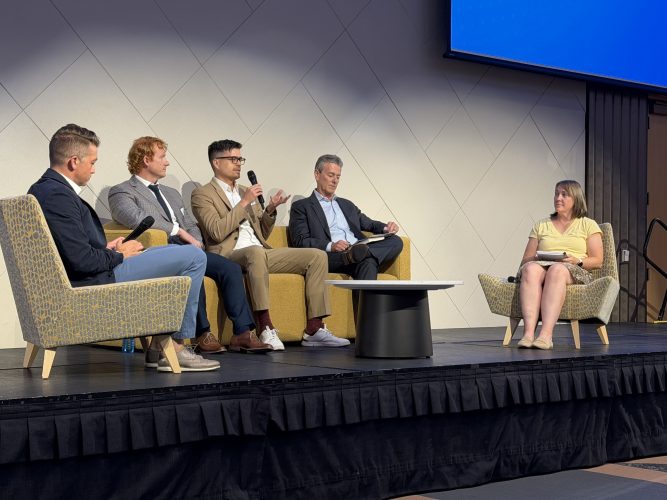
A panel speaks during the Weber County Nuclear Energy Symposium on Wednesday, August 5, 2026.Editor’s note: This is the first of two stories covering the Weber County Nuclear Energy Symposium, held on August 5, 2026, in Ogden.
OGDEN — What is nuclear energy’s future in Weber County?
Is it feasible?
What local education considerations need to be made to make nuclear energy work in the region?
Do Weber County residents want nuclear energy to play a role in the county’s future growth?
That’s exactly what county officials and other stakeholders are trying to find out, and the discussion began Wednesday evening with the Weber County Nuclear Energy Symposium — held in partnership with the Utah Office of Energy Development — at the Eccles Conference Center.
Wednesday’s symposium brought together county officials, nuclear industry experts and regional educators to begin a community discussion on the prospect of establishing nuclear power in Weber County along with building the ecosystem to support it.
Seeking information
Weber County Commissioner Gage Froerer said the county faces the same realities that other counties and municipalities do.
“Weber County, similar to other counties in the state of Utah, continues to experience growth, high growth in manufacturing, logistics, technology and infrastructure,” he said. “One thing we depend on is reliable energy, and that’s really required to take care of the growth and the infrastructure process that we have coming down the pipeline.”
He said this growth and the county’s ongoing mission both require the same thing.
“Our mission — it’s not a secret — in Weber County is to provide two things; attainable housing and work opportunities for our residents and for their kids and grandkids and probably even their great-grandkids,” he said. “We’re looking that far down the road. All of those will require reliable, affordable energy and that’s what we’re hoping to hear today.”
Froerer noted that the symposium was not the harbinger of a concrete plan to build nuclear energy infrastructure in Weber County in the near future.
“This workshop, just as a reminder, is about two things — education and asking questions,” he said. “It’s not about advocacy. There’s no decisions that will be made by Weber County or probably anybody else in this room today. No projects are going to be discussed. It’s really an opportunity to learn, ask your questions and hear from the experts, which we have some great panels with the experts in this field across the state of Utah, and really want to look at the potential that nuclear energy may have in the state of Utah.”
He said that it’s imperative to gather information.
“It’s our responsibility to understand these emerging technologies,” he said. “We can’t rely upon past technologies to get us in the future for our kids and grandkids and great-grandkids. We need those emerging technologies. We need the information so that we as community leaders can make the right decision for our residents, and you’re part of that decision process.”
Utah Office of Energy Development Public Information Officer Heather McShane said that Utah’s energy needs are outpacing the ability to supply them.
“When Governor Cox announced Operation Megawatt in 2024, it was to address the growing demographics of our population, which frankly will not be able to keep up with the energy demands of the future,” she said. “Currently, we have so many more EVs on our roadways. I’m guessing pretty much everyone in this room has at least one smart device on their possession, not to mention the ones at home, and given how hot our summers are, our air conditioners are just running overtime right now and all of these devices are just pulling more and more energy from our grid.”
She said this symposium is part of a much broader statewide conversation.
“We are traveling to all 29 counties and tribal nations to find out what’s important to you in your backyards, in your communities, and Utah is committed to our diverse energy profile and maintaining our quality of life, not just right now for us, but for our future generations,” she said. “That means under Operation Megawatt, we’re exploring adding more geothermal in power. We’re looking at added battery storage and nuclear energy to our already robust coal, oil, and gas industries.”
Panel 1
Wednesday’s symposium featured two panels with the first — titled “Nuclear Energy Development Feasibility” — including:
- Chris Hayter — founder of Hi Tech Solutions and Fulcrum Point Holdings;
- Dr. Ethan Bates — founder and CEO of Cambrian Nuclear;
- John Battaglini — vice president of project development for the Americas with Westinghouse;
- Michelle Zietlow-Miller — public engagement manager with Gateway for Accelerated Innovation in Nuclear (GAIN);
- Mike Squires — government affairs director with Utah Associated Municipal Power Systems (UAMPS).
The first panel was facilitated by Shannon Kang, project manager with Envoy Public Labs.
Battaglini said the takeaway from recent projects is that it’s critical that all parties from contractors to regulators to the community are on the same page.
“Whether it’s the technology provider, the constructor, the off-taker, the utility, the community as well — they all have to be at the same table at the same time or else these projects aren’t going to move. We had so many one-on-one conversations and we were kind of stalled there for a while until we got all those parties in the room at the same time, financiers included. That’s when things started to happen, so I think that engagement is critical. I think it’s going to get more important as newer technologies are being introduced.”
Hayter said building a successful nuclear ecosystem in Utah comes down to making sure students learn about it early and often.
“We can start educating our youth at a very young age about their opportunities,” he said. “Nuclear power a decade ago was something that most youth were not interested in. ‘That’s a dying industry.’ And trust me, I know — I was trying to recruit and build my teams and expand our company. … Nuclear power is very cool. Our youth should be very excited about this and now it’s time to actually get into the schools.”
Zietlow-Miller said organizations like GAIN are doing more to reach out and educate communities on their questions, from the technology itself to what nuclear waste is and isn’t.
“We do a lot to help folks at least understand what the technology is, what the waste forms are, what some of the challenges are ) and how they can participate in conversations,” she said. “Utah is a great example — they’ve got a community engagement program they’re running … trying to help folks bring forward their questions so that resources can be provided and then communities can make up their own mind about the technology and whether or not they want to consider something in their particular communities.”