Nuclear training and research campus pitched in Brigham City
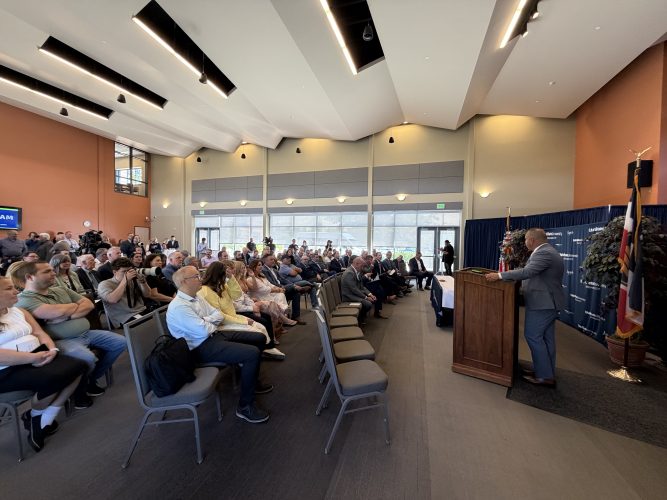
Photo supplied, Chris Coombs
Brigham City Mayor DJ Bott addresses the announcement of the proposed Center for Energy Research & Technology Campus, or CERT, on the Utah State University-Brigham City campus on Monday, August 24, 2026. (Photo supplied, Chris Coombs)BRIGHAM CITY — Brigham City is potentially a step closer to being the center of Utah’s budding nuclear industry.
On Monday, officials gathered at Utah State University’s Brigham City campus to announce the proposed Center for Energy Research & Technology Campus, or CERT, to be located at USU-Brigham City. The 20,000-square-foot facility would be a collaboration between Hi Tech Solutions, the State of Utah and Utah State University.
Hi Tech Solutions Senior Vice President Kurt Marlow told the Standard-Examiner on Tuesday about how the facility will function to train future workers in the nuclear industry.
“The training facility that we’re looking for has some very specific characteristics,” he said. “This will not be an operating reactor. There won’t be any nuclear materials on the campus. It will be a training facility with mockups and the opportunity to take local people and give them specific qualifications that will allow them to work in the nuclear industry.”
He said, currently, only three similar training facilities exist in the United States with one being located in California and the other two being located on the East Coast.
“We’re excited for, one, the Intermountain West to have a facility like this, and two, the ability to kind of bring that industry to Utah, and the opportunity to take Utah individuals who are going to technical schools, community colleges and universities, and then give them the up-skill and qualifications needed to go out and work in the nuclear industry,” he said.
Marlow said while the CERT will be able to teach people skills to apply to the nuclear industry all over the globe, the goal is to help kickstart the industry a little closer to home.
The ultimate goal is for us to not just ship Utah folks out to the industry, but to be able to bring the industry to Utah,” he said. “Whether it’s manufacturing for new reactor facilities, which we’ve talked a little bit about previously in Brigham City, the opportunity to build new reactor (projects in Utah and across the Intermountain West, having a fleet of operating reactors locally so that we have the ability to take those individuals that we’re training and be able to use them locally in the Intermountain West, and specifically in Utah.”
He said that there will be several training opportunities available at the CERT campus.
“We’ve got mock-ups for the way that we de-fuel and re-fuel reactors,” he said. “We’ll be taking some of the folks who are getting welding certificates and examinations, what we call non-destructive examination capabilities that the schools, the local schools are already teaching, and then being able to give them nuclear-specific qualifications. So it can range from inspectors to welders to electricians and trades folks, all the way up to people who have engineering degrees from Utah State who will have the opportunity to come in and look at control systems, look at mechanical systems, tooling programs for those.”
Marlow said the number of people that the CERT can train at any one time will depend largely on the partnerships forged in the future and their needs.
He added that this type of training won’t exclusively help the nuclear energy sector.
“If you’re getting a certificate from a welding program, you have the ability to get some initial and additional qualifications that allow you to work in not just the nuclear industry, but maybe geothermal and maybe natural gas projects and maybe a lot of other things that we have the ability to boost their training and certifications,” he said.
However, Marlow noted that there’s a lot of work to go before CERT is made into a reality.
“We’ve got quite a bit of work to do to scope the campus, understand what our partners — everyone that’s coming to the table — wants to accomplish from this, identify specific programs,” he said. “We’ve got engineering and design work to do on buildings. We’ve got permitting to go through.”
Marlow said the hope is to start construction sometime next year.
“The fact that you can take both elected officials, university presidents, national laboratory individuals and private sector and get them all to agree on a path forward says a lot, in my opinion, of kind of the acceptance and the fact that I think there’s a broad recognition that this is something that is needed in the industry,” he said.
Local News
Antelope Island State Park celebrates expanded visitor center
Utah House speaker ‘extremely disappointed’ in how JCC handled Hagen investigation