
Weber County Library System rolls out BrAIny AI program at all branches
Rob Nielsen, Standard-Examiner
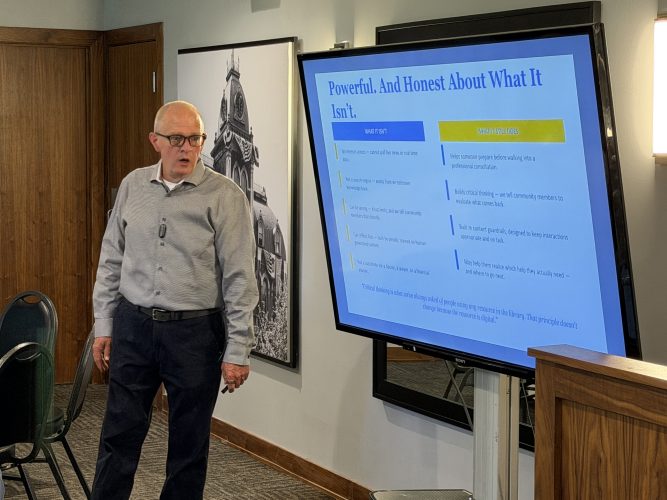
Weber County Library System IT Systems Manager Bryant Reeder gives a presentation to the Ogden Breakfast Exchange Club on the WCLS's new BrAIny AI initiative at Ogden Golf & Country Club on Thursday, July 9, 2026.OGDEN — Libraries have evolved to adapt the tools of the time that, in many cases, were initially cast as the harbinger of their demise in order to better serve the public.
As artificial intelligence, or AI, becomes a greater part of eduction, the job market, law, medicine and other everyday facets of life, the Weber County Library System is trying to meet that challenge.
On Thursday, library officials spoke to members of the Ogden Breakfast Exchange Club about the new BrAIny AI program that has been rolled out at the system’s five branches.
Weber County Library System Director Lynnda Wangsgard noted that the county’s five public libraries still play a role in so many lives with 18,000 people visiting per week and 2.5 million books checked out in 2025.
“Libraries are really busy places, and they’re a good investment by members of the community,” she said. “But today’s libraries are about a lot more than books.”
She noted that just a few decades ago, people were starting to doubt the need for libraries.
“Back in the 1990s, you may recall, people were saying, ‘Libraries are going to go away. The Internet’s on the horizon. The Internet’s going to replace libraries,'” she said. “But instead, exactly the opposite happened. The Internet brought us an entirely new group of users. Last year, 161,000 one-hour sessions were logged on library public computers, and many of those people received technology assistance from the library staff.
Then came the e-book.
“Then came another prediction, and that was that e-books were going to replace print books, and again, libraries were going to go out of business,” Wangsgard said. “Well, e-books haven’t replaced print books. Last year, publishers issued 643,000 new titles in print. And again, the e-books brought us a whole new group of customers. We circulated 780,000 e-books and e-audiobooks.”
She said it’s testament that libraries can adapt to whatever technology arrives.
“The simple lesson is that libraries don’t disappear when technology changes,” she said. “Libraries are not going away. We’re adapting to meet the needs of the community, and in many ways, business has never been better.”
Wangsgard said that AI is now the big technological leap of the day and that Weber County’s libraries intend to be on the forefront of the technology.
“Today, we’re standing at another turning point, and people are saying, ‘Artificial intelligence is going to do away with libraries. They’re going to be going away,'” she said. “Well, that’s not going to be the case, and rather than waiting for the future to overlay what’s going to happen in business and government and our personal lives, the library is stepping forward to help the community understand it and use it and put it to our advantage.”
Weber County Library System IT Systems Manager Bryant Reeder said that libraries have long been the place to give people access to resources they may not otherwise have access to.
“When books were a luxury, we lent them,” he said. “When the internet arrived and threatened to divide the world into the connected and the left behind, libraries became the place where that divide closed — one public terminal at a time. When people needed computers and couldn’t afford them, they came to us. Every single time a powerful resource threatened to sort people into those who had access and those who didn’t, libraries showed up.”
He said this applies to AI as well.
“Artificial intelligence is sorting people right now, today,” he said. “The gap between those who know how to use it and those who don’t, it’s already costing people opportunities in the job market, in school and in their ability to advocate for themselves. We’re not willing to let that happen in Weber County without doing something about it.”
Enter BrAIny, an AI text assistant that accesses open source large language models that have been included in the system — available free of charge at all five branch locations which began its rollout in the Weber County Library System at the beginning of June.
At the June 30 Weber County Commission meeting, Reeder gave a presentation that said BrAIny “helps someone prepare before walking into a professional consultation” and “builds critical thinking — we tell community members to evaluate what comes back.” He said it has “built-in content guardrails, designed to keep interactions appropriate and on task” and “may help (people) realize which help they actually need — and where to go next.”
Reeder said staff help community members open conversations with BrAIny correctly, “telling BrAIny what role to play, what the task is and what boundaries to stay within.”
He showed prompts that could be used if a person was a small business owner, a veteran or a high school student.
“You are a tutor helping a tenth grader understand a short story for class,” the prompt for the high school student read. “Don’t give me the answers — help me think through the questions so I understand it myself.”
On Thursday, Reeder pointed out that the BrAIny has a lot more privacy built in than most other AI programs.
“BrAIny runs on our hardware inside our buildings,” he said. “Not a server farm somewhere. Not a cloud service owned by a company with its own interests. Conversations do not leave our network. They’re not processed inside companies. There are no ads, no profiling community members based on what they ask. Brainy does not use their conversations to train models. A community member’s account belongs entirely to them. They can delete it. We cannot access it. And that’s not a policy we adopted — that’s how the system is built.”
He added that BrAIny also works differently from mainstream AI programs.
“It has no Internet access,” he said. “It cannot look up today’s news or pull live information. It’s not a search engine. It works from an extensive base of knowledge. But it does have limits, and it can be wrong. We tell community members that directly, and we stand behind that honestly. AI can reflect bias. It’s built by people, trained on human-generated content, and it carries the imperfections of both. We don’t hide it. We tell community members to think critically about what Brainy produces, not because the tool is untrustworthy, but because critical thinking is what we’ve always asked of people, using any resource in the library, and that principle doesn’t change because the resource is digital.”
Reeder said that it doesn’t replace expertise but can help people know the right questions to ask and the best places to start.
“It’s also not a substitute for a doctor, a lawyer, or a financial advisor,” he said. “What it can do is help someone walk into those conversations better prepared, understanding their situation, knowing the right questions to ask and able to advocate for themselves in ways they couldn’t before. It may even help them realize they need a different kind of help than they thought.”
Reeder said library staff members have been trained to help guide new users on how to utilize the program effectively at a time when AI skills are becoming more in demand for the workforce.
“For many community members, BrAIny will be their first real experience with AI — not a passing curiosity — an actual working session where they accomplish something meaningful,” he said. The workforce is changing. Employers are expecting familiarity with AI tools. Commercial platforms like ChatGPT, Copilot, Gemini — those are increasingly part of professional life. Those tools are more powerful and, for many people, more overwhelming. They can also cost money. What we’re seeing is that community members who learn to work with AI here, who understand how to frame a task, set expectations and evaluate what comes back, are building skills that transfer directly to those platforms. BrAIny becomes the place where they find their footing, where there is no subscription, no usage limit cutting them off and someone’s there to help if they get stuck.”
Following the presentation, Reeder told the Standard-Examiner that, in a time where programs such as ChatGPT and OpenAI have very limited use in their free versions, BrAIny adds a powerful tool to the library’s arsenal.
“It’s another tool, and it’s an important tool for the public to get access to something that typically … the free service is extremely limited,” he said. “It’s really hard to do something meaningful on a free service like that. You can get a taste, which is kind of why they offer that free portion of it. We wanted something that people can do something meaningful, produce meaningful results. It’s another tool in the belt, what we’re offering at the library.”
Standard-Examiner editor Ryan Comer contributed to this report.