Jon Atkin focusing on current, future challenges in bid for Davis County sheriff
-
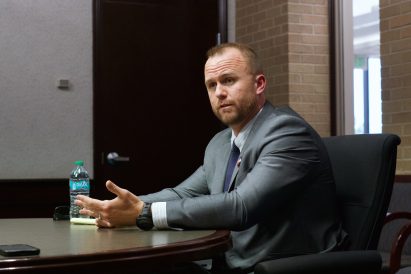
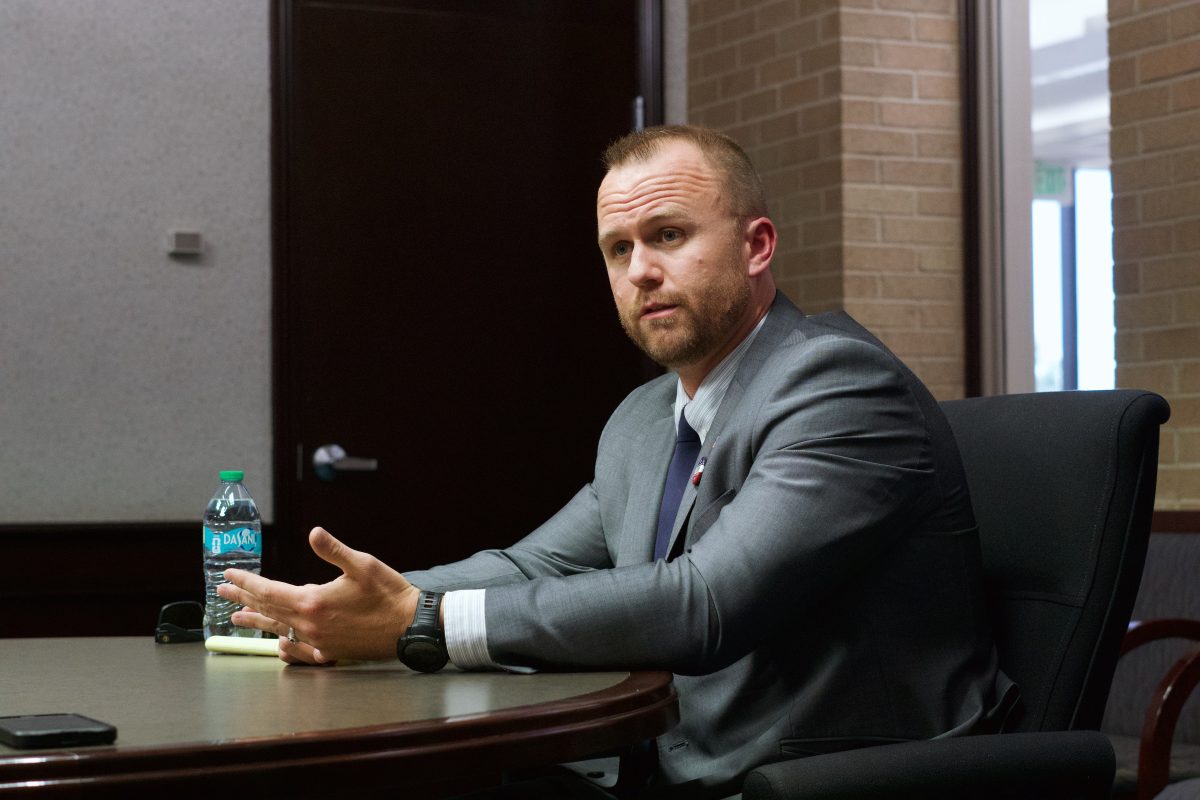
- Davis County sheriff candidate Jon Atkin talks to the editorial board at the Standard-Examiner in Ogden on Tuesday, May 19, 2026.
-
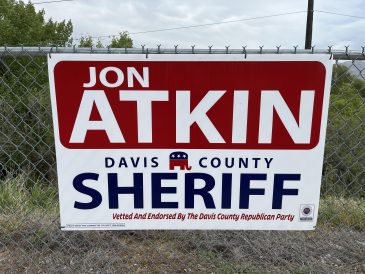
- A campaign sign for Jon Atkin, running as a Republican for Davis County sheriff, on Wednesday, May 13, 2026. (Ryan Comer, Standard-Examiner)
Grace Watters, Standard-Examiner
Davis County sheriff candidate Jon Atkin talks to the editorial board at the Standard-Examiner in Ogden on Tuesday, May 19, 2026.
Jon Atkin isn’t shy about stating where he thinks improvement is necessary within the Davis County Sheriff’s Office and within law enforcement in general.
He realizes speaking about it may not be the best career choice, and when he said that in a recent interview with the Standard-Examiner, his voice broke.
“But what kind of man am I and what kind of dad and husband if I don’t do something about it?” he said. “Military officer, firefighter and cop, investigator – I have to be able to find those values and stand on them.”
Atkin, who has worked for the Davis County Sheriff’s Office for nine years, is running to be the next Davis County sheriff so that he can not only address current issues but help lead the department into a future that has challenges he believes need to be taken seriously, and he believes that being the only active law enforcement officer in this race, he is that person.
“Who do you trust to be more innovative — the John Deere CEO or the fourth-generation farmer?” he said. “And it’s going to be that fourth-generation farmer. The person that’s doing the job every single day is going to be the most creative and also the most innovative. …
Ryan Comer, Standard-Examiner
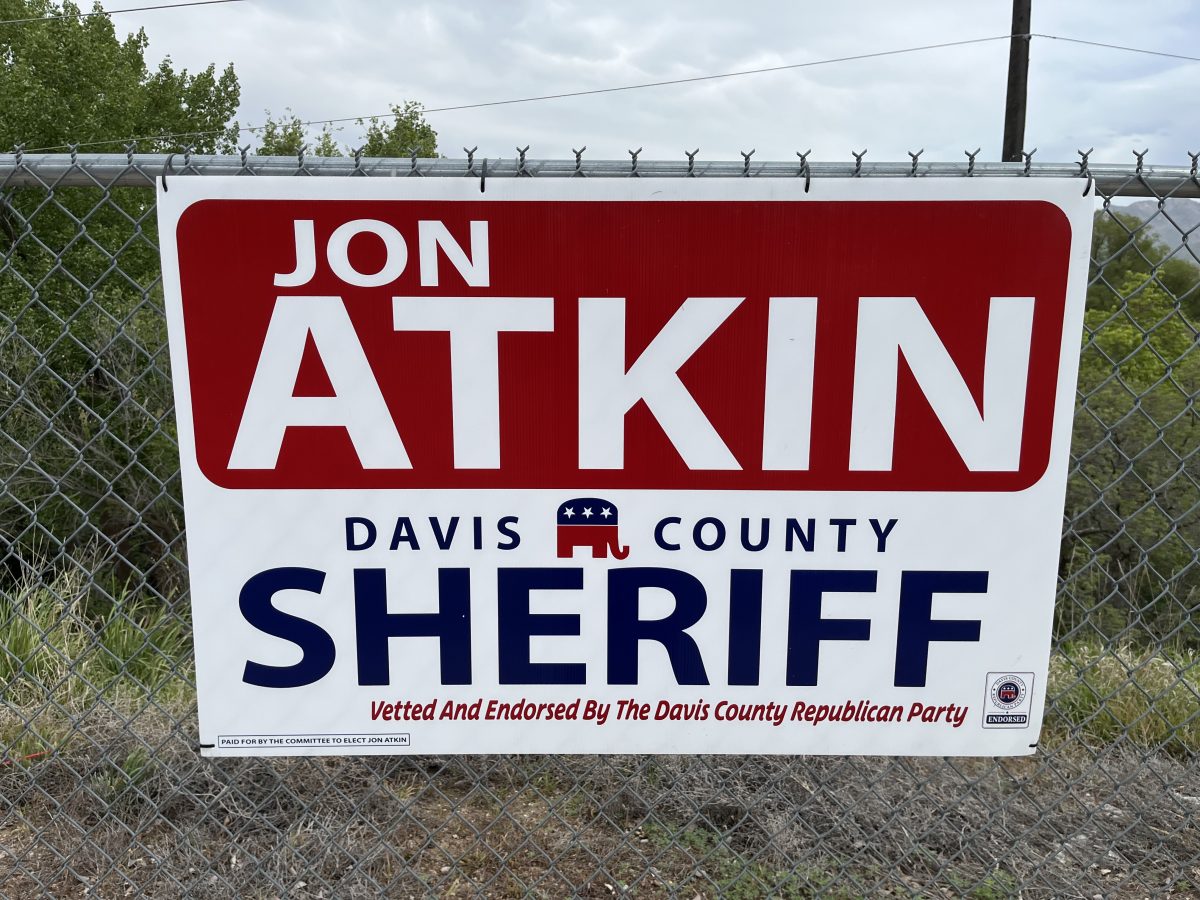
A campaign sign for Jon Atkin, running as a Republican for Davis County sheriff, on Wednesday, May 13, 2026. (Ryan Comer, Standard-Examiner)
“I don’t want to be disparaging … but the simple fact is our world is changing so quick and so fast and so drastic. If you’re not on that and leaning into it, you’re going to get left behind in a hurry. Especially when we start talking about the technology side and how that technology side is going to start equating to law enforcement. And I feel like that is one of the big disconnects is the folks that have been in the job for 25, 30, 35, 40 years — they rely on the merits that they’ve done the job for 25, 30 and 35 years, but it’s like, ‘Well, it’s shifted so much since then.'”
Technology
Atkin said he has over 14 years of military experience and was commissioned as an Air Force intelligence officer.
“I do still have a very active top-secret clearance,” he said. “I still very much stay in the realm of those national threats and national concerns to not just our military but also our economy and our way of life as U.S. citizens on the global stage.”
He’s concerned with the potential of drones, fraud and artificial intelligence.
“As an Air Force intelligence officer, it’s my job to perceive threats that are coming down the pipe,” he said. “What is coming down that’s going to affect us on any scale? The military has dumped hundreds of thousands of dollars into me through these trainings for specifically that. What is coming down? What can we do about it? What is it that’s going to affect us? How can we mitigate to the best of our abilities?”
Atkin said he wants to, as the sheriff, be that voice to tell people, specifically those in Davis County, what is coming, what he’s concerned about and what he’s planning on doing about it.
“That way, people that are paying attention to it, they don’t maybe become a catastrophist,” he said. “It’s like, ‘OK, at least my elected sheriff is aware of these things, and there are plans and there are things being done to be able to mitigate.'”
Internal challenges
Speaking about the Davis County sheriff’s office, Atkin highlighted retention and recruitment as challenges.
He said he looked at the numbers not too long ago and realized the sheriff’s department was 85% staffed. He compared it to the Ogden Police Department, which he said was over 100%.
He said retention is about 50% after the first three years.
He called it “one of the biggest plagues” that the department is facing.
Atkin used the words “bloated bureaucracy” to describe what he feels like the sheriff’s office has become in some ways and pointed to the loss of three sergeants and a lieutenant in the past 18 months.
He said the sergeants leaving was unique in law enforcement.
He said someone he worked very closely with on the SWAT team and was also in investigations left and took an $8 an hour pay cut.
In explaining how to keep people from leaving, he said the sheriff’s office doesn’t always chase people.
“And when I’ve heard comments from executive staff that some people we chase, some people we let go, and when you don’t chase my friends who I feel are capable and who I’ve worked closely with and who are great investigators and great law enforcement professionals, that in some ways becomes personal,” he said. “It’s like, ‘Well, I know that they’re great. They just weren’t entrusted and they weren’t valued.’ And so I think one way we can get back to that is putting a greater emphasis on our people and investing in them and showing them that there is a future for them and helping to mentor them.”
Working together and collaboration
Atkin said one thing that separates himself in this race is that he’s a collaborator.
“I’ve been all over the country and all over other countries doing work with people that believe in different gods, different languages … but we find the commonality is the mission, what is it that we’re entrusted to do and how can we work together and collaborate to deal with these problems,” he said. “Throughout my professional career, I’ve been a part of eight professional organizations, and so I’ve seen a lot of ways, what works and what doesn’t work. And the common theme is knowing that no individual has all the answers and always being open to objective results and objective information in making the best decision.
“I think one thing that we struggle with within our organization is having the culture where people feel comfortable speaking truth to power, where someone within an organization sees something and they feel comfortable enough to say, ‘Hey, boss, that’s probably not a good idea, and this is why.’ I know sometimes the boss has information that the rest of the people don’t, but the last thing I want is to go and make a decision when someone that works for me sees me about to do something really dumb. I want to be able to have a culture where they say, ‘Hey, have you thought about this?’ And then if I’m like, ‘Yep, thought about it. Thank you,’ or ‘No, I didn’t. Tell me more.'”
He said in terms of handling concerns in the county, he wants to have more people involved.
“I think one thing within law enforcement that has not always done us and the citizens service is we always traditionally very much so have come to the table as, ‘We have all the right answers. We know exactly what we’re doing,'” he said.
“And especially with the world, how it’s changing so much now, I very much feel that we need to be able to have more people at the table that have stakes in the game, like the school district, like the commissioners, like the city mayors, like the legislators, because it doesn’t do us very much good if we’re all kind of dancing to our own sheet of music. We need to make sure that we’re on a similar page, because specifically in Davis County … we’re very much like-minded. It’s not like you go from Syracuse to West Point and you have a vastly different type of people and type of views.”
Highlighting his collaborative record, Atkin mentioned the support he has received.
“I’ve got over 20 endorsements from local elected officials from the mayors of the cities within Davis County to county commissioners to previous sheriffs to our legislators because I believe, again, that this should be a holistic approach,” he said. “I don’t want to stand on my own little island and make my own little decisions. There are things and there’s values that I will stand for that are absolutes, but I feel that we haven’t done the citizens and law enforcement justice to be able to open up those collaboration pools and those communication lines.”
ICE cooperation
Asked about how he would handle the ongoing question of cooperation with Immigrations and Customs Enforcement, or ICE, Atkin said of the three law enforcement agreements with ICE, the one that makes the most sense to him is the Jail Enforcement Model.
The Jail Enforcement Model, according ice.gov, “is designed to identify and process removable aliens — with criminal or pending criminal charges — who are arrested by state or local law enforcement agencies.”
Explained Atkin:
“And I think that it’s an easy one to be able to address if you’re here illegally and you’re committing crimes, especially arrestable offenses, and we catch you and we can charge you for it. At that point, that’s where the relationship handoff is with ICE. Say, ‘We have them, they committed this crime,’ and then, (they) more than likely, say, ‘Yeah retain them and we’ll deal with it.'”
He said the other two agreements, the Task Force Model and the Warrant Service Officer Program, don’t make sense for Davis County because of current staffing challenges and he would rather focus on arresting criminals rather than looking for people simply in the country illegally.
Experience
Atkin joined the Army as military police in the Utah National Guard after he got married. He got his associate’s and bachelor’s degrees, the latter in criminal justice, from Weber State University and switched to the Air National Guard.
He spent time with the Utah Department of Natural Resources as a law enforcement park ranger before completing his certifications as a paramedic at Weber State.
He worked court security, in patrols and as a deputy paramedic and then went through investigations and the child abduction task force.
He spent seven or eight years on the SWAT team and said he’s been an instructor of defensive tactics and firearms and a paramedic instructor.
He went to criminal investigations and then to internal affairs, his current position. He’s been in internal affairs for the past three and a half years.
“Supervised all department-wide training, written policies for the office, and how internal affairs looks is, if somebody within the office commits a crime or a violation of policy, it’s my job to investigate them,” he said. “And so I’ve investigated law enforcement officers and officer-involved shootings, in-custody deaths, a myriad of other things throughout the whole office.”
He said the whole office has essentially been his purview.
Concluding statement
As part of his concluding statement, Atkin said he would like people to vote for him because he has the energy, drive, desire and ability to be successful as the sheriff.
“There’s absolutely no way I’m going to fail at it,” he said. “I have the tenacity, and I have those working relationships with all those key players I’ve mentioned before with our mayors, with our city council members, with our legislators to be able to address the problems of today and of tomorrow. And I very much want to represent the people, and I feel like too long we have been using the same paradigm of leadership and the same paradigm of elected officials. And some have worked out, but I feel by and large, most people have been dissatisfied with it because it hasn’t really addressed a lot of the problems that we face.”
For more on Atkin and his campaign, visit https://atkin4sheriff.com/
Contact Standard-Examiner editor Ryan Comer at rcomer@standard.net.