
Moore discusses his work with Hill Air Force Base, Congress as primary season unfolds
Jared Lloyd, Standard-Examiner
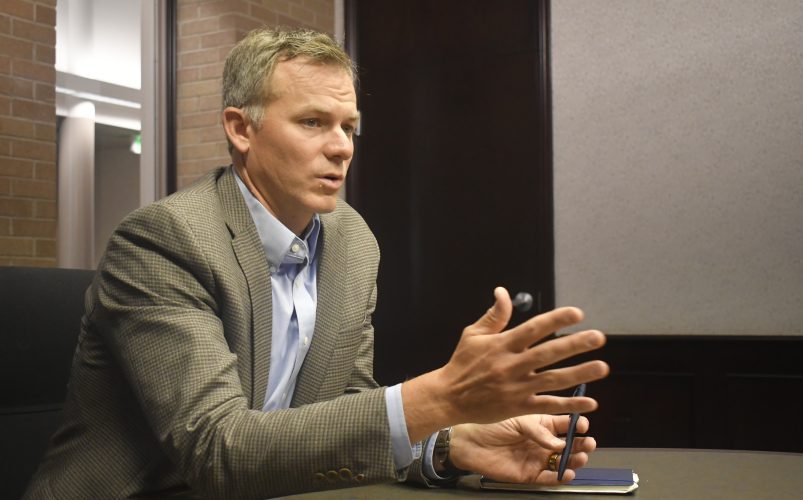
Rep. Blake Moore meets with the editorial board at the Standard-Examiner in Ogden on Wednesday, May 27, 2026.Rep. Blake Moore is highlighting his work with Hill Air Force Base and the ability for Congress to get things done as he campaigns for reelection.
Moore, who has served as Utah’s First District House representative in Congress since 2021, is running for the seat in the newly drawn Second District. He is being challenged by Utah State Rep. Karianne Lisonbee for the Republican nomination in the 2026 primary election.
Recently, Moore sat down with the Standard-Examiner editorial board to discuss his campaign, why he’s running for Congress and his goals if elected.
‘There’s more in my tank’
Moore said that even after half a decade in the House, he feels that he’s got a lot more to contribute.
“I love serving Hill Air Force Base,” he said. “There’s more in my tank. I’m in the House leadership. That’s the first time that’s happened in Utah, and so I’m trying my best to give an outsized voice to Utah. So I’m in a strong position.”
He said that he feels the Republican Party has been doing a good job in power.
“I’m confident we can maintain the majority and continue to govern and lead back there,” he said. “Speaker (Mike) Johnson’s done a great job. I love serving with him. And we’re creating an outsized voice for Utah and I don’t think this is the time to change that up.”
Moore said one area that he’s been especially proud of over the last few years is being an advocate for Hill Air Force Base.
“Hill Air Force Base is as strong as it’s ever been,” he said. “We’ve had a consistent approach to make sure that it’s had the support that it’s needed. We just secured another really important aspect to their F-35 sustainment program with the canopy. That comes on the heels of a $28 million investment that we secured for Hill Air Force Base to establish the infrastructure for that F-35 future maintenance. It’s one of the most important programs that we’re going to maintain here, along with the Sentinel and the nuclear triad land-based, ground-based element. It’s in a really strong position.”
Challenges
Moore said that it’s no secret that Northern Utah’s economic position is bringing in more people.
“Obviously, Northern Utah has a uniquely strong and diverse economy — as well as the entirety of the state — and that helps us weather downturns,” he said. “But with that comes growth issues, housing issues, transportation (issues) and, of course, water issues. Three years ago, we had the highest snow totals in history. Then last winter, we had the lowest snow totals.”
He said that efforts are well underway at the federal level to help with one of the state’s biggest challenges — maintaining a healthy Great Salt Lake.
“I think the water issues will be uniquely important to Northern Utah because of what could happen with the Great Salt Lake if it continues to dry up,” he said. “We just had the EPA administrator out here (in May) and we were out there with him, emphasizing the importance of the funding requests. And we’ve never been in a position to be this strongly supported with the attention that we have on the Great Salt Lake. I passed a key piece of legislation, my first term — the Saline Lakes Ecosystem Act. We call it the Great Salt Lake bill. … This is what started the process to say, ‘Hey, this isn’t just a lake in Utah. This is a Western United States major issue to the ecosystem, to the bird migration, to snowpack and all those types of things.'”
Moore said, at the federal level, the deficit remains an issue.
“We’ve had some success in the last year with the reduction of deficits, signaling that we can do it,” he said. “Still a lot left to be done, but we can do it, and we continue to try to move this ship around.”
Getting things done
Moore said that Congress has actually been functioning very much in a bipartisan way despite what many may believe.
“The cable news shows are not making their whole entire evening segment about the housing bill we just did that had over 400 votes in favor of it,” he said. “I honestly think it comes down to that. The majority of bills passed are on suspension, which means you suspend the rules of debate so you can just pass it because it’s been worked through the system and it’s got broad support. And so that stuff doesn’t catch much attention.”
He said that doesn’t mean that polarization isn’t a thing in the political world.
“Now it’s political season,” he said. “Party infighting and all that kind of stuff has been a part of the system forever, but now with the advent of social media and everybody’s an expert … it’s clearly there. It’s clearly worsening, but I still feel like Congress is trying to get some key things done.”
Moore said there are many recent examples of Congress trying to get things done.
“People said, ‘Oh, Republicans aren’t gonna be able to get this done. Speaker Johnson’s not gonna be able to get this done,’ and we got the Farm Bill done,” Moore said. “E15 was addressed in a bipartisan way. The Farm Bill had bipartisan support. The Foreign Intelligence Surveillance Act that had bipartisan, unanimous support in the Senate, right? And we got through that.”
On the Stratos Data Center
Moore said that he feels the proposed Stratos Hyperscale Data Center in Box Elder County is a great opportunity for the area and in the realm of AI.
These data centers are a big part of the new economy, right?” he said. “Some people call this the fourth revolution, and Box Elder County is at the forefront of it all. When has that happened before? Well, when we wanted to join the railroads, when it was time to put someone in space. Box Elder County has done some things that are incredibly impactful — outsized things for major pivotal points in our nation’s history, in the world’s history. And, and this might be one of those moments.”
He emphasized that, while he sees great opportunity in the data center, he ultimately doesn’t have much say in its construction.
“I’ve also been very clear about the importance of local decision making on this,” he said. “I’m not being asked to make any vote on anything related to this.”
Moore said that the Military Installation Development Authority, or MIDA, which oversees the Stratos project, has made some positive contributions to the region already while also acknowledging the need for better communication.
“Who thinks Falcon Hill has been a bad idea? Falcon Hill has been an exceptional plan, a streamlined way to get good solid growth and job opportunities here,” he said. “MIDA has a good track record.”
However, he also said that communication and transparency are key to the process working out.
“I think through this, there’s a recognition of, ‘OK, we need to make sure that we’re getting out communication,'” he said. “The commissioners need to be brought on board more thoroughly. Those are areas to definitely address and improve the process. There’s a strong track record of good, solid growth that’s been responsible with MIDA and I’m hopeful that people can weigh in on this and make this process better because there was some frustration among citizens, even among some local elected leaders, like, ‘Hey, we weren’t brought in on early enough for this.’ Hopefully, we can fix that.”
For more information on Rep. Blake Moore and his campaign, visit https://www.electmoore.com/.
Local News

Weber County 4-H members assemble care kits for county correctional officers in observance of 9/11 Day of Service

Volunteer opportunities available at local organizations
