Kearsley, Beesley likely moving on to November ballot for Weber County Commission seats
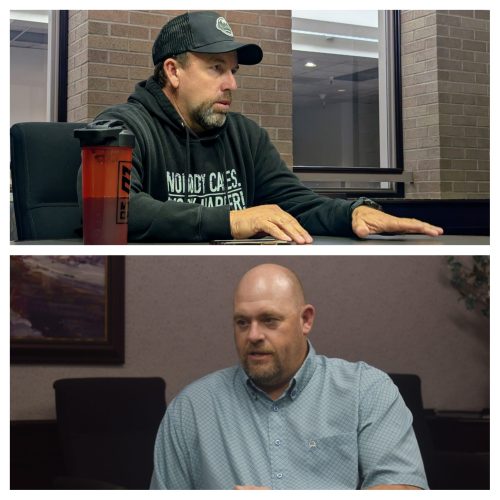
Image made from Standard-Examiner file photos
Processed with MOLDIVWEBER COUNTY — Up and down the Wasatch Front, a theme developed in several primary elections on Tuesday.
Voters want new local leaders.
One place that became apparent this week was in the Weber County Commission primaries which will see two of three seats filled with new faces come January.
As of Thursday’s count, with 99.5% of ballots counted in Weber County, in the Seat B race between incumbent commissioner Sharon Bolos and former Plain City Mayor Jon Beesley, Beesley has a commanding lead of 13,004 votes (55.57%) versus Bolos’ 10,398 (44.43%). Bolos conceded the election in a Facebook post late Tuesday evening.
Beesley told the Standard-Examiner Thursday that he was excited and happy to advance.
“We put in a ton of work to make it happen, so it’s nice to see your hard work pay off,” he said.
Beesley can still be challenged in November by a write-in candidate — the deadline to announce is in August. However, should no write-in candidate materialize, Beesley will be unopposed in November’s election.
In the Seat A race, newcomer Duane Kearsley was nearly 1,200 votes ahead of his nearest competitor. As of Thursday afternoon, he had 7,277 votes (31.22%) versus challengers James Ebert’s 6,027 votes (25.85%), Katrina Gibson’s 5,878 votes (25.22%) and Richard Hyer’s 4,129 votes (17.71%). Incumbent Commissioner Gage Froerer opted not to run for reelection.
Kearsley told the Standard-Examiner Thursday that he’s excited to move on to the next step.
“I’m already talking to local leaders and state leaders as far as moving forward and how best to implement some of the stuff we talked about in this campaign,” he said.
Kearsley (Republican Party) will face Alvin Thurgood (Democratic Party) and Gary C. New (Forward Party) in November’s election.
Beesley said that he’s been speaking with many county officials already about the job ahead.
“The last couple of days, I’ve had almost all of the department heads and other elected county officials reach out to me and invite me to come sit with them and see what their day looks like and what their processes are,” he said. “I look forward to starting to set up a schedule where I can go and spend time with those folks and start digging into the job a little bit.”
He said he’s thankful for the support of his family through the process of a primary election along with the support of the voters.
“Thank you for wanting to see a change in how the county operates,” he said. “I think we can do a lot of things to shrink our government, and that’s one place we’re going to start. … I look forward to serving the people of Weber County.”
Kearsley said preparing for November will look a lot like his preparation for the primary.
“We’re still doing the same thing,” he said. “We’re attending all of the commission meetings. We’re working on getting people out to the commission meetings, educating them on what’s happening at the meetings and doing town halls.”
He added that he’s been reaching out to his primary opponents about their own experiences.
“We campaigned on the message that I want to represent the people of the county, I want to be their voice and represent them,” he said. “We’re just grateful for all of the support and all of the support out there. I know it’s a primary and there’s four candidates and a lot of people might have voted for someone different, but I think there’s not too big of a bridge to gap between most of us. I’m already reaching out to the ones we ran against and talking different ideas on what they heard on the campaign trail and just making sure we represent that people.”
Weber County Clerk/Auditor Ricky Hatch told the Standard-Examiner in an email Thursday that some outstanding ballots remain in need of curing.
“There are 427 ballots that have been challenged due to issues with either the voter’s signature or with the last 4 digits of their driver license or social security number,” he said. “Each of these voters was mailed a letter and, if we have email addresses or phone numbers for them, we send them emails and texts as well. They can ‘cure’ the issue online, in person, by mail, or even by phone. The instructions were included in the letters we sent to them. The deadline for them to resolve the issue is Monday, July 6th.”
He said that turnout was a bit lower for this primary, but well ahead of other years.
“We originally thought turnout would exceed 40%, given the new redistricting, contested congressional races, and an open commission seat,” he said. “We got close to that turnout with 38%. Although that’s the lowest primary turnout rate since 2014, it’s much higher than 2010’s primary turnout, when Mike Lee beat Tim Bridgewater as the Republican nominee for U.S. Senate. Turnout in that election was 8%. In 2014’s primary election, turnout was 7%.”
Despite not reaching 40%, Hatch said he feels the process went well this year.
“(It went) quite smooth, especially given several significant changes to election law over the past couple of years and a last-minute lawsuit against our office that was unsuccessful,” he said. “Within 20 hours of the close of polls, we had posted over 99.5% of all votes cast. The remaining votes are 43 provisional votes and any ballots that have yet to be cured. Our equipment worked well, our elections team performed wonderfully, and the voters were generally respectful and appreciative.”
He added that he and his staff are always happy to help de-mystify the election process for people with questions.
“I was super excited to have poll watchers for much of the days during election week,” he said. “We love having people observe our process, and we had several poll watchers who stayed for several hours, triple checking our numbers, giving suggested improvements to processes, and asking good, hard questions. We love providing information to voters, candidates, campaigns, and parties and wish we had observers present every minute we are processing ballots. We like to tell people what our processes are, but we love to SHOW them the processes. If anyone wants to see how we function, they’re welcome to contact our office and we’ll arrange a special tour for them.”
For more information, visit https://www.weberelections.gov/.
Local News
3 Northern Utah residents indicted with credit union robbery charges over alleged gambling debt
UDOT warns drivers of upcoming traffic disruptions in Weber, Davis counties