John Taylor touts Lisonbee support, ‘conservative discernment’ in House District 14 race
-
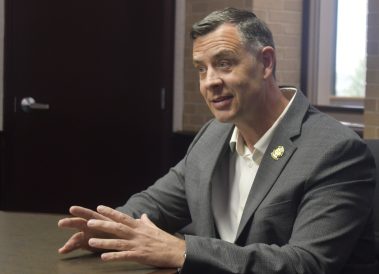
- John Taylor, competing in the Republican primary for the House District 14 seat in Utah, participates in a candidate interview at the Standard-Examiner office on Wednesday, April 29, 2026. (Jared Lloyd, Standard-Examiner)
-
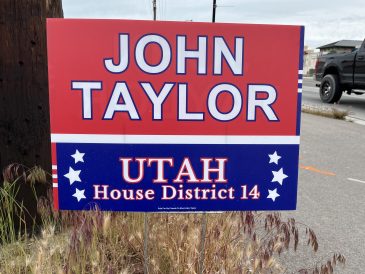
- A campaign sign for John Taylor, competing in the Republican primary for the House District 14 seat in Utah, on Saturday, May 16, 2026. (Ryan Comer, Standard-Examiner)
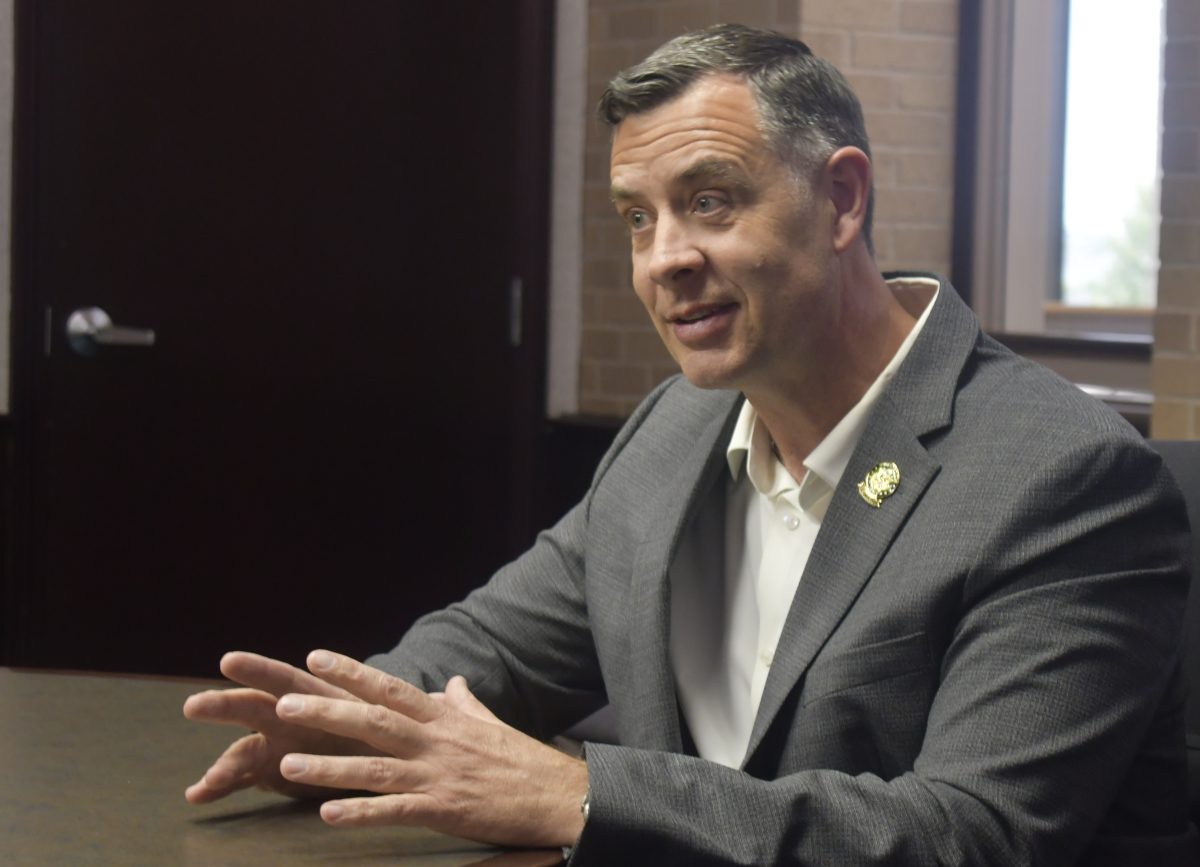
Jared Lloyd, Standard-Examiner
John Taylor, competing in the Republican primary for the House District 14 seat in Utah, participates in a candidate interview at the Standard-Examiner office on Wednesday, April 29, 2026. (Jared Lloyd, Standard-Examiner)
Editor’s note: The Standard-Examiner has invited primary candidates from Weber and Davis counties to sit down to answer questions from the editorial board and share their vision. Over the next month, the Standard-Examiner will share the highlights from these conversations, giving candidates equal time and balanced presentation so you can evaluate these candidacies as fairly as possible.
John Taylor said he was recruited by many to jump into the race for the House District 14 seat – including outgoing representative and U.S. House hopeful Karianne Lisonbee.
Taylor said he has always been politically engaged. He served as a state delegate, county delegate and precinct chair for the last 20 years.
“I’ve never been a candidate before,” he said. “I’ve never ran for anything in my life, so this is all brand new to me.”
As he ponders why Lisonbee would suggest he join the race, Taylor said he thinks it’s because Lisonbee recognizes he’s “a principled conservative.” He said he and Lisonbee are “aligned pretty well” in how they think.
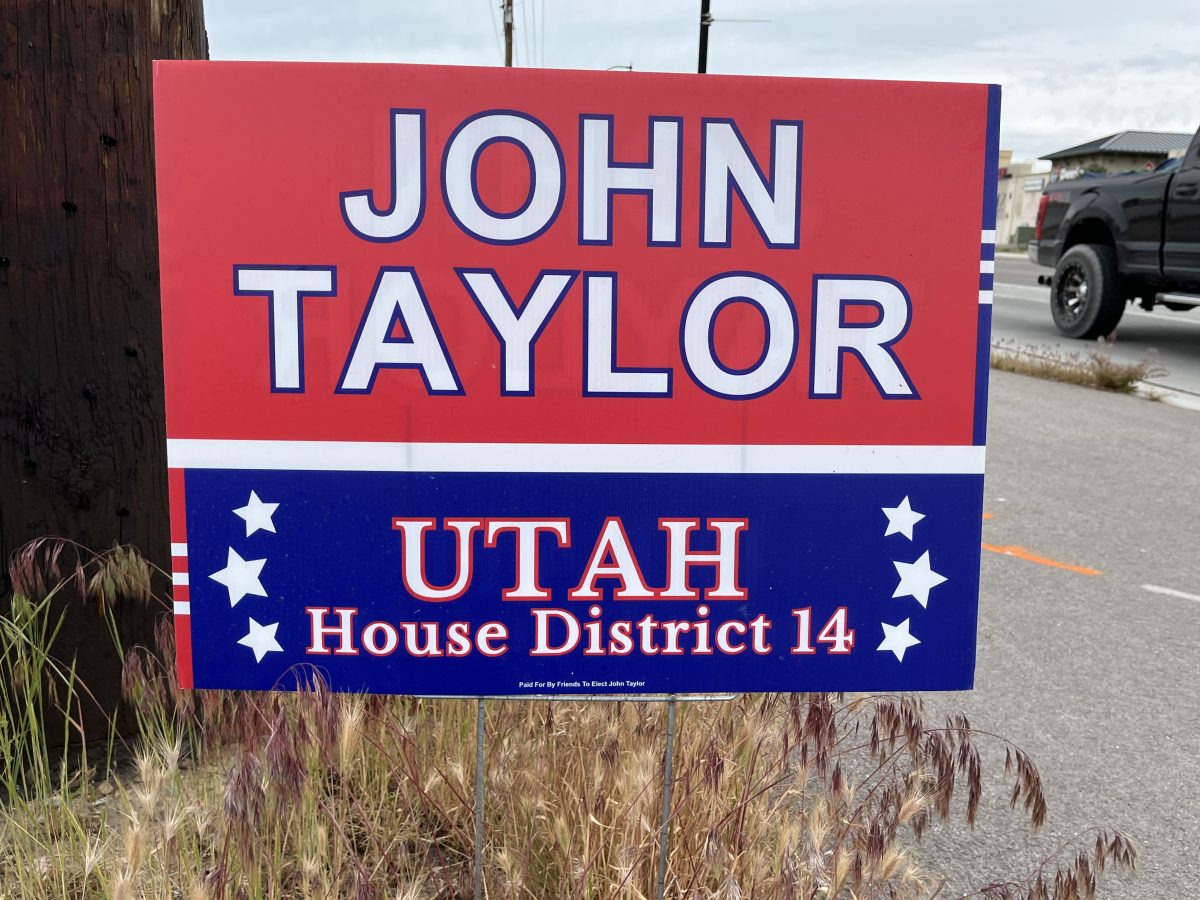
Ryan Comer, Standard-Examiner
A campaign sign for John Taylor, competing in the Republican primary for the House District 14 seat in Utah, on Saturday, May 16, 2026. (Ryan Comer, Standard-Examiner)
“And it’s important, I think, for my constituency to have a conservative representative,” he said. “And when you look … District 14 ranks as one of the most conservative districts in the entire state of Utah, percentage wise. … And so to be an effective representative for District 14, you would want a very conservative candidate.”
Taylor said he doesn’t believe his opponent in the race is as aligned to the district in that regard as he is.
“So when it came to being recruited by … Karianne Lisonbee and many others, they just felt that I’ve got that conservative discernment, I call it, which, when you … consider conservative discernment, you’re trying to understand how legislation affects things,” he said.
“So, for example, if a piece of legislation comes down, what are the unintended consequences? Does this give power to the people? Or is this government overreaching, government overstepping its bounds? And that ideology and those fundamentals I think are what people see in my candidacy.”
Taylor said that people as conservative as he considers himself to be are sometimes branded as extremists, but he doesn’t believe that’s an accurate label.
“I align myself with the constitutional principles, the founding fathers, and I want limited government, smaller government,” he said. “So if I can go to the state and make it smaller and less intrusive and less burdensome and less taxing, I think I will have succeeded.
“So when bills come that want to spend your money, I don’t think we should look at taxes as our personal charities. If a candidate believes vehemently in abortion and wants to use taxpayer dollars to fund abortion, I don’t think that’s right. … Utah’s a very generous state, and we … donate a lot of our own resources to our own personal charities. But when a politician starts using taxpayer funds to donate to their specific charities, that starts to cross the bounds of what’s right. So when you look at government, what should be funded and what shouldn’t be funded … I think that’s why I talk about conservative discernment and a conservative compass. Being able to understand the proper role of government as intended by the founding fathers.”
Political interest
Taylor was born in Logan, grew up in Ogden and has raised his kids in Davis County. He joined the military to pay for college and was a field medic and a surgical tech.
He was part of Army intelligence, had a top secret security clearance and went on deployments to Saudi Arabia and Bosnia.
He’s been a business consultant and has worked with the National Federation of Independent Business. Most recently, he said, he’s been in the pharmaceutical industry. He currently does pharmacogenomic testing and is a molecular consultant.
Taylor said his political interest picked up steam when he was an army officer in active duty just after college.
“I had a friend … he was talking about OPEC and all this geopolitical stuff,” Taylor said. “And he knew all this information. And I was just off of school and everything else. I had never really delved into the political space and legislation, all that stuff. And I asked him, ‘How do you know all this? How are you so smart and understand all of these things?’ And he says, ‘Well, I listen to Rush Limbaugh.’ I was like, ‘Oh.’ And after that, I started listening to Rush Limbaugh and then Hannity and Glenn Beck and Mark Levin, and all of these talk show news people gave me a conservative compass. They … instilled in me this intense interest in politics at the national level, and then at the state level when I moved back to Utah as well.”
He said he’s always been interesting in serving.
“You know, I served in my faith. I was a bishop for my church,” he said. “But, you know, whether it’s my military leadership, business or community leadership, or my faith leadership, or even leadership in the Republican Party, I feel it’s always been important to serve, and I’ve always preached that to my kids. … But I’ve always believed and I’ve always instilled in them that you should serve in every capacity, whether it’s your faith, whether it’s your community and whether it’s in the military.”
He said he almost challenged Blake Moore for the U.S. House when Moore first ran for Congress.
“I almost jumped into the race against him because I had a much more in-depth resume and experience, life experience, and capability,” he said. “We had some similar experiences, you know, with our overseas work as intel analysts … but my friend Kerry Gibson jumped into the race, too, and I thought, ‘Well, I’m not going to run against Kerry Gibson. I think I’m going to stay out.’
“And the other component was I had just been released as a bishop in my church, and I was exhausted. … And so serving in that capacity was very rewarding, but … five years was time to be done. And this feels similar in terms of how busy I am. And it’s rewarding in a different sense.”
Taylor is proud of being an outsider so that he can “bring a whole new set of experience and a diversity of experience” that he believes is needed.
Not a developer or a real estate agent
Taylor noted a comment from one of the first constituents that he called to present himself as a potential legislator.
“The first question he asked me was, ‘Are you a developer or a real-estate agent?'” Taylor recalled. “And I proudly and gratefully said, ‘No.’ And he said, ‘Good, because we have so many developers and real-estate agents. We need somebody different, somebody with a different perspective.'”
Related to housing, a specific piece of legislation that Taylor takes issue with involves public infrastructure districts.
“And this is a piece of legislation that came about to help because of the aggressive increase in housing demand,” he said. “They needed to be able to develop properties quickly and turn them over to meet the demand. But it did favor developers. Developers were able to offset the cost of developing that property via a bond. Now, everybody that moves into the public infrastructure district, not only will they have a property tax and maybe an HOA fee, but they’ll have an additional bond that they’re obligated to pay.
“So the developers were able to offset the risk and cost of the development. Now, you would think that the developers would price the houses cheaper, but they don’t, and they didn’t have to, because the market sets the price of the housing.”
Taylor laments examples of people that have started the process of moving and then found out the additional costs associated with being part of a public infrastructure district.
“And it’s really frustrating because what the price of their house was is no longer that price; it’s much more,” Taylor said. “Who benefited? The developer. So being an outsider, a lot of these legislators … we’ll have a working relationship, we’ll probably become friends, but we need somebody that can take an outside step, and, you know, legislate with a different perspective.”
As a legislator, this is an issue that Taylor said he would like to address.
“I would say, ‘Listen, if you’re going to create a public infrastructure district, you need to disclose up front, maybe even in contract writing, what this district is and the bond that you will be accountable to,'” he said.
Housing solutions
Taylor acknowledged the efforts being made locally to help with the housing situation but said one specifically was not the answer.
“The state and Governor (Spencer) Cox – they’ve been involved, and they’ve tried to mandate and legislate municipalities, the city mayors and the city council members, to create so many single-dwelling homes or condos or townhomes … and we’ve seen that,” he said. “I drive the whole state for work. I am in every single community in this state. Everywhere there’s a doctor’s office, I’m there all the time. So I’ve seen some communities have tons of multiple housing and it’s empty.
“So when the state tries to mandate to Syracuse, you’ve got to have so much high-density housing, but the Syracuse citizens don’t want it. I don’t know if that’s the right fix. That’s almost a government overreach. We don’t like the national government reaching into Utah saying, ‘We’re going to control your lands and what you do with it.’ Neither should we have the state overreaching into the municipalities. Those city council members – they know what’s best. They know what their citizens want. So that’s not the answer to housing, because we already have the diversity of housing.”
He said the fix almost has to come at the national level and has to do with government spending.
“And if there’s anything that I will be a hawk over, if I will be aggressive, it will be out-of-control government spending,” he said. “The federal government has spent us into a corner – $39 trillion. And that debt-to-GDP ratio is unsustainable.”
He highlighted quantitative easing and said that means the government “is printing money to cover that debt,” which makes the value of the dollar go down.
“That’s the silent theft,” he said. “And here’s the real kicker. When inflation sets in … the municipalities and these commissioners, they will have to hold truth-in-taxation hearings again, and they will have to tell the citizens, ‘Hey, guys, we have to raise your taxes again because of inflation, because we can no longer afford firefighters and police officers.’ So your taxes are going to continue to go up. … Your taxes are going to go up, and the value of your dollar is going down, and the government’s taking out from both sides. So if you want to fix anything in the economy, everything – everything – stems from out-of-control spending.”
What a Utah legislator can do
Taylor said that Utah legislators can “implement austerity measures” and “be responsible stewards.” He said they can “maintain Utah’s economic momentum.”
He said legislators can make sure bad legislation that hurts industry and businesses doesn’t pass, and he cited a meeting with the Utah Bankers Association to make his point. He pointed out that the Utah Bankers Association has not endorsed him or given him any money.
“But the Utah Bankers Association talked about all these banks that have come and set up shop based here in Utah,” he said. “They’ve left California. They left Colorado. They leave these blue states and come to Utah. Why? Because Utah has very favorable legislation for banks. …
“Now, take a piece of legislation, Senate Bill 230, for example. This seemed like a great piece of legislation because it said, ‘Hey, banks, you can no longer charge a pre-payoff penalty.’ Because the banks … look at the risk and they say, ‘We’re going to give you this loan, but based on this risk, if you’re going to pay this off early, we’re going to give you a penalty.’ Well, that sounds mean, you know. … So the legislators got together and said, ‘Yeah, that’s unfair practice. …’
“Well, all of the sudden, what that has created is the banks have a much higher risk. So the 10% to 20% that would pay off their loan early, maybe they benefit because now there’s not a pre-payment penalty, but the banks are going to look at the risks, say, ‘We have a higher risk. We are not going to offer as aggressive interest rates anymore to the people.’ They’re going to transfer that to the rest of the people. So what looked like a good piece of legislation, maybe it wasn’t so good.”
Taylor said banks left California to come to Utah and could easily leave Utah and go to Texas or Florida, and then those states will benefit from the economic momentum.
“So when you look at a bill like 230 and you think, ‘Yeah, that’s a great idea because it’s unfair those … pre-payment penalties,’ look at the unintended consequences, losing bank business to other states and squelching that economic momentum. … And so having a diversity of experience in the Legislature is very helpful,” he said.
“It’s important for legislators to get along. Utah does great. We have the good old boy network in some aspects. They get along very well. But you have to be able to say … ‘I disagree and I’m not supporting this piece of legislation, even though you’re my best friend, because of this principle, and this is my principle.’ And that has to take place. You can’t have a system where we’re all getting along and we’re passing all the legislation because we’re all buddies. We need to all be principled legislators. And we need to be able to say, to work cordially like we have been, but then to say, ‘This is bad legislation. You’re a great guy, but I can’t support you.'”
Property taxes
Also cited by Taylor as a concern, and also related to housing, was property taxes.
“The commissioners in Davis County held a truth-in-taxation hearing, and we had 300 show up,” he said. “I was the first to stand up and speak against raising our property taxes. It was going to come from the general fund, and it was going to be a 30% increase, which meant $8 more. They voted for a 15% increase, $4 more, which doesn’t seem like a lot, but it was the principle of it because I sat next to a senior citizen there. He was from Farmington and he owned his house and land. He showed me his tax statement and his income. They weren’t congruent. He was going to have to sell some of his property and stuff because the value of the property went so high, the taxes went high and his income’s fixed. So he was facing having to sell that.”
This is one area Taylor said could benefit from stronger legislative measures.
“Because the bottom line is, they shouldn’t be priced out of their home and property,” he said. “They spent their entire life building and doing all of that, and now because the value of their property went through the roof, they shouldn’t be forced to have to sell it.”
The Great Salt Lake and Proposition 4
Taylor called water “a huge topic for discussion because of the really bad snow year that we’ve had” and also mentioned the threat of arsenic dust from the Great Salt Lake blowing into communities. He talked about potential ideas being floated but expressed hesitation.
“But what I’m leery of is I don’t want to throw a bunch of money at an environmental issue unless it goes to real, meaningful benefit,” he said. “Sometimes they say, ‘We appropriated $200 million to the lake.’ OK, what did it do? Did it go to a study? Did it go to somebody’s pocket like it does at the federal level? I mean, they appropriate money like crazy, and it works their way back into their political campaigns and it’s a mess. Corruption is through the roof at the federal level. But at the state level, let’s not … throw a whole bunch of money at it for the sake of just throwing money at it. Let’s make sure there’s real meaningful changes that will actually help fill up the lake or cover the arsenic threat.”
Taylor also cited Proposition 4 as an issue.
“So that’s a huge issue because it’s the representative legislators that draw the maps,” he said. “When you look at the Constitution, they gave power to the people via elections.”
Concluding statement
Taylor said he would tell the voters in House District 14 that he’s one of them.
“I feel like I have the leadership experience and a diversity of experience to be an effective legislator,” he said. “I have not sought to be a politician, and I think we need outsider perspectives.”
He considers himself to be like a Swiss Army knife candidate with a variety of tools, and he said he wants to listen to people.
“I will openly admit that I do not have all the answers, and I require and need my constituents to teach me and help and educate me on some of the challenges that they’re facing,” he said. “So anybody that thinks they’ve got all the answers, I’d be nervous.”
He said the people’s voice matters, elections matter and being involved matters.
“We’re at a point where we cannot be complacent in the leaders that we choose, because we put a lot of faith and trust and responsibility in them, hoping that they will not make a mistake,” he said.
He compared voters to the board of directors in a business that votes to choose a new chief executive officer, hoping that the CEO will make good business decisions, and said the voters are his boss and he is interviewing.
“And I hope to be that one that they can see and feel confident that I will make the right decisions that give them the freedom and protection from the overreach of the government,” he said. “So, I’m John Taylor, running for House District 14, and I would I ask for their vote.”
For more on Taylor and his campaign, visit https://www.johntaylor4utah.com/
Contact Standard-Examiner editor Ryan Comer at rcomer@standard.net.
Local News

Antelope Island State Park celebrates expanded visitor center
Utah House speaker ‘extremely disappointed’ in how JCC handled Hagen investigation