Bob Stevenson hopes to use lessons learned to help in Legislature
-
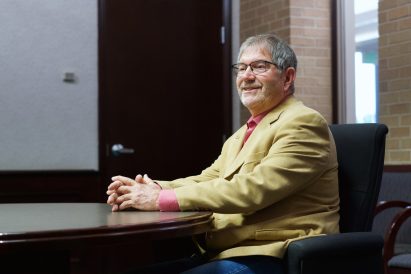
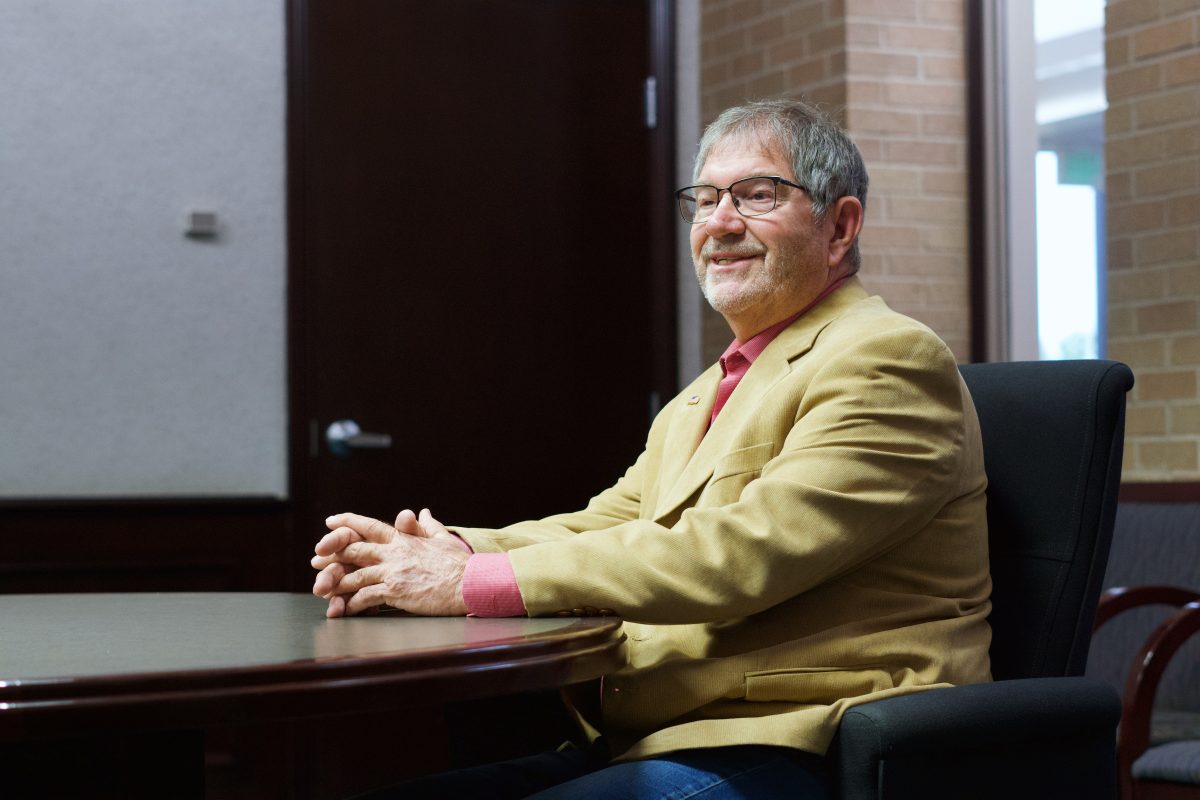
- Bob Stevenson, competing in the Republican primary for the House District 16 seat in Utah, participates in a candidate interview at the Standard-Examiner office on Thursday, May 7, 2026 (Grace Watters, Standard-Examiner)
-
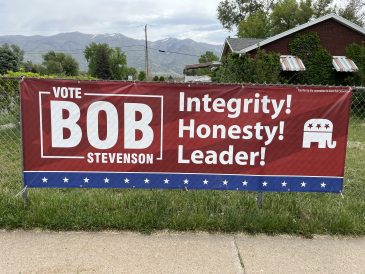
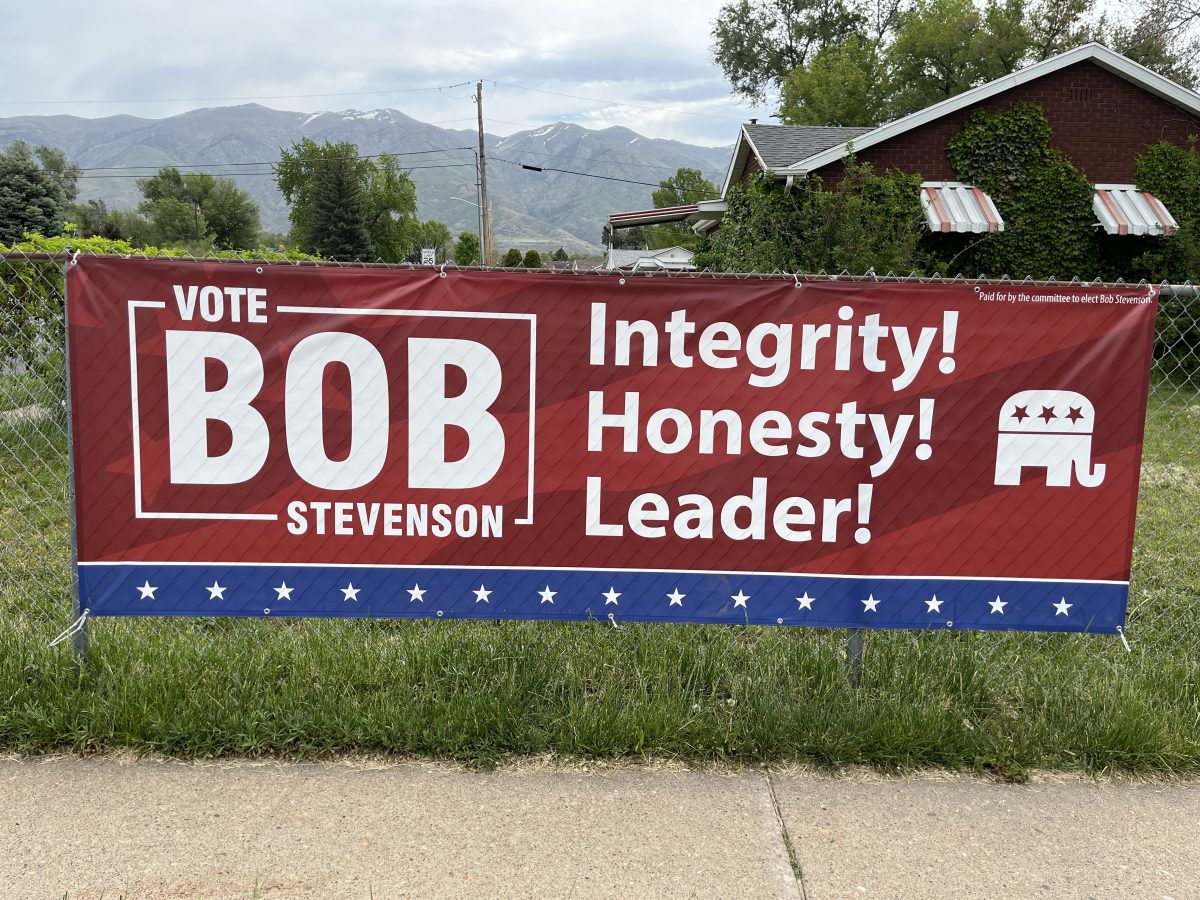
- A campaign sign for Bob Stevenson, competing in the Republican primary for the House District 16 seat in Utah, on Wednesday, May 13, 2026. (Ryan Comer, Standard-Examiner)
Grace Watters, Standard-Examiner
Bob Stevenson, competing in the Republican primary for the House District 16 seat in Utah, participates in a candidate interview at the Standard-Examiner office on Thursday, May 7, 2026 (Grace Watters, Standard-Examiner)
Davis County Commissioner Bob Stevenson has two business stories related to his time as Layton City mayor that he said aren’t widely known.
The first involves how WinCo ended up in Layton.
“And so, actually, right after I was elected, I rode up to Boise, where WinCo’s headquarters is, and sat down and started talking to WinCo about coming to town,” Stevenson said. “And I did have a little bit of an advantage, because when I was with Nestle, I also worked with WinCo. So it wasn’t as though they were an unknown quantity to me. I knew WinCo … and we rode up there and that’s basically how we got WinCo there. A lot of people don’t know that.”
The second involves how RC Willey ended up in the city.
“And, actually, the story on that was that we had that piece of property and I had Kent Andersen … who is our economic development director at the county,” he said. “He actually was the economic development director of Layton City, so he and I have worked together for a long time. … And I told those guys that I thought that we should get an RC Willey out there. And so I went and started talking to the hierarchy of RC Willey and they finally came in and visited with us and said, ‘We think we can take care of you.’ And that’s kind of how RC Willey got there also.”
Ryan Comer, Standard-Examiner
A campaign sign for Bob Stevenson, competing in the Republican primary for the House District 16 seat in Utah, on Wednesday, May 13, 2026. (Ryan Comer, Standard-Examiner)
The lesson that Stevenson believes that can translate from those experiences to the job that he is now seeking – representative of House District 16 – is that “when it comes to legislation, it is working with people.”
He said it’s “having an understanding of what someone may want.”
Why be involved in politics
Stevenson said his political interest started when he was a young man and a volunteer fireman in Layton. Politics wasn’t on his “bucket list” as a kid, he said.
“And we needed a new fire truck, and the City Council wouldn’t give us a new fire truck,” he said. “And so I had asked some of the older firemen that had been there, ‘How do we accomplish that?’ And they said, ‘You need to run for City Council.’ And I said, ‘OK,’ so I ran for City Council and got elected, and before I was through, I think we ended up with three trucks.”
Stevenson said his parents taught him two “very important concepts in life” – work and service.
“And going down the street and helping the widow by cleaning her yard up or mowing her lawn was important – to give that service and not worry about the financial payment for doing that, but offer the service,” he said.
“Government, realistically, is a service-type job, and I thoroughly enjoy giving that service. I’m at that time of my life to where I have the time and I have the resources to be able to spend time serving in government without worrying too much about the everyday type thing.”
Why move on from commission
Stevenson said he’s a “big believer” in self-imposed term limits.
“Somebody has to leave for you to serve in an office and you’ve got to leave so somebody else can serve,” he said. “And so I’ve always followed the philosophy that you serve for a few terms and then it’s someone else’s turn as far as it goes.
“I look forward to being able to serve in the Legislature. I think it’s another challenge, and what I’m hoping to do is take all of the knowledge that I’ve learned from serving in local government — city council, mayor, also county commissioner — and also my business background with what I’ve done and be able to take that knowledge and understanding and be able to hopefully help not only Legislative 16 but this state as a whole.”
Stevenson said from working on the County Commission, he’s been involved throughout the state.
“And I’ve learned a lot about rural counties, learned a lot about transportation, learned a lot about public lands, right along with the economic development we’re dealing with in Northern Utah,” he said. “So it’s been a lot of fun, and I think I can take that knowledge I have on to the state and be able to hopefully help lead things out at the state also.”
District issues
As he’s talked to constituents, Stevenson said there are a number of concerns, namely, water, housing and taxes.
On taxes, he mentioned that Utah is one of eight states that charges income tax on Social Security benefits and it needs to be one of the states that doesn’t.
He also mentioned property taxes, which he said “are getting a little bit out of control.”
He said when he was Layton’s mayor, he had the opportunity to lower property taxes one year, but as the Davis County Commissioner, he “unfortunately” had to raise property taxes.
“And you know, if I can get my way, I would love to be able to come up with the formulation, which may help bring property taxes down some, and also, hopefully, if I get elected, be able to maybe run the legislation that would support it,” he said. “So it would be kind of fun to finish out my county job, working on something like that, and go into the state job and be able to finish out that with legislation. So we’ll see what happens on that.”
Property tax increase
Speaking about the property tax increase for Davis County, a 14.9% increase that was approved last year, Stevenson said nearly 70% of the budget goes to public safety, which he said involves the sheriff’s office and also the attorney’s offices.
“And keeping attorneys is costing more money,” he said. “There’s no question that we have more cases as far as that have to be tried. Then, if you turn around and look over at the sheriff’s department, people want to think the sheriff’s department is just maybe a sheriff driving around in a car or a truck with the saying Sheriff’s Department on it, but that’s not correct … Sheriff’s department involves investigations. It involves a lot of administrative stuff… And then probably one of the elements that people don’t realize is that we do run a jail, and when you’ve got a jail that’s got 700 prisoners in it, it takes quite a bit of manpower to be able to run that. And these costs have all gone up, and that’s realistically where the cost was hitting us.
“You cannot in public safety just turn around and say, ‘We’re going to cut people back,’ because you have to have people to be able to run.”
Stevenson said because of state statute, when there’s a potential property tax increase, a number has to be given up front that would be a maximum.
“And so when we sat down and talked about it, we said, ‘Well, let’s go ahead and let’s show a 30%,'” he said. “We, realistically, were talking the 14, 15% level the entire time. But people want to turn around and react that it was 30% and it never was 30%.”
Stevenson said because of his experience and understanding of budgets, he believed an increase between 9% and 10% would be sufficient, so he made a motion to go with 9.9%. He said he couldn’t get a second. He said one commissioner wouldn’t support a tax increase at all.
“The other commissioner made a motion to go to the 14.9, and I agreed, because we have to have the money to run the county,” he said. “You can’t just turn around and, hypothetically, at home, say, ‘We have no money to put gas in the car’ and think the car is going to go.
“When you go into these elected positions, there’s a lot of fun things that you may get to do. But there’s also the fact that it’s a job, and you’ve got to be willing to do your job.”
Stevenson said in talking with the controller, he learned that at least 10 entities throughout Davis County have talked about doing truth-in-taxation to raise taxes.
“Growth and costs are going up, and we have to figure that out,” he said. “And that’s part of the reason why I say we’ve got to take a look at this property tax and figure out how we can try to come up with a way for schools, cities, counties, special service districts to be able to function, because they have to have that revenue.”
Outside-the-box thinking
When it comes to trying to tackle issues like water and housing, Stevenson advocates for thinking outside the box.
“One of the questions that I’ve always asked as I sit in meetings, especially with government, is, ‘Why do we do it that way?'” he said. “And sometimes people say, ‘We always have done it that way.’ And my question back is, ‘But why have we? Would somebody answer me why have we done it this way? Is there a better way?’ …
“Government, especially, I think, needs to be willing to turn around and say, ‘Is there a better way of doing this? Should we look at other ways?’ And that’s always been my philosophy.”
Stevenson said that people hate change, but there can’t be a fear of it.
“We need to embrace change because change can really help improve things,” he said.
“One of the vehicles I have is an electric car, and the first time I had an electric car, it scared me to death. I didn’t like it. And the reason why is it was different than what the gas car was, and that’s what I had always driven. But as I adjusted and learned and understood it, electric cars are actually kind of fun to drive. And right now with how expensive gas is, they’re actually really fun to drive as far as that goes.”
Housing
On housing, Stevenson mentioned that when he bought his first house, it wasn’t a house that was bought but rather a lot.
“So, in other words, there’s 10 acres. Go buy the lot you want,” he said. “You buy the lot, once you got the lot, what are you going to go do? You’re going to find a builder to build (the house). So all of the sudden, you’re talking to three different builders about this is the house you want, and if you’ve got three different builders you’re dealing with, what are you creating? Competition. Competition does what?”
It drives down the price, Stevenson said.
Stevenson said there needs to be a return to competition that starts with people buying a lot.
“And maybe they buy a lot and it takes them another 18 months before they can afford to build a house,” he said. “But they started to tie property up. They’re making an investment. And I think this is some of the stuff that we’ve got to be able to look at and see.”
He said people can’t be afraid of density, but he’s not talking about apartments or townhouses.
“I’m talking about the fact that you can start having lots that are 6,000 square feet and still have a front yard and a backyard and a place for kids to play,” he said. “And you divide the cost of that lot up into hypothetically six. It’s a lot cheaper than if you’re dividing it in half-acre lots. And I think that these are these types of things that cities, city councils, neighbors even have got to be willing to work with this and realize that we are in a different world now, and that what our parents and grandparents had is different than what kids nowadays have. But we’ve got to get that investment. It is very important for (the younger) generation to start building that family wealth, and part of that starts with being able to buy your first house.”
Closing statement
In his closing statement, Stevenson said he’s always been service-oriented and believes that with his knowledge and understanding, he can represent the district.
“I’ve always been very respectful of the electorate,” he said. “And again, as I say, a very good listener and an individual who gets things done. My history shows that. And I do believe that as far as going down to the Legislature that I will represent them with integrity, I’ll respect them, and we’ll try to see if we can get as much stuff done as we possibly can, as far as benefiting not only Leg 16, but also benefiting the state as a whole.”
For more on Stevenson and his campaign, visit https://www.electbobstevenson.com.
Contact Standard-Examiner editor Ryan Comer at rcomer@standard.net.