Crossing conflicts: State, rail officials discuss trains blocking railroad crossings for extended periods of time
State, rail officials discuss trains blocking railroad crossings for extended periods of time
Rob Nielsen, Standard-Examiner
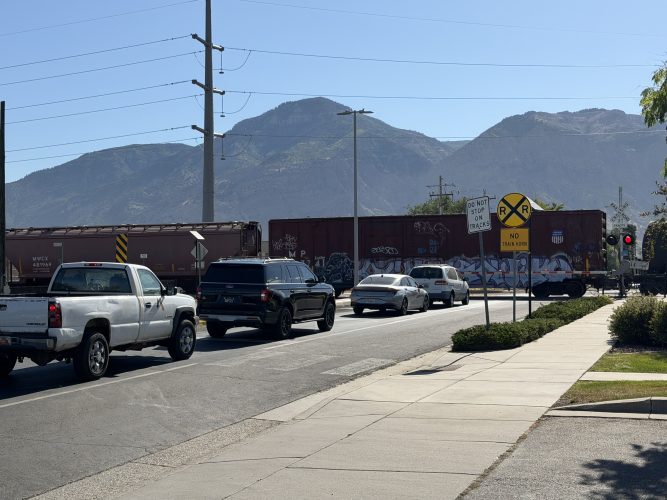
After making a brief stop, a slow train rolls across the Second Street railroad crossing in Ogden on Friday, July 10, 2026. (Rob Nielsen, Standard-Examiner)OGDEN — Trains are one of the most prominent examples of rolling commerce worldwide.
However, from time to time and for a plethora of reasons, that rolling commerce comes to a screeching halt across the very points where rail meets roadway, leading to delays for drivers.
In recent months, the Standard-Examiner has observed several trains stopped over the Second Street and 12th Street railroad crossings for prolonged periods, sometimes approaching an hour in length. The Standard-Examiner reached out to the Union Pacific Railroad and state and local officials to learn why these prolonged stops occur and how entities work together to mitigate impacts.
“Union Pacific has been serving America for more than 160 years, delivering goods communities rely on,” the Union Pacific Railroad said in a statement. “Cities and towns grew up along our network for a reason – we are a vital economic link that connects shippers and buyers to each other, and the world. Union Pacific’s goal is to keep trains moving safely and efficiently – a stopped train isn’t good for our customers or communities. There are a number of variables that can lead to stopped trains and blocked crossings, such as unplanned weather events that cause track blockages/damage, signal malfunctions, trains operating under reduced speed restrictions or mechanical issues.”
The statement continues by noting the railroad does try to work with local entities.
“Union Pacific regularly engages with local officials across our network to identify solutions and reduce conflicts between rail operations and roadway traffic,” the statement said. “While occupied crossings can sometimes create temporary delays, rail transportation plays a critical role in moving goods and reducing highway congestion, with a single train capable of removing hundreds of trucks from the road.”
State law — specifically Utah Code 41-6a-1204 — states that, “A person or government agency may not operate a train in a manner to prevent vehicular use of a roadway for a period of time in excess of five consecutive minutes.”
However, there are a handful of examples when this five-minute limit can be exceeded, including:
- “(a) when necessary to comply with signals affecting the safety of the movement of trains;
- (b) when necessary to avoid striking any object or person on the track;
- (c) when the train is disabled;
- (d) when the train is in motion or while engaged in switching operations;
- (e) when there is no vehicular traffic waiting to use the crossing;
- (f) when necessary to comply with a governmental safety regulation; or
- (g) as determined by a highway authority.”
Brad Palmer, Rail Division director with the Utah Department of Transportation, told the Standard-Examiner in an email that they are aware of several crossings where long stoppages occur and are in constant dialogue to mitigate these issues.
“UDOT has an open dialogue with several railroad companies to find solutions to minimize blocked crossings,” he said. “This is done through regular coordination meetings, reporting known blocked crossings, and working with cities and railroads to apply for federal grants to address blocked crossings at specific locations.”
UDOT Region 1 Senior Communication Manager Mitch Shaw told the Standard-Examiner this will likely be a reality in Ogden for some time.
“We’ve had discussions with both Ogden City and Union Pacific,” he said. “Last year, UDOT was informed by Union Pacific that due to new network demands and constraints, the railroad’s trains could potentially block traffic on 12th Street for up to 30 minutes at a time.”
However, he said there may be some relief coming to 12th Street in the long-term.
“UDOT is currently working with the Federal Railroad Administration to study the feasibility and cost of constructing a bridge across 12th Street,” he said. “It’s still in the early stages, but the project appears viable and ultimately we plan to seek federal funding to help pay for the project.”
In the meantime, the Federal Railroad Administration maintains a website where the public can log instances of blocked railroad crossings “to learn where, when, for how long, and what impacts result from blocked highway-rail grade crossings,” according to the site’s disclaimer. The site can be reached here: https://www.fra.dot.gov/blockedcrossings/
The Union Pacific Railroad also maintains a site where the public can report blocked crossings at https://www.up.com/communities/notify-union-pacific.
Local News
Bob Stevenson highlights mayoral, county-level governing history in House District 16 campaign
Julie Powell highlights ‘high level of expertise’ and ‘years of time and effort’ in campaign for Davis School Board District 3 seat