Guardrails needed: Ogden mayor, police chief discuss Flock cameras, their utility and their own concerns about abuse
Rob Nielsen, Standard-Examiner
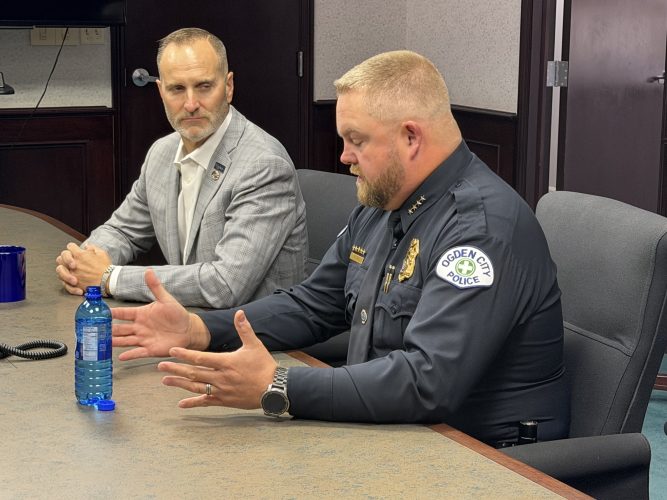
Ogden Mayor Ben Nadolski and Ogden Chief of Police Jake Sube speak with the Ogden Standard-Examiner editorial board on Thursday, Sept. 10, 2026.Editor’s note: This is the second of three stories following a Standard-Examiner editorial board interview with Ogden Mayor Ben Nadolski and Ogden Police Chief Jake Sube. Discussion topics included Immigration and Customs Enforcement and Automatic License Plate Recognition, or ALPR, technology.
OGDEN — Concerns have grown around Automatic License Plate Recognition, or ALPR, technology usage among law enforcement agencies across the country.
One of the biggest utilizations of ALPR technology is the Flock camera. Deployed by Atlanta-based Flock Safety, the Associated Press reported earlier this month that they have been deployed in 6,000 communities in very state except for Alaska and have become a point of bipartisan contention as the 2026 Midterm Election approaches.
Ogden Mayor Ben Nadolski said he felt the city was in a good position, but while researching ALPR technology use elsewhere, he said it became clear that more guardrails are needed.
“When this first started to bubble up, I was viewing it through the lens of how we manage it,” he said. “I thought, ‘Oh, no, I think we’re good.’ But when I started to hear more examples around the country about how other agencies manage it, or — in some limited situations — don’t manage it, I think it became pretty clear that there needs to be some strict guidelines on this stuff. In the upcoming legislative session, I’ll be looking for opportunities to support legislation that brings strong governance and strong guidelines and strong sideboards to this technology.”
He said that protecting the privacy of residents is paramount.
“We have got to protect people’s privacy, and we’ve got to have a framework that gives people the confidence that we’re operating within that,” he said. “So whatever accountability needs to happen, whatever transparency needs to take place, whatever governance to use those tools, I think people will find if they look into agencies across the state and the country, they’ll find that Ogden does it as well as anybody. But I think it’s important for Ogden that everybody does it as well as anybody, and if there’s anything out there that we can do and do better, we’re open to that, and we want to do that.”
Ogden Chief of Police Jake Sube said that Flock cameras have been an effective tool for police departments.
“I think they have a very profound effect on our ability to identify suspects, close cases — everything from arresting homicide suspects to sadly an individual hit and killed on Washington Boulevard,” he said. “Because of ALPR, we had a suspect arrested within an hour. These are valuable tools.”
However, he said he is aware of the public’s concerns about the technology and how it’s used, and that the Ogden City Police Department has already adopted stricter guidelines on ALPR’s use than is allowed in Utah.
“I do believe we in Ogden PD are doing it right,” he said. “We have been very much more restrictive than state law from the outset. State law authorized nine months worth of these license plate data. We’ve held to 30 days. We can see nothing past 30 days. We felt that that was sufficient, that it gave people the privacy right that they expected. We do have a robust ALPR program, but it is not so robust that it is creating an environment where you can’t move throughout the entire city without having been hit.”
Sube said there are currently 41 such cameras in Ogden City and that, so far, there haven’t been any reports of misuse involving the system in Ogden or involving Ogden residents.
“If you look at our system, we have put safeguards in place that a lot of agencies aren’t doing … that there are some cities across the state and country that don’t have that,” he said. “We’re not going to share any of our data with anybody until we have an MOU, or a Memorandum of Understanding, with that agency so they know our expectation, they’re held to our expectation, they’re held to our rules and regulations to access our data. Right now, we don’t share our data with anybody. You can pull our system, and it is not being shared by anybody.”
Nadolski said the city hears the concerns around the technology and will continue to implement guardrails on its use as needed.
“The feedback we’re getting right from the public on this is they demand transparency,” he said. “They’re demanding accountability. They’re demanding strict and strong guidelines on this topic. And I think if you look across the country, you can find instances where that’s not taking place, but I think the overwhelming majority of agencies are doing that. And if you look into Ogden, you’ll find that we have proactively, before this became such a hot topic, created a policy around the topic. We have created guidelines that are stronger than what are currently in state law, that we have a transparency portal online that puts a lot of this stuff in place, and that we have proactively communicated in the past when this technology has been used to solve crimes. And so I think that we have done a good job of being an example for how you can regulate this technology and do it in a smart and responsible way that balances the need and the requirement, in my view, of people’s privacy and confidence.”
Local News
Guardrails needed: Ogden mayor, police chief discuss Flock cameras, their utility and their own concerns about abuse
‘Duty and responsibility’: Ogden police chief, mayor discuss ICE involvement