Dance plus math = learning at Weber State workshop
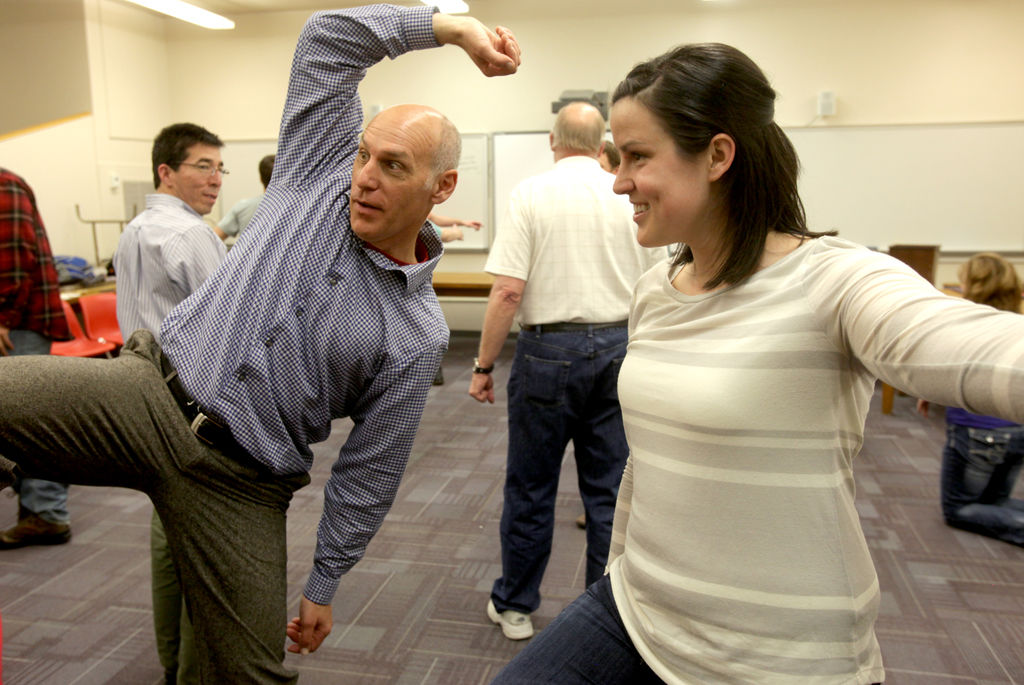
Dance professor Erik Stern, left,and student Whitney Ehlers, take part in a math dance class at Weber State University on Friday, Apr. 19, 2013. Stern teaches the course as a way to help future math teachers use dance in their instructions. (BENJAMIN ZACK/Standard-Examiner)
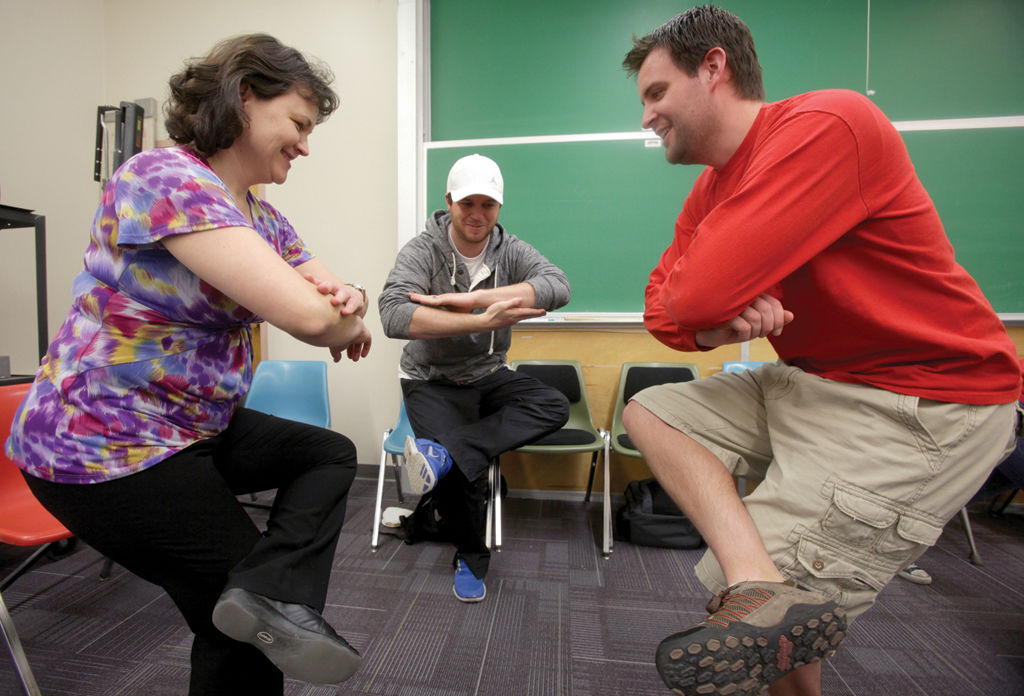
BENJAMIN ZACK/Standard-ExaminerMath professor Sandra Fital-Akelbek (left) and students Jason Frekcleton (center) and Ben Sherman practice moves in a math dance class at Weber State University on Friday. Fital-Akelbek brought the one-day course to her math methods class as a way to help future math teachers use dance in their instructions.
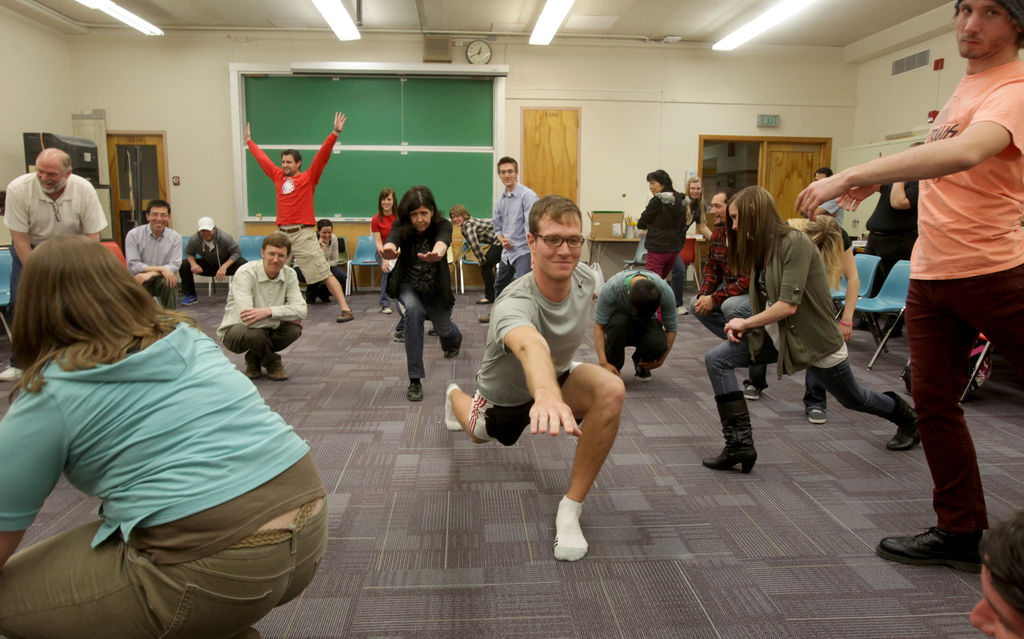
Students and professor from the math and dance departments take part in a "math dance" class at Weber State University on Friday, Apr. 19, 2013. The course is designed to help math teachers use dance as a optional way to teach math concepts. (BENJAMIN ZACK/Standard-Examiner)
OGDEN — Math major Mollie Emerson had doubts as she waited Friday for a Weber State University workshop that promised to illustrate mathematical principles through dance.
“I’m skeptical,” said Emerson, 21, of Ogden. “I can understand that maybe physics and dance are related. And I enjoy watching dance, but for myself, I have always just enjoyed pure science.”
The guest lecturer was Weber State’s own Erik Stern, Performing Arts dance professor, a touring artist/educator and co-author of “Math Dance,” a book of classroom activities for teaching mathematics through whole-body movement. Longtime dance partner Karl Shaffer is Stern’s co-author and collaborator on educational tours.
“I think the goal is to bring right brain and left brain together,” Emerson said. “I guess we will see.”
The chairs and long study tables of the math classroom had been pushed tidily to one side, and a single box of doughnuts beaconed to nervous, sensibly-dressed mathematics students and faculty members. Stern, dressed for movement and with untied shoelaces trailing behind him, strode to the front of the classroom, and before long had leapt atop a long, wooden table.
“Mathematics has patterns, and so does dance,” Stern explained. “Nobody gets to claim patterns. They belong to us all. And dance and mathematics are one of the most natural intersections of patterns.”
Stern asked his audience, about 30 mathematicians and five dancers, to form their bodies into random shapes. He then asked Emerson to demonstrate a shape — using her arms, legs and posture — which he mirrored with his own body.
“Now fly 30 feet above us, and look down,” Stern instructed his students, who exchanged perplexed glances. “Notice our symmetry and that when we rotate, we maintain our symmetry.”
Stern asked his listeners to move the poses they had improvised earlier in relation to each other. The group transitioned through variations on symmetry, including reflective, rotational and gliding forms.
“Symmetry is part of mathematics, dance, chemistry, architecture, genetics, visual arts, anthropology, and many other fields,” Stern explained. “You have just used your bodies to understand and explore symmetry.”
Stern led the group through a series of exercises, then divided them into eight subgroups, and announced each perform within a matter of minutes. Alarmed grumbling ensued.
“I tell my third-graders, ‘Take your mouth energy and put it into your bodies,'” Stern said, with a good natured laugh. “Don’t worry. This will not be going on YouTube.”
After the eight mini dances, the veteran teacher, dancers and mathematicians gave each other an appreciative round of applause. The group reviewed skills used, which included problem solving, balancing, communication and 3-D thinking. All were skills, Stern noted, that applied both to dance and to math concepts.
“We want to diversify how many ways something can be taught,” Stern said. “If we had discussed symmetry for a while, then I gave you a test, or if we had done this exercise, which way do you think you would remember more of what you learned?”
Stern believes math and dance are closely related.
“The arts and sciences have a tremendous amount in common,” he said. “When Karl and I started our work together, we both felt math and dance were doing the same things in different ways.”
Dixielee Blackinton, a WSU mathematics professor who prepares students to teach math to K-12 learners, said Stern’s “Math Dance” techniques would be invaluable in helping school children grasp many mathematical concepts.
“Mathematics is fairy abstract, and children understand it based on their prior experiences,” Blackinton said. “I think melding it with a physical experience would be very powerful for children. Erik Stern is a genius.”
Emerson also left a believer.
“That was awesome,” she said. “If I teach, I will be able to teach principles in a way my students can understand. My mind is blown.”
Education

9/11 at 25: WSU professor discusses what we’ve learned and how attacks compare to other historical benchmarks
Information session on Flock cameras set for Saturday