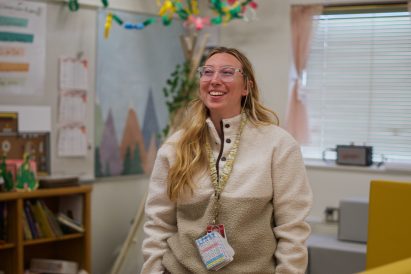
Davis School District children learn Navajo language in weekly classes
CLEARFIELD — The language of the Navajo rose and fell as Patricia Benally spoke to her class Wednesday evening with guttural stops, prolonged vowels and soft consonants.
Benally recited the Pledge of Allegiance while her class of about 15 elementary school children repeated after her.
“Kéyah ‘ashdladiingo bit háhoodzooígíí,” she said. “Bidahnaat’a’í shit niliigo biniinaa bich’i’ádíshní.”
While some of them faltered, all of the young students in the class parroted it back proudly.
Benally teaches Navajo language classes for the Davis School District in the Davis Community Learning Center. She Grew up in Arizona, attending a school on the reservation that taught in both Navajo and English.
“I never really knew how significant and special that was,” she said.
Benally left the reservation, went to college and bounced around New Mexico for a time before finding her calling volunteering in a kindergarten classroom.
“Now I see there is a demand (from) parents that do live off the reservation that are Navajo; they actually are yearning for that culture, classes and awareness,” she said.
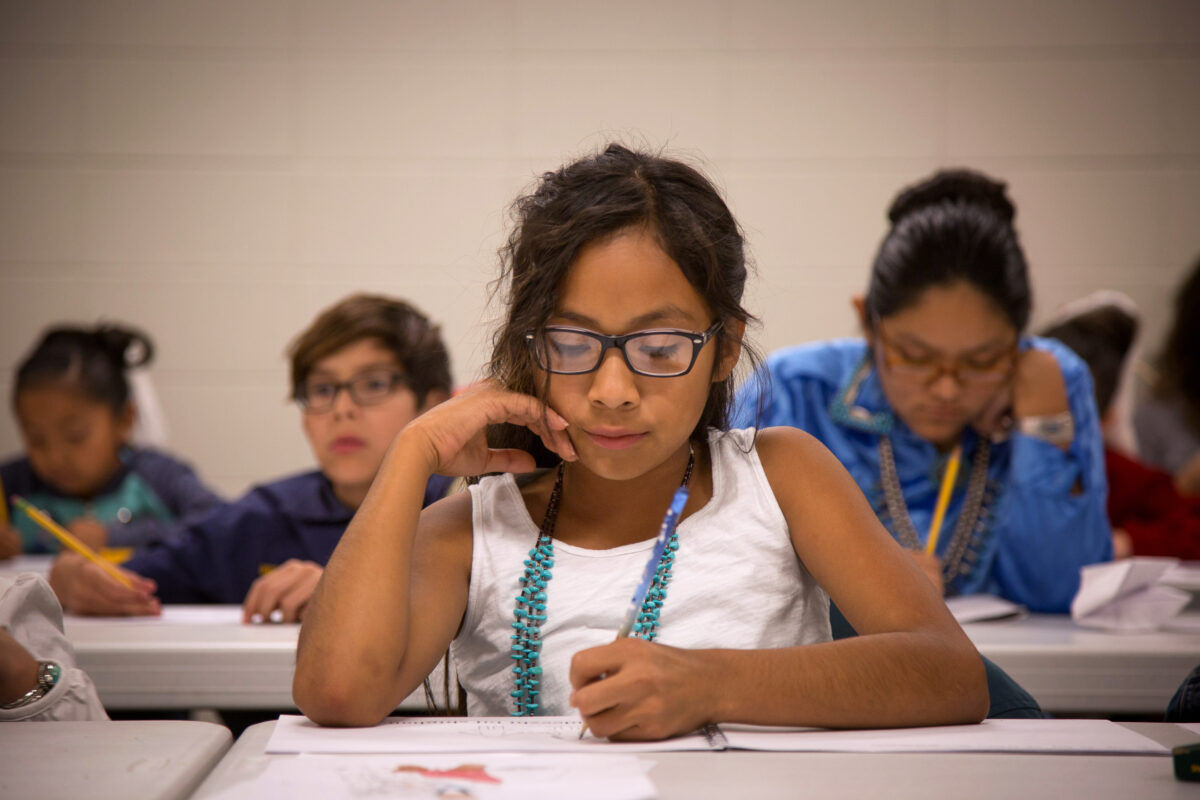
BENJAMIN ZACK/Standard-Examiner
Mikenzy John, 11, draws a picture of her “shideezhí” (the Navajo word for “little sister”) in the elementary Navajo language class at the Davis Community Learning Center on Wednesday, Nov. 16, 2016. Eighteen students from elementary schools around Davis School District spent the evening practicing traditional greetings, the alphabet and words for family members.
During her class Wednesday night, Benally went on to review vocabulary words — shimá for mom, shizhé’é for dad and shideezhí for little sister.
Mikenzy John, an 11-year-old in the class, said she has learned how to refer to several family members in Navajo.
“I think the hardest part with what I was learning was ‘bith,'” she said, drawing a lowercase ‘L’ with a slash through it. “You make the ‘th’ sound. That was always the hardest part.”
The Navajo Nation extends for more than 27,000 square miles in Utah, Arizona and New Mexico according to the tribal government website. The tribe is famously known for the Navajo Code Talkers, who played a crucial role in sending and receiving messages for U.S. troops in World War II.
As an oral tradition, the first Navajo-English dictionary was published in 1958. Benally has to teach her pupils a whole new alphabet with distinctly Navajo sounds not used in English and other latin-based languages.
Benally said that unlike English, tone is very important in the Navajo language.
“We’re basically singing with our voices,” she said.
Benally offered to teach the class because she wanted to get involved when she enrolled her 8-year-old daughter in the Davis School District and has been happy to see how many students are eager to learn Navajo.
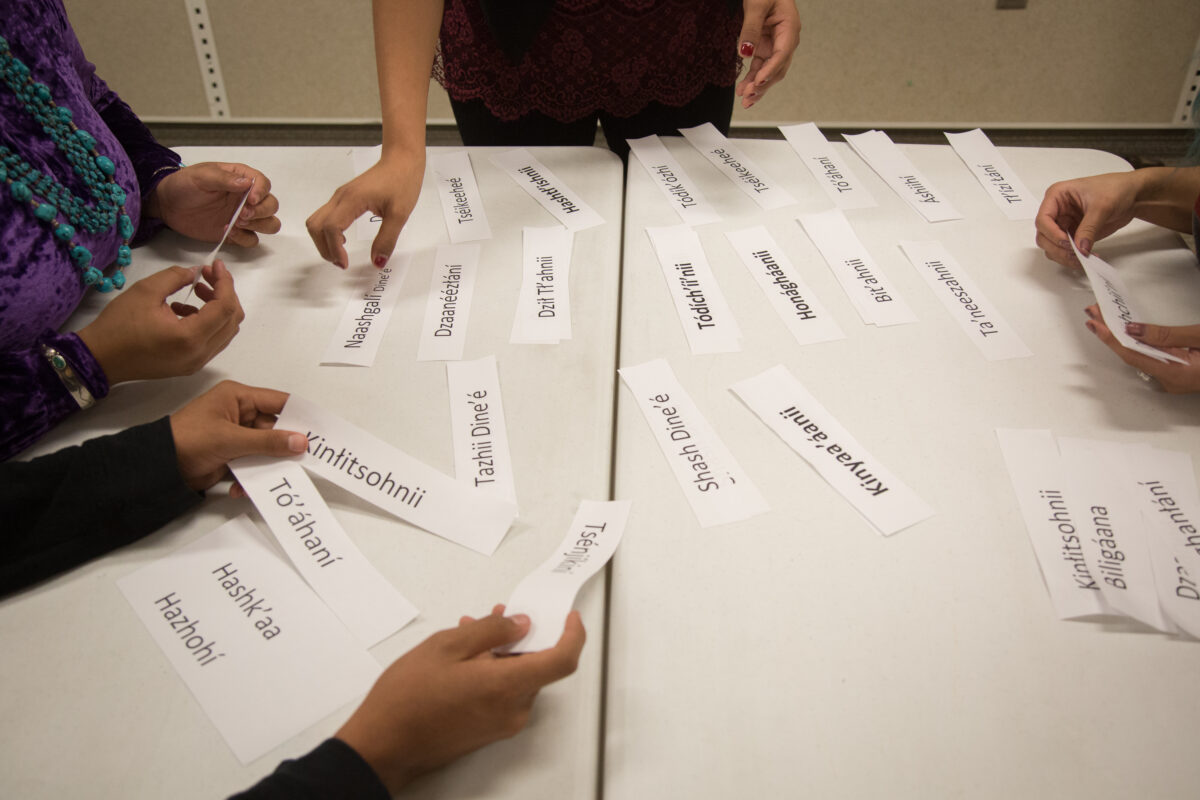
BENJAMIN ZACK/Standard-Examiner
Patricia Benally and her students sort the names of Navajo clans in Benally’s Navajo language class at the Davis Community Learning Center on Wednesday, Nov. 16, 2016. Some of the first lessons in the year-long class focus on traditional family and clan structures.
“Really I’m trying to instill their culture,” she said. “That’s their identity as a Navajo person.”
Jennifer Christensen is half Navajo and said she always wanted her children to learn the language, which is why she excitedly enrolled her daughter Zamari, 7, and son Zaiah, 5.
Christensen said her children love learning because of their grandpa, Christensen’s father, who is full Navajo.
“They always ask him questions about growing up,” she said.”They’re interested because they’re really close to him, so they want to be like him.”
Candice Bahe’s 10-year-old son Ian Stowell is also in the class.
“My son is half Navajo, so I wanted him to know his own language, and hopefully, I’d catch some of it,” she said.”
Benally said her class is almost entirely Native American except for one girl who comes because her best friend is in the class.

BENJAMIN ZACK/Standard-Examiner
Patricia Benally discusses a documentary on Navajo doctors with her secondary Navajo language class at the Davis Community Learning Center on Wednesday, Nov. 16, 2016. While the class is built around learning the traditional language, Benally also discusses Navajo cultural issues with her students.
“It’s an enrichment class, an extra-curricular activity. But it’s learning a second language, and it’s getting them exposed to the language and the culture earlier in life,” she said.
Benally is also enrolled in the Weber State University elementary education program on top of teaching the Navajo language class.
“I feel me being here as a Navajo student coming from the southwest, I’m bringing diversity and cultural awareness and as a student ambassador that’s my goal,” she said.
The language class is a Title VI program funded through the Office of Indian Education and Benally also works with a group of high school students every week because the class was originally created to accommodate those eligible for a Navajo Nation Scholarship, which requires a course in Navajo history.
On Wednesday, she showed her class of six students a video about being a medical professional as a Navajo because the Navajo don’t believe in touching the dead.
Dru Yazzie, a 16-year-old, takes science classes and is interested in going into the medical field but was told by a tribal medicine man it was an unusual path for a Navajo to take.
“The balance between modern culture and our traditional culture is kind of hard,” Yazzie said.
Anna Burleson at aburleson@standard.net. Follow her on Twitter at @AnnagatorB or like her on Facebook at Facebook.com/BurlesonReports.
Education
Longtime Roy AD Puzey resigning amid district changes to the position
To raise our children: Early childhood educators fill vital roles in building communities but face tough challenges