Utah Senate approves homeless shelter bill after county official opposition
Deborah Wilber, Standard-Examiner file photo
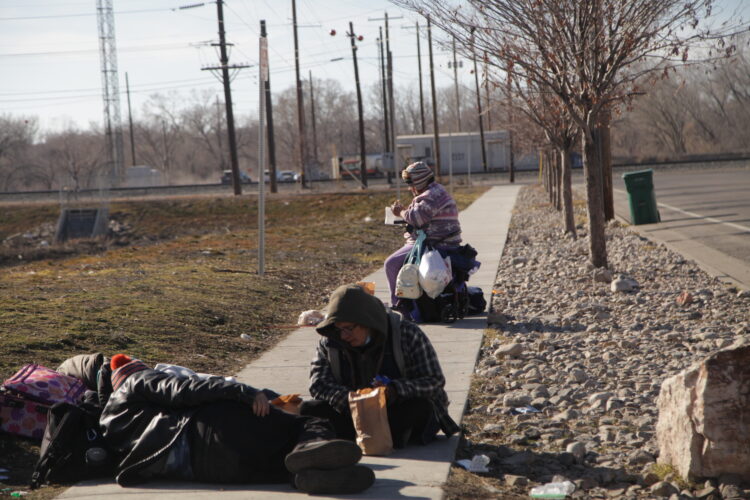
Ogden residents eat sack lunches on the sidewalk outside of the Lantern House homeless shelter in Ogden on Friday, Feb. 11, 2022.As the 2023 Utah legislative general session comes to a close, elected officials introduced a bill that seeks to introduce new guidelines for cities and counties in helping homeless individuals.
House Bill 499, titled “Homeless Services Amendments,” would adjust plans instituted in 2022, focused on Salt Lake City, and expand them across the Wasatch Front, including Utah County.
The goal of the bill is to provide shelter for people experiencing homelessness and make resources more readily available, along with enforcing existing laws.
“We want to get people out of the streets, where assaults, sexual abuse, drug use runs rampant,” Rep. Steve Eliason, R-Sandy, the bill’s sponsor, said in a committee hearing.
The bill has the support of Wayne Niederhauser, the state’s homelessness czar, and was sponsored in the Utah Senate by Jacob Anderegg, R-Lehi. It passed the Utah House of Representatives on Tuesday by a vote of 71-1 with three members — including Utah County’s Kay Christofferson, R-Lehi, and Val Peterson, R-Orem — not present. On Wednesday, the bill passed the Senate with a voice vote.
Utah County, with a population just under 650,00, is the second largest in the state, ahead of Davis County with over 358,000 people. Neither county has a homeless shelter, leaving many unhoused people traveling to Salt Lake and Weber counties to find shelter.
The bill, which is now heading to Gov. Spencer Cox for his signature, modifies the formula used by the Office of Homeless Services and “requires certain counties to convene a county winter response task force for the purpose of preparing a county winter response plan.”
Counties will also be required to annually prepare a winter response plan to meet minimum bed counts, create a transportation plan to aid homeless people and meet requirements in a “code blue” event as initiated by the Department of Health and Human Services.
While it will not result in a direct tax on residents and businesses, the bill would decrease local sales tax revenue to local governments by approximately $1.41 million.
The final bill comes after opposition by multiple Utah County officials and bodies specifically against mandates put forward by the state to each county.
“We are writing … to respectfully request one change to HB499: removal of the provision mandating that we plan for, and then operate, the means to shelter individuals under certain circumstances,” reads a letter released by the Utah County Council of Governments. “We know you can enact that later, so this can be considered a pause. But we would greatly appreciate a time period to learn more about the existing shelter system and expansion plans, the core philosophies underlying them, and the long-term vision of where this overall shelter approach will put Utah, and Utah County, decades from now.”
The request that officials change language in the bill came after a determination by members of the COG that it was considered a high priority by Cox’s office and was likely to pass. The COG is comprised of each city’s mayor and the three Utah County commissioners and operates under the Mountainland Association of Governments.
When discussing the bill in a Feb. 22 meeting, Commissioner Amelia Powers Gardner said the group’s lobbying efforts should focus on not having a full-time shelter and allowing a nonprofit to run an emergency shelter in the county.
Officials also questioned why the funding is placed on counties, rather than coming from state coffers. “It’d be nice if those tax dollars came from the extra money the state has instead of putting it on our shoulders when we have so many other financial responsibilities in Utah County,” Lehi Mayor Mark Johnson said in the meeting.
According to Anderegg, the bill focuses primarily on Salt Lake County and the “crux” of the discussion surrounds emergency housing availability. He also highlighted the deaths of five unsheltered people in January due to cold weather, including one person in Utah County. The letter received unanimous support from the COG.
“Homelessness has long been a statewide concern, but it is fought on a community level. Local elected officials in Utah County want to be part of the solution,” Provo City spokesperson Nicole Martin said in a statement to the Daily Herald. “Those elected officials, acting through their regional body, the Utah County (Council of Governments,) have never opposed the bill. They have requested modification to that one piece of it. They are willing to organize a task force and spend more funds on this, as contemplated by the bill. But they would appreciate the chance to explore whether this idea of local government being required to plan to ensure shelter from extreme cold is fully vetted.”
If enacted, the bill would also increase revenue to the Homeless Shelter Cities Mitigation Restricted Account with costs to the Department of Workforce Services from the same account.
Local News
MEDIC SOLO first aid courses coming to Ogden next month

Giving back: Ogden Pioneer Days Foundation, school district foundations form partnership to aid Dolly Parton’s Imagination Library