Utah election audit finds no ‘compliance issues’ in Weber or Davis Counties
Concerns highlighted in Utah, Wasatch counties
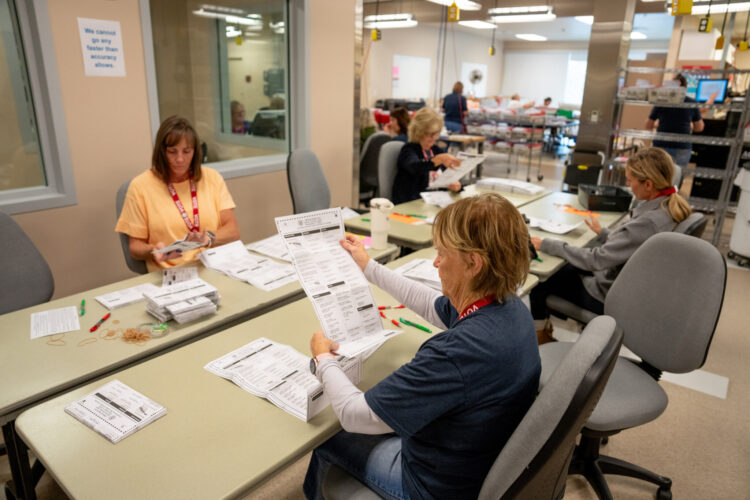
Photo by Spenser Heaps for Utah News Dispatch
Election workers process ballots at the Davis County Administrative Building in Farmington on Election Day on Nov. 5, 2024.After years of close scrutiny and multiple audits, a new legislative audit says the office of Utah’s chief election official has been “diligent in improving” the state’s election system — but some county clerks “did not fully implement all changes” to their elections.
Legislative auditors, according to the report released Tuesday, did an in-depth review of three counties: Utah, Wasatch and San Juan. Clerks overseeing those counties’ elections, auditors wrote, “can improve their efforts to follow and implement changes to election requirements.”
“In some cases, county clerks committed similar compliance errors we identified in previous audits,” auditors wrote. “The repeated nature of these errors is concerning, as it shows that clerks misunderstood corrective actions or did not fully address them.”
Auditors continue to note, as they have in past audits, that they’ve found no “significant fraud” in Utah’s elections. However, some “repeated deficiencies,” auditors concluded, “show the need for greater oversight of election compliance.”
“When clerks fall short of their election duties, the (lieutenant governor’s office) has statutory authority to enforce compliance,” auditors said, also noting that Lt. Gov. Deidre Henderson’s office has prioritized assisting and supporting clerks rather than jumping to enforcing compliance.
That “limited approach to oversight, sometimes deferring to county elected officials’ implementation decisions rather than actively monitoring and correcting noncompliance,” may have contributed to errors auditors said they observed over multiple previous election audits.
The audit released Tuesday comes after legislative auditors followed up on how the lieutenant governor’s office and county clerks have implemented recommendations from an audit in 2024.
“As we said in 2024, ‘While we did not find significant fraud in Utah’s election system, the recommendations and findings in this report are needed to ensure continued election integrity,'” auditors wrote. “Utah’s election controls mitigate the risk of fraud as long as election officials use them properly. Given the errors we continue to see, we believe there is a need for improved oversight of compliance with election requirements.”
Auditors credited Henderson’s office with following their recommendations to improve the state’s election system stemming from two reports, in 2022 and 2024, and for taking steps.
“Even so, we observed county clerks repeating errors identified in previous audits and struggling to implement new election requirements,” auditors wrote.
Henderson, in a written response to the audit, said it “strikes at the heart of the balance between state oversight of elections and the actions of independently elected county officials.”
She detailed her office’s efforts to visit each of the three counties, give training and provide other resources in order to help them correct their mistakes.
But she also noted that “numerous legislative changes” to the state’s election system by the Utah Legislature each year “makes successful implementation of new election laws a challenge.” She also noted last year’s major election law, HB300, passed even though lawmakers didn’t fund a full-time employee to help implement its changes.
“We would welcome the chance to fully implement new laws and have time to assess their effectiveness before substantial new changes are made,” Henderson wrote. “This would reduce both voter confusion and human error, and save taxpayer dollars.”
Issues in Utah County
In Utah County, the state’s second-most populous county, auditors said the office that has most recently been headed by Utah County Clerk Aaron Davidson “generally conducts its elections well,” but they saw some instances where “the county clerk and staff did not fully comply with some election requirements.”
That included not fully complying with requirements for reviewing candidate nomination signature packets, some volunteers not taking state-required training before conducting the county’s post-election audit, poll workers inconsistently accepting or rejecting different types of documents for proof of residency in ways that may have impacted some provisional voters’ ability to register and cast a ballot, and not reconciling or documenting reconciliation discrepancies within the timeframe required under law.
Auditors wrote that some candidate signature packets submitted to Utah County lacked required information, including contact information for those who gathered signatures. Instead of rejecting the packets, in an effort to address the missing information, the Utah County clerk’s office in some cases gathered “missing information from indirect sources instead of from the candidates,” and still accepted those packets.
Additionally, Davidson and his elections director “did not create policies or procedures to avoid a conflict of interest when processing candidate nomination petitions,” auditors wrote, even though Davidson was on the ballot for the 2026 primary election. Administrative rules require county clerks to develop a written audit policy and, in a race where there could be a conflict of interest, to designate another elected official to conduct the audits for that race.
In that election, Davidson lost to his GOP challenger Corey Astill, who will now be on the upcoming November ballot to compete in the general election. Astill is likely to win the Republican-majority Utah County, but he’ll face off with Forward Party candidate Russ Rampton.
Davidson “did not involve himself in the candidate nomination petition signature audit,” auditors wrote. “However, rather than a separate elected official, the elections director and an elections administrator performed the audit.”
Auditors noted Davidson’s office indicated it wasn’t aware of the requirements to develop a written policy and to have another elected official audit a conflicted race.
Davidson, in a written response to the findings, disagreed with the audit’s findings and criticized it as “nitpicking.”
“While this performance audit is well-intentioned, we feel it went way beyond its intended purpose by identifying minor mistakes and creating an environment of contention,” Davidson wrote. “It is already difficult to find and retain well-qualified election workers, and this level of scrutiny will only drive more of them away and make it more difficult to hire election workers.”
Davidson also wrote that “performance audits should be used to identify issues that could meaningfully improve systems and controls, rather than nitpicking county clerks or threatening enforcement actions for minor errors made by humans operating within a complex, ever-changing system.”
“Unless the state intends to invest in automated robotics to implement these processes, performance audits should account for the complexities of the system and recognize that humans are doing their best to carry out these duties without the benefit of trial elections,” Davidson wrote.
In response to Davidson, auditors acknowledged that “human error is a factor in all systems,” but the mistakes they found “are repeat errors that appeared in prior audits and that have been made by multiple clerks.”
“That pattern is concerning and contributed to why we reported those mistakes and expect improvement,” auditors wrote. They acknowledged that Davidson won’t be in office when they conduct their follow-up audit, but “we still expect the subsequent clerk to implement the recommendations in our report.”
Issues in Wasatch County
Auditors also listed what they characterized as “several relatively minor shortcomings in processes” in Wasatch County, including ballot chain of custody, reconciliation and election audits.
The office, headed by Wasatch County Clerk-Auditor Joey Granger, had “failed to implement some recent changes to election requirements” even though the lieutenant governor’s office provided guidance in the state’s elections handbook.
For example, Wasatch County “correctly performed its post-election ballot audit but did not properly implement certain attestation requirements,” auditors wrote.
“Wasatch County filled out the election officer’s attestation form, but the forms for the audit participants did not contain the required information,” the report says. “Audit participants also did not complete the required training.”
Additionally, for the 2026 primary, Wasatch County did not have two auditors conduct its 1% ballot signature audit as required and reported doing the audit inconsistently.
“While the county performed other parts of its election audits correctly, it can still address the errors mentioned,” auditors wrote.
Auditors also found Wasatch County still has one room where ballots were processed that did not have proper camera monitoring as required under Utah law. They also said Wasatch County election staff did not use security seals on drop boxes.
“While we did not observe staff tampering with ballots during the pick-up process, security seals increase ballot integrity and security,” auditors wrote.
During Wasatch County’s reconciliation process, one double vote was also found after it had been counted, not before.
“The county processes mail-in envelopes and in-person votes through separate election machines that are not connected. Election workers must manually upload voter data so the machines know who has already voted and can identify double votes,” the report says. “In this case, the voter cast an in-person ballot, but that vote credit was not uploaded into the mail-in ballot processing machine before the county processed the voter’s mail-in ballot. Thus, the machine did not flag their mail-in ballot as a double vote and both ballots were counted.”
In discussing the issue with Granger and the lieutenant governor’s office, auditors said they confirmed that it’s possible for double votes to happen in not just Wasatch County but others, so they did a “limited review” of other counties to see if it could be happening in other parts of the state. However, they concluded the double vote in Wasatch County to likely be the only one.
Like Utah County, Wasatch County also had issues with accepting candidate signature packets that lacked required information, and it lacked a policy designating that another elected official audit the signature packets in races that could have a conflict of interest.
“As a result, it was reported that staff in the clerk’s office — rather than another elected official — audited the packets for both candidates running for county clerk,” auditors wrote.
In this year’s primary, Granger lost to her Republican challenger, Park City Record Michelle Kellogg.
Granger, in a written response to the audit, said her office “recognizes the vital importance of free and fair elections, and the laws and administrative rules that ensure such elections.” While she objected to some of the specifics included in the audit, she echoed auditors’ characterizations that the “shortcomings identified in the audit are relatively minor, but even so I will strive to ensure strong and effective election controls.”
Utah News Dispatch is part of States Newsroom, the nation’s largest state-focused nonprofit news organization.
Government
Utah election audit finds no ‘compliance issues’ in Weber or Davis Counties
Guardrails needed: Ogden mayor, police chief discuss Flock cameras, their utility and their own concerns about abuse