Shorter radiation treatment could ease burden on breast cancer patients after reconstruction
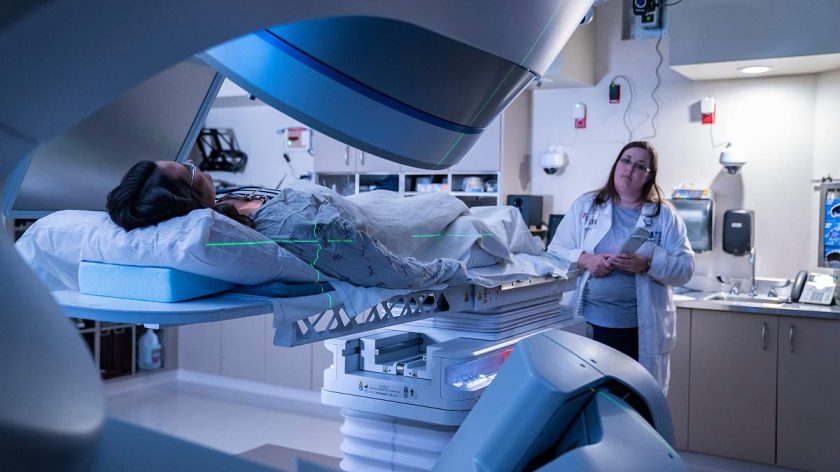
Courtesy Huntsman Cancer Institute at the University of Utah
A clinical trial found short-course radiation after mastectomy and breast reconstruction is as safe and effective as standard five-week treatment.A study led by a physician from Huntsman Cancer Institute at the University of Utah (the U) found that shorter courses of radiation are as safe and effective as the standard five-week treatment for breast cancer patients who undergo the removal and reconstruction of their breasts–practice-shifting findings that could lead to more accessible and convenient treatment opportunities for patients.
“This clinical trial showed us that it’s safe to do short-course radiation, that its effectiveness is the same, and that the rates of breast cancer recurrence are no higher,” says Matthew Poppe, MD, FASTRO, Huntsman Cancer Institute physician-scientist, professor of radiation oncology at the U, and first author of the study. “We have been trying to establish shorter, more cost-effective, and more convenient courses of radiation for breast cancer patients. These findings should make cancer care more accessible for our patients and encourage physicians to adopt the practice.”
The results of RT CHARM, a clinical trial from the Alliance for Clinical Trials in Oncology, were published in the prestigious Journal of Clinical Oncology.
Short-course radiation, which Poppe and his team evaluated in the study, is delivered over three weeks instead of the standard five weeks. Patients who undergo short-course treatment–also known as hypofractionation–receive a stronger daily dose of radiation but less radiation overall throughout the entirety of their treatment.
Physicians recommend many patients undergo radiation after a total mastectomy, or removal of the breast tissue, as it has been clinically shown to improve survival rates for breast cancer patients with larger tumors or positive lymph nodes. Many patients who have their breasts removed also choose to have breast reconstruction, a procedure in which surgeons recreate the shape of the breast with an implant or the patient’s own tissue.
Radiation can cause reconstruction complications, including infection, poor wound healing, and hardening of the scar tissue. Poppe says that physicians have long been concerned that the shorter treatment plan with a stronger daily dose of radiation would worsen reconstruction complications.
To evaluate the safety and efficacy of short-course radiation after a mastectomy, the RT CHARM trial enrolled 898 eligible patients from 209 academic and community sites in both the United States and Canada. Enrolled patients were divided into two groups–one that underwent 25 radiation sessions over the standard five-to-six-week treatment and another that was treated during 16 sessions over three to four weeks.
The team found that the shorter, 16-session course of treatment did not compromise cancer outcomes or raise reconstruction complication rates.
Poppe says these findings are particularly impactful for Huntsman Cancer Institute patients, who often travel long distances from across the Mountain West to receive specialized cancer care.
“I’ve had many patients who live far from Salt Lake City who have said they won’t do radiation, as they can’t close their small business or be away from their children for five or six weeks. It’s just not convenient,” says Poppe. “Giving our patients the option to choose short-course radiation will require significantly less travel time and less time away from their lives and families.”
Huntsman Cancer Institute is the only National Cancer Institute-designated comprehensive cancer center in the Mountain West, serving patients in Idaho, Montana, Nevada, Utah, and Idaho. Nearly a third of Huntsman Cancer Institute patients travel over 150 miles for cancer care.
Poppe’s next report from the study will evaluate how short-course radiation impacts cosmetic and patient-reported outcomes of reconstruction in breast cancer patients.
The Alliance for Clinical Trials in Oncology is one of several large cooperative groups federally funded by the National Cancer Institute who conduct clinical trials in the United States and Canada.
The critical research happening every day at Huntsman Cancer Institute is supported by the National Institutes of Health/National Cancer Institute, including cancer center support grant P30 CA042014, as well as Huntsman Cancer Foundation.
Health News
Shorter radiation treatment could ease burden on breast cancer patients after reconstruction
Celebrating 50 Years: Holy Cross Hospital-Davis invites public to celebrate hospital’s 50th birthday