At Weber State, Jewell notes epic Western drought
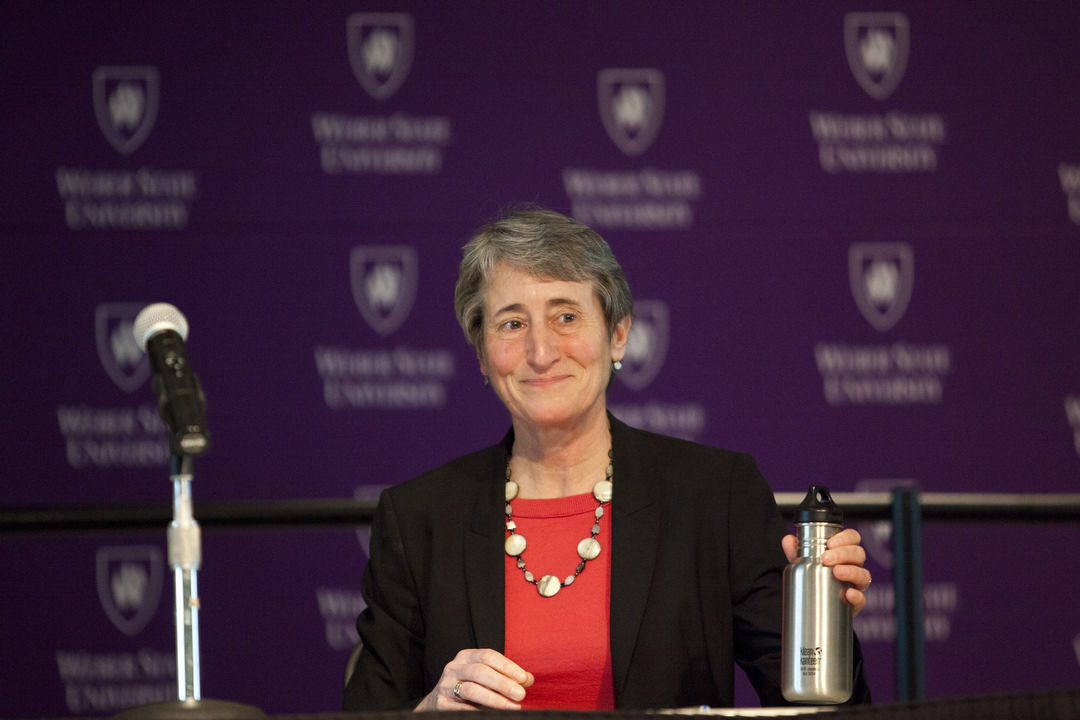
US Secretary of the Interior Sally Jewell spoke at the Intermountain Sustainability Summit at Weber State Universityin Ogden on Thursday March 6, 2014. She touched on topics such as recycling, minimizing bushiness's carbon foot prints, designated areas for development and conservation and connecting the millennial generation with nature. (BRIANA SCROGGINS/Standard-Examiner)
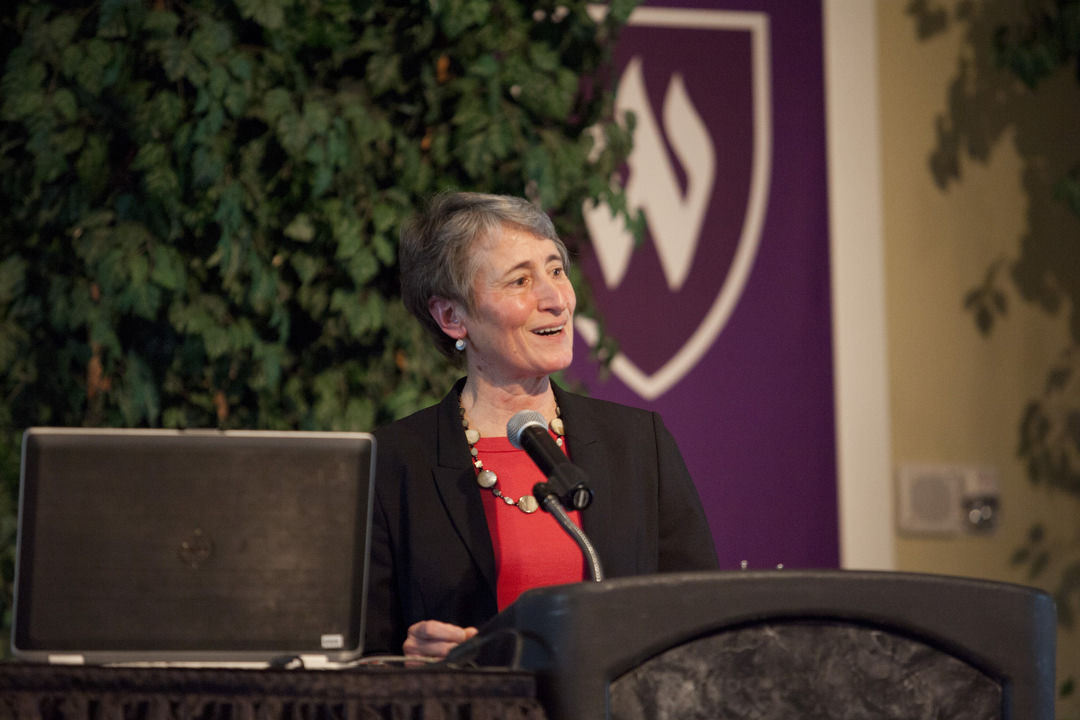
US Secretary of the Interior Sally Jewell spoke at the Intermountain Sustainability Summit at Weber State Universityin Ogden on Thursday March 6, 2014. She touched on topics such as recycling, minimizing bushiness's carbon foot prints, designated areas for development and conservation and connecting the millennial generation with nature. (BRIANA SCROGGINS/Standard-Examiner)US Secretary of the Interior Sally Jewell spoke at the Intermountain Sustainability Summit at Weber State Universityin Ogden on Thursday March 6, 2014. She touched on topics such as recycling, minimizing bushiness's carbon foot prints, designated areas for development and conservation and connecting the millennial generation with nature. (BRIANA SCROGGINS/Standard-Examiner)
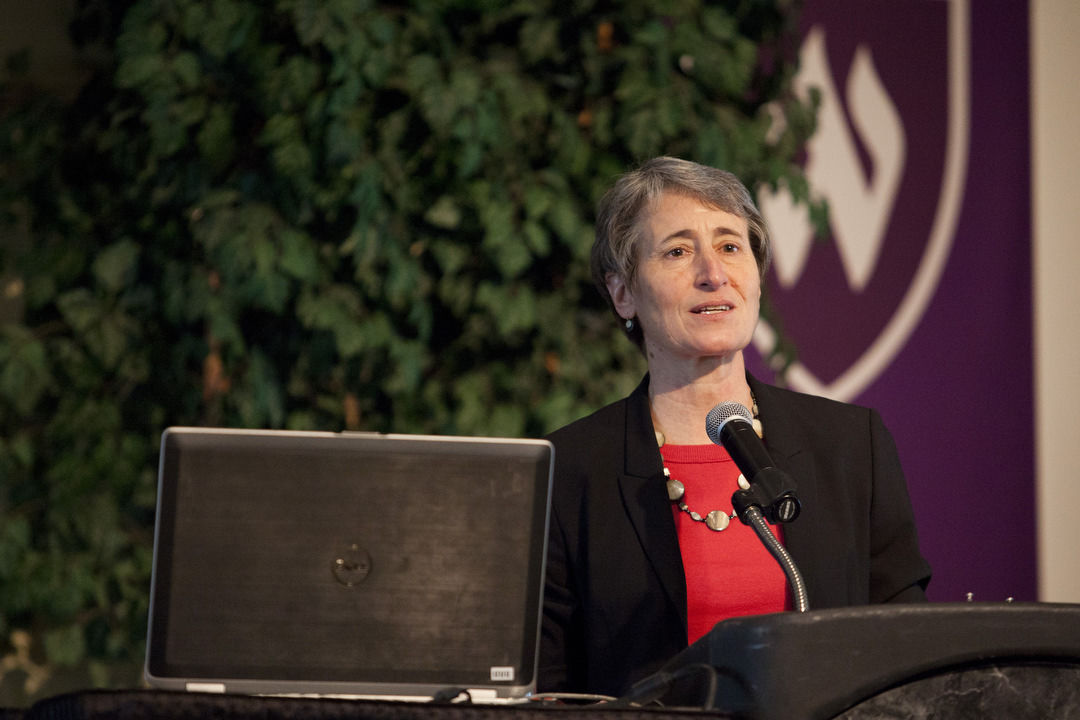
US Secretary of the Interior Sally Jewell spoke at the Intermountain Sustainability Summit at Weber State Universityin Ogden on Thursday March 6, 2014. She touched on topics such as recycling, minimizing bushiness's carbon foot prints, designated areas for development and conservation and connecting the millennial generation with nature. (BRIANA SCROGGINS/Standard-Examiner)
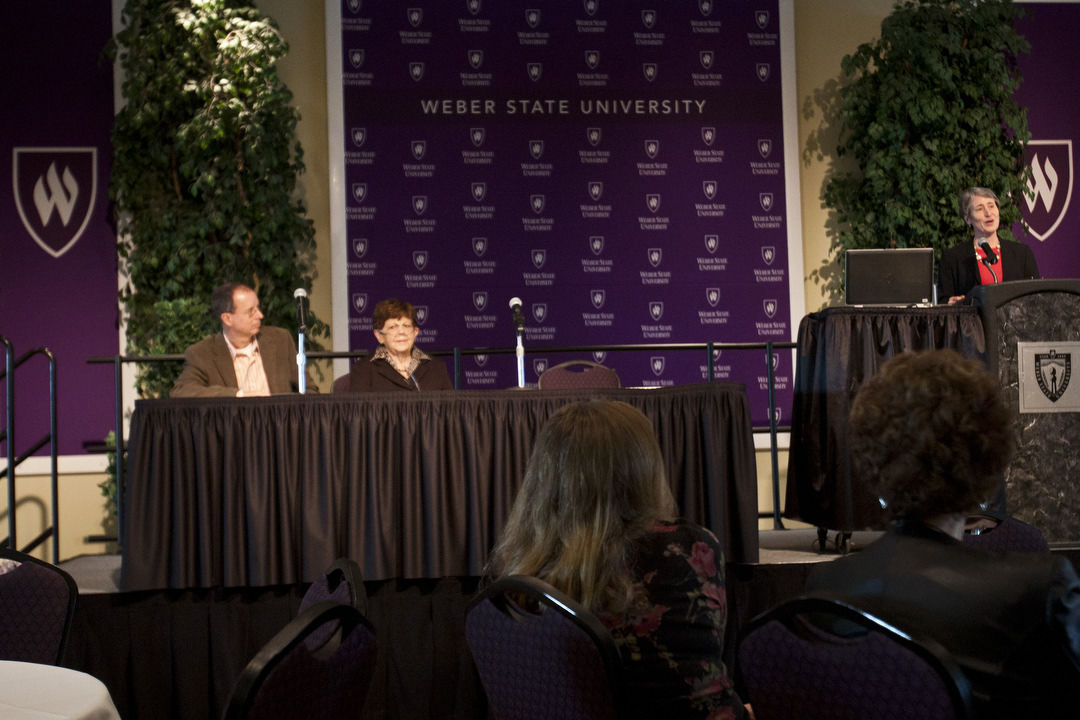
US Secretary of the Interior Sally Jewell spoke at the Intermountain Sustainability Summit at Weber State Universityin Ogden on Thursday March 6, 2014. She touched on topics such as recycling, minimizing bushiness's carbon foot prints, designated areas for development and conservation and connecting the millennial generation with nature. (BRIANA SCROGGINS/Standard-Examiner)
OGDEN — Dealing with drought is one of the biggest challenges facing Sally Jewell as U.S. Secretary of the Interior — and Utah is included in one of the areas of greatest concern.
“In the Colorado River Basin … we are looking at the lowest one percent recharge rate into the Colorado River, looking back over a 1,200-year paleo record,” she said. “The 14-year period we’ve just ended, in 2013, is the driest one percent of a 1,200-year record.”
Utah hasn’t suffered much from water shortages yet, largely because of management by the Bureau of Reclamation and state water authorities, she said, but we need to be even smarter.
“Snowpack is being reduced over time, in Utah and many other states,” Jewell said. “One of our great reservoirs is snowpack — it’s the frozen kind. When climates warm a little bit … the snowpack is getting reduced, and the liquid water is increasing, but we don’t have ways of capturing that.”
Water was just one of the topics Jewell touched on in her keynote address at the Intermountain Sustainability Summit, which opened Thursday at Weber State University, and continues today in the Shepherd Union Building ballrooms.
This is the fifth year the summit has been held at WSU. It started with a 60-person meeting focused on recycling, and now has four additional tracks: Energy, Sustainability in Higher Education, Air Quality, and Green Building and Urbanism. In addition to speeches, and classes, there were booths from local businesses, non-profit organizations and even national parks, about sustainable products and practices.
Jewell, who has worked in the oil business, banking and as CEO of REI outdoor supply company, told the audience she accepted the job as Secretary of the Interior because we’re facing some of the most challenging issues of our time.
“It’s not easy to be a public servant — there’s an awful lot of people that like to pummel you, and say it’s full of waste, fraud and abuse, and give you a hard time,” she said. “But the reality is there is no higher calling than public service, because you can make a difference.”
Jewell says she has challenged the 70,000 people who work for her department to pay attention to three trends that are now affecting the United States: Constrained resources, generational transformation, and climate change.
People want to pay less in taxes, but get more in services — and that can only happen for so long, she said. “Soon you’re doing less, with less. … How to you prioritize what you do?”
The generation transformation is happening because the large baby boomer population is retiring, and they take with them a lot of knowledge. As an example, she pointed to two men in charge of operations at Hoover Dam — ages 72 and 58.
“Who’s going to learn from those two individuals?” she asked. “How do we transfer knowledge?”
When it comes to climate change, Jewell says we are all part of the problem.
“There’s sort of a paradox between enjoying healthy outdoors, and perhaps being part of the challenge that the outdoors is facing in climate change,” she said.
Finding solutions often means taking risks, but Jewell admits that can be tricky.
“In business, you’re encouraged to take risks. In the public sector, if you take a risk and you’re wrong you are crucified, so it causes people to want to take less risk,” she said. “We’re in the forever business — people expect Arches National Park and Delicate Arch to be around forever.”
In the face of those challenges, Jewell says the Department of the Interior is working on climate science, resilience and renewable energy, while also recognizing that conventional energy fuels the economy now — and will for many years to come.
“The BLM (Bureau of Land Management) is working on master leasing plans,” she said, and that means talking to local citizens about areas they think should be developed, and those that are too special to consider. “I issued my only secretarial order so far, and it was on looking at landscapes broadly, and thinking about mitigation for development on a more broad scale. … I want to think more holistically about landscapes, to de-conflict areas and say, ‘Let’s put our efforts into supporting development, where there’s agreement there should be development, and let’s put our efforts into conservation where we agree there should be conservation, instead of focusing on fighting and being in the courts.’ “
There’s plenty of fighting when it comes to land management.
“With the federal government — which people love to vilify, and this state is right up there — you have to recognize that there’s a lot of things that we all, as citizens of the United States, get benefit from that we’re not aware of on a day to day basis,” she said, noting that the value to the nation of all national parks includes about $27 billion in visitor spending every year. “Utah’s share is $613 million in visitor spending, and more than 9,400 jobs directly involved with national parks statewide.”
People learned a lesson about that last year, she said.
“There’s not a better brand, I think, in the federal government than the National Park Service, and there’s a reason when the government shut down in October, which was a miserable experience for all of us, they were the pointy end of the spear,” Jewell said. “You know their logo is the arrowhead?”
Jewell is pushing an ambitious youth initiative, saying that today’s young people are more disconnected from nature than any previous generation.
“I want millions of children playing on public lands — playing in an unstructured way,” she said. “I’m charging my team to get 10 million children learning in nature’s classroom.”
She also wants them working as volunteers and interns, on public lands.
Christine Myers, from Durango, Colo., was happy to hear Jewell’s emphasis on youth programs, including one similar to the Depression-era Civilian Conservation Corps.
“That way youth can come in and get the skills needed to take the place of aging baby boomers,” she said.
Thomas Cushing, a young University of Utah student from Boston, found Jewell’s take on the need for young people to connect with nature interesting.
“We’re not outside as much,” he said of his generation. “But I think climate change, and global warming, is a much more pressing issue to my generation than, I would say, to the baby boomer generation.”
Cushing was disappointed in one aspect of Jewell’s speech.
“She kind of danced around fracking,” he said. “She was talking about how we do need to expand resources in a responsible way, which I completely agree with — you can’t just do away with the old system — but she wasn’t promoting any regulations or different practices to make fracking a cleaner alternative to what were doing today.”
Leroy Christensen, a WSU student from Ogden, noticed that she didn’t take on the big issue of the Keystone Pipeline.
“I wonder how much she influences President Obama, and her thoughts and feelings on things, but we didn’t hear any of that,” he said.
Christensen was happy that she answered an audience question about the controversial roundups of wild horses in the West.
The horse population increases 20 percent every year, Jewell said, so the herd doubles in size every three-and-a-half years. That’s a problem because of conflicts over grazing, and it also creates more water issues.
“The horses, when it gets dry in a drought situation, get very protective of the water supply and don’t want to share with cattle, elk and other species,” she said.
Laws prevent the animals from being euthanized, and nobody likes the round-ups, but they’re better than horses dying of thirst and starvation, she said. The best solution may be birth control.
“It’s pretty easy for a stallion — we know what to do — but it’s hard to get to all of them,” Jewell said, adding that birth control for female horses is not so simple. “If you’ve got a silver bullet, I’d love to have it , but I don’t think there is one.”
Contact reporter Becky Wright at 801-625-4274 or bwright@standard.net. Follow her on Twitter at @ReporterBWright.