Fentanyl is behind many Utah overdoses. A DEA agent shows how easy it is to make
Courtesy U.S. Attorney’s Office for the District of Utah
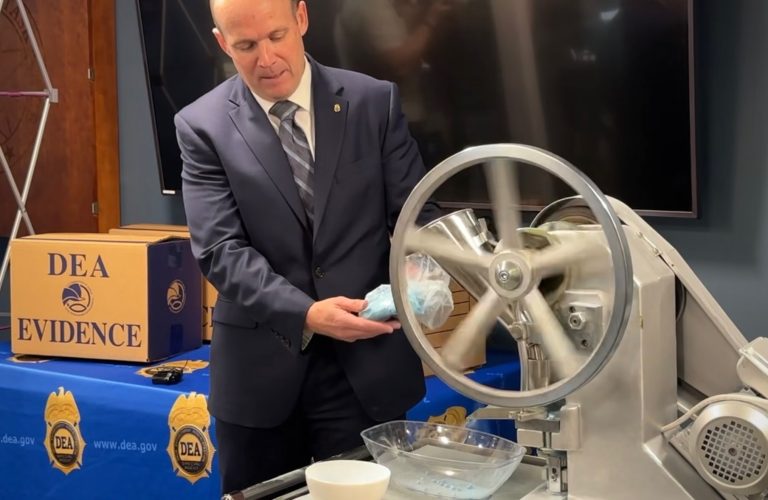
Miguel Chino, assistant special agent in charge for the Drug Enforcement Administration’s Rocky Mountain field division, uses a pill press to demonstrate how easily fentanyl pills can be made on April 29, 2026.A federal drug enforcement official fired up a pill press in Salt Lake City Wednesday, cupping his hand to catch little blue tablets as the machine cranked and spat them out at a rapid pace.
The highly unusual scene illustrated how easy it is to make and turn big profits from illicit pills containing the powerful synthetic opioid, said Miguel Chino, assistant special agent in charge for the Drug Enforcement Administration’s Rocky Mountain field division.
“It only costs the cartel about one cent a pill,” Chino told reporters before starting the demonstration. “Here in the state of Utah, you buy a pill for $1 to $5, so the profit margin is extremely big.”
Chino and Melissa Holyoak, the first assistant U.S. attorney for Utah, touted their agencies’ efforts to fight a flood of illicit fentanyl in the state and across the country. They noted the DEA seized a record-high 2 million fentanyl pills in Utah last year and said they’re working toward a goal of eliminating the drug’s presence altogether.
Their announcement came on a national day of awareness for the highly addictive drug and the devastation it’s caused families and communities. As Chino poured powder down a chute and into a pill press previously recovered by the DEA, he emphasized it did not contain any of the actual drug, of which even a tiny amount can be fatal.
The officials attributed a national drop in drug overdose deaths and a similar downward trend in Utah largely to law enforcement efforts and prosecutions. But they said fentanyl pills, often made to look like less powerful drugs such as oxycodone, Xanax and Percocet, are still making their way to Utah communities from Mexico in large amounts.
Just this week, Holyoak said, her office filed charges in a case involving 225,000 pills hidden away in pieces of ready-to-build furniture.
“No matter how creative and no matter how much is being flooded into the United States, we will remain vigilant,” Holyoak said.
The DEA accuses the Sinaloa and CJNG Cartels of being responsible for the majority of fentanyl entering the United States, which Chino said travels by bus or car. Often the pills are pressed before crossing the border into the U.S., but the drug also comes to Utah in powder form, Chino said.
In Utah, fentanyl surpassed methamphetamine as the most common drug in overdoses in 2023, according to the Utah Department of Health and Human Services. The following year, the two drugs were about even, with meth involved in 44% of overdose deaths, and fentanyl in 43%.
The federal officials said one death is too many and they’re working to prevent overdoses
“We have men and women out all hours of the night working to eliminate this, seizing drugs, doing drug buys, doing search warrants, whatever they can do,” Chino said.
In December, President Donald Trump designated the drug a “a weapon of mass destruction,” calling it “closer to a chemical weapon than a narcotic.”
Trump has claimed without evidence that Venezuelan boats struck by the U.S. military last year were carrying fentanyl. According to the U.S. Sentencing Commission, most illicit fentanyl in the U.S. comes from Mexico and is mostly smuggled through official ports of entry by U.S. citizens.
This week, the U.S. military said its latest strike on an accused drug-trafficking boat killed two “narco-terrorists.” The operation raised the death toll of the strikes that began in September to at least 170.
Utah News Dispatch is part of States Newsroom, the nation’s largest state-focused nonprofit news organization.