News cameras can stay, but judge sets other limits in Charlie Kirk murder case
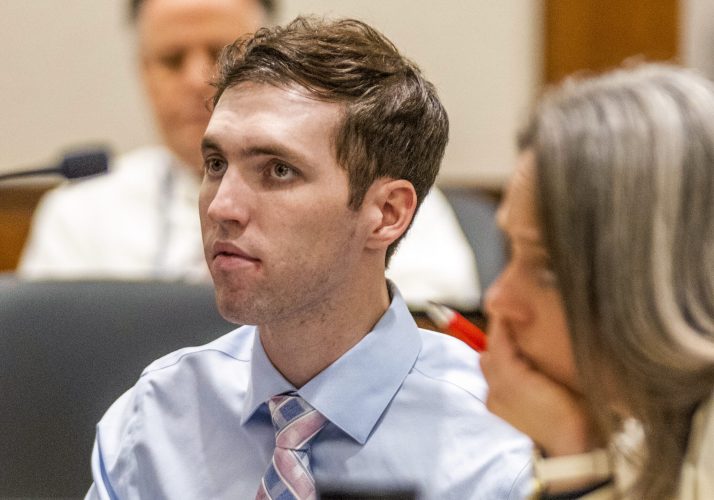
Pool photo by Rick Egan/The Salt Lake Tribune
Tyler Robinson, accused in the fatal shooting of Charlie Kirk, appears during a hearing in 4th District Court in Provo, Thursday, Dec. 11, 2025. (Pool photo by Rick Egan/The Salt Lake Tribune)In a weeklong court hearing livestreamed to the public, Utah prosecutors are set to make their case next week for why Tyler Robinson should stand trial for murder in the assassination of political activist Charlie Kirk.
Kirk, a close ally of President Donald Trump and founder of the student organization Turning Point USA, was killed just minutes into a speaking event before a crowd of thousands at Utah Valley University in Orem on Sept. 10.
Robinson brought a 33-hour manhunt to an end when he turned himself in. He has not yet entered pleas to a charge of aggravated murder and six other counts including witness tampering and obstruction of justice.
The hearing starting Monday is the most significant yet in one of the highest-profile court cases in recent memory, with Kirk’s widow Erika Kirk expected to attend as attorneys question witnesses and pick apart evidence. In the leadup to next week, the question of how much the public should be able to see from inside the courtroom has loomed large.
A judge is allowing news photographers to take pictures and livestream video from the preliminary hearing in Provo’s 4th District Court. But he also took the unusual step of restricting other journalists and members of the public from bringing laptops or phones into the courtroom.
In his order laying out the terms, 4th District Judge Tony Graf said he was concerned the use of those devices “may disrupt and/or compromise the integrity of the preliminary hearing proceedings.”
University of Utah law professor Teneille Brown told Utah News Dispatch it’s reasonable for judges to try to limit distractions in the courtroom in an effort to ensure defendants get a fair shake.
“I think he’s actually trying to thread this needle very carefully, and it’s just an incredibly hard needle to thread,” Brown said of the judge. She described a defendant’s constitutional rights as paramount but said the public’s access is also very important. Even at an early stage in the case, she said judges consider what may happen far down the road, after a jury delivers a verdict.
“He’s also trying to make sure that anyone who’s going to be scrutinizing him — if the defendant appeals — can’t say that he abused discretion. They’re going to say, ‘OK, he tried, because that’s the best you can do,'” Brown said. “It’s very hard to keep it perfectly on lock, but as much as he could, he was trying to balance the interests of having a public trial with also protecting the defendant’s constitutional rights.”
Noting the state plans to seek the death penalty if Robinson is convicted of aggravated murder, his defense team has argued news footage could taint the jury pool and foster bias against their client leading up to his trial.
Kirk’s widow Erika Kirk, Utah County prosecutors, and a coalition of local and national media organizations have argued against banning news cameras. The Utah County Attorney’s Office has said that giving the public a chance to see inside the courtroom could help to settle conspiracy theories and misinformation circulating about the case.
Attorneys representing the news media point out that a criminal case has never been overturned on appeal in Utah because of publicity ahead of trial.
“We’ve had those before in Utah, and defendants have received a fair trial. I think the judge recognized in his latest order that the benefit of electronic media coverage is that you can show the public exactly what transpired in the courtroom,” said attorney Jeff Hunt. “They can hear and see it for themselves, and then they can dispel these conspiracy theories and inflammatory commentary about what happened.”
Hunt said he and other counsel for the journalists plan to argue they should be able to bring in their devices to do their jobs.
Brown, the University of Utah law professor, said that while other high-profile cases in Utah have drawn intense scrutiny, such as the civil trial over Gwenyth Paltrow’s ski crash and the murder case against author and mom Kouri Richins, they did not attract the same sort of attention or commentary from President Donald Trump.
“Everyone always says ‘unprecedented,’ but this is a pretty unprecedented case,” Brown said.
Kirk’s assasination followed other instances of political violence, including the 2024 attempt on President Donald Trump’s life and the Minnesota shootings that killed a former state lawmaker and her husband and wounded another politician and his wife. Other attacks followed, including the White House Correspondents Dinner in Washington, D.C., where authorities said a gunman targeted the president.